To increase your frozen food storage, an upright freezer is a good choice if you regularly need to access food kept in drawers. A chest freezer is better suited to storing bulky items, provided you have enough floor space and room to open the lid. A compact model offers a modest amount of extra storage, while a large fridge freezer is mainly worth considering if you were already planning to replace your main appliance. In every case, check the dimensions, the ambient temperature range, annual energy consumption and the stated power-cut storage time.
Who is a separate freezer for?
A separate appliance is mainly useful when your fridge freezer’s compartment no longer offers enough storage. The way you store and retrieve food will then help you choose the right format.
Households that freeze food in bulk
If you prepare meals in advance or buy large packs, compare the stated capacity with the interior layout. A chest freezer has room for bulky items, while an upright freezer with drawers makes it easier to separate portions you reach for regularly.
People with limited space
In a small kitchen or home, capacity in litres isn’t the only thing to consider. Check the width, depth, delivery route and the space needed to open the door or lid.
Households planning to use a cellar, garage or utility room
ADEME recommends checking the advised ambient temperature for the room where the appliance will be installed. If the room isn’t heated, compare its temperatures throughout the year with the range supported by the specific model. Not every freezer is designed to operate in cold conditions.
What sets the different formats apart?
First decide whether you need a large stock of frozen food or a compact extra freezer. Then check that your chosen format can be installed and used in the room you have in mind.
| Factor | What to check | Depending on your needs |
|---|
| Capacity and storage |
Compare the net capacity in litres, then look at the drawers or baskets. A large capacity alone doesn’t tell you how easy it will be to find smaller portions. |
I prepare several meals in advance: an upright freezer with compartments would help me keep them separate. For bulky packs, I’d also consider the space available in a chest freezer. |
| Space and opening |
Measure the width, depth, height and delivery route. Allow space to open an upright freezer door or lift a chest freezer lid, as well as the clearances specified in the instructions. |
If floor space is limited, I can compare upright freezers. If I choose a chest freezer, I’ll also need room to lift the lid. |
| Compact size |
Check how much extra capacity you’ll actually gain and the ventilation requirements before installing an appliance under a worktop. Don’t assume that a freestanding appliance can be built in. |
I only need a little extra storage and have limited space: a compact model could work, but it won’t offer the same capacity as a large upright or chest freezer. |
| Main appliance |
If you’re considering a large fridge freezer, compare the capacity and layout of its freezer compartment alone with those of a separate appliance. |
I already need to replace my fridge: combining both functions in one appliance could be worth considering. Otherwise, I’d have to replace an appliance I wanted to keep. |
| Room temperature |
Make sure the room’s minimum and maximum temperatures fall within the climate class and temperature range specified for the model. ADEME highlights the importance of checking this for installations in kitchens or cellars. |
My garage or cellar can get cold: I’ll only choose an appliance if its operating range covers the temperatures in that room. |
| Energy use and noise |
Check the kWh/year figure as well as the energy rating. Ideally, compare appliances with similar capacities and uses. If the appliance will be near a living area, check its stated noise level separately. |
I want to compare energy use over time rather than relying on the letter on the label alone. Noise is also a factor in my choice if it’s going in the kitchen. |
| Power cuts |
Check the stated storage time in hours for each model and the conditions under which it was measured. In its test protocol, UFC-Que Choisir measures energy consumption separately at 25 °C and 32 °C, as well as how long the temperature stays below −9 °C during a simulated power cut. |
If power cuts are a concern for me, I’ll compare the stated storage times for the models I’m considering rather than trying to estimate them from their capacity. |
What should you avoid before installation?
-
Choosing based only on the stated capacity
A chest freezer may offer the capacity you want, but it might not fit easily through a doorway, into the room or leave enough space to open the lid. Its deep compartment can also make it harder to find smaller portions.
Measure the delivery route and the space where it will go, then compare the drawers or baskets with the way you store food.
-
Assuming every freezer is suitable for a garage
The permitted ambient temperature varies from model to model. For example, Beko states that its HSM14540 chest freezer operates in temperatures as low as −15 °C. This feature doesn’t apply to every appliance.
Check the possible temperatures in the room, then look up the operating range in the product details or instructions for the model you’re considering.
-
Comparing only the energy rating
The letter doesn’t replace the annual energy consumption figure in kWh. Capacity, noise and storage time during a power cut are other features to assess separately.
Compare the kWh/year figures for appliances with similar capacities and uses, then check the stated noise level and storage time for each one.
-
Leaving arrangements for your old appliance until delivery day
A freezer that needs to be removed can obstruct access and make it harder to install the new one, particularly if the delivery route or installation upstairs requires extra planning.
Before you order, check the arrangements for delivery, installation and removal of your old appliance, if applicable.
A few brands to know
These examples show features to compare on specific models. They don’t represent every model from each brand or the product selection below.
Beko
Beko offers upright and chest freezers in France, including some models designed for unheated rooms.
- According to Beko’s product details, the HSM14540 chest freezer offers 205 L of capacity, a stated storage time of 23 h and a minimum operating ambient temperature of −15 °C.
- Check the temperature range and features such as No Frost or a reversible door for each model; they aren’t available across the entire range.
Haier
Haier’s French range includes upright and chest freezers. Consider both formats in relation to your available space and preferred layout.
- According to Haier’s product details, the H4F272WCH1 upright freezer offers 276 L of capacity, four drawers, a width of 600 mm and a C energy rating.
- These dimensions and this capacity apply to the H4F272WCH1. Check the details of the model you’re considering before planning where to put it.
Whirlpool
Whirlpool offers chest and upright freezers in France for separate frozen food storage.
- According to Whirlpool’s product details, the WHCF 204 4 chest freezer offers 204 L of capacity, a noise level of 42 dB and a storage time of 26 h.
- These figures don’t apply to other models. If you’re placing a freezer in a cold room, check the temperature range for that specific model rather than relying on the format alone.
Freezers available on Joybuy
These models show three ways to add frozen food storage: an upright freezer with drawers, chest freezers and a compact upright freezer. First choose the capacity and access that suit you, then check the installation requirements for the model you select.
 Image unavailable
Heinrich´s, 161 L upright freezer, stainless steel
A handy way to organise extra frozen food in separate compartments: the product name specifies three freezer drawers, a No Frost function and a C energy rating. Check the dimensions and clearances, along with the kWh/year figure, power-cut storage time and ambient temperature range if you’re planning to install it outside the kitchen.
View on Joybuy
 Image unavailable
TCL CF182EWE0FR, 140 L chest freezer
This chest freezer comes with a basket and is suited to a space where you can access it from above. The product name specifies a counterbalanced lid and an E energy rating. Compare the appliance’s dimensions with the space available, then check the clearances, kWh/year figure, storage time and permitted ambient temperature.
View on Joybuy
 Image unavailable
CHiQ JR99DWE, 99 L chest freezer
This capacity is better suited to a little extra storage than a large stock of frozen food. The product name specifies a removable basket, an adjustable thermostat and an E energy rating. Check the lid mechanism and the space needed to open it, as well as the defrosting instructions, kWh/year figure, storage time and ambient temperature range.
View on Joybuy
 Image unavailable
COMFEE' RCU60WH2(E), 60 L upright freezer
This compact model offers a little extra storage when space is limited. The product name specifies three drawers, a reversible door and an E energy rating. Before placing it under a worktop, check the dimensions, ventilation requirements and clearances. Also check the kWh/year figure, storage time and permitted ambient temperature.
View on Joybuy
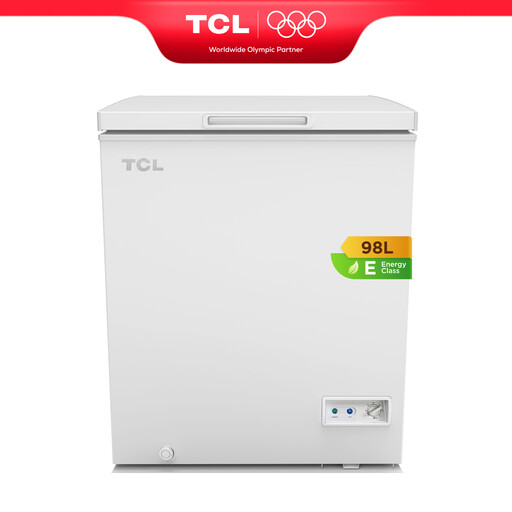 Image unavailable
TCL CF126EWE0FR, 98 L chest freezer
This chest freezer comes with a basket and offers a modest amount of extra storage, provided you have room to open the lid from above. The product name specifies a counterbalanced lid and an E energy rating. Check the dimensions, clearances, kWh/year figure, storage time and ambient temperature range before deciding where to put it.
View on Joybuy
Frequently asked questions
Can you install a freezer in a garage or cellar?
Yes, provided the model’s permitted ambient temperature range covers the room’s temperatures throughout the year. ADEME recommends checking the advised temperature for the installation location. A stated ability to operate down to −15 °C applies only to certain models.
Which figures should you compare between two freezers?
Compare the net capacity, dimensions, kWh/year figure, noise level and stated storage time during a power cut. Don’t forget the ambient temperature range and interior layout. Consider the energy rating alongside annual consumption rather than on its own. Ideally, compare appliances with similar capacities and uses.
Should you choose a No Frost freezer?
Not necessarily. This feature may suit you if you want to reduce the need for manual defrosting, but check that it’s available on the specific model. Also make sure its capacity, dimensions, energy consumption and layout suit your needs.


