What should you check before choosing?
First choose a format to suit how often you’ll access the freezer and how much you need to store. Then check that each model is suitable for the room where you plan to put it.
Upright freezer
Worth considering: if you often take out small portions and want to organise them in drawers.
Bear in mind: allow for the appliance’s height and the clearance needed to open the door.
Chest freezer
Worth considering: for larger stocks that you access less often, if you have enough floor space.
Bear in mind: top access means you’ll need to organise food into sections or baskets.
Under-counter freezer
Worth considering: if you need a little extra freezer space in a small kitchen.
Bear in mind: check that its capacity suits the packaging and quantities you want to store.
Large fridge freezer
Worth considering: if you also need to replace your main fridge.
Bear in mind: check that the freezer compartment is large enough for your food stock; don’t rely on the appliance’s total capacity.
| Priority | What to check | Your needs |
|---|
| Capacity |
Compare the usable capacity with the quantities and packaging you need to store. If you often add unfrozen food, also check the stated freezing capacity in kg/24 h. |
I want to store portions and larger supplies without choosing an appliance that’s too small for the containers I usually use. |
| Access to food |
Look at the drawers, baskets and storage options. For a chest freezer, check how easy it is to reach items at the bottom. |
If I use the freezer stock for meals every day, I’d rather be able to find the right portion quickly than move several packets around. |
| Installation |
Measure the space and leave enough clearance to open the door or lid. Compare the room’s minimum and maximum temperatures with the manual and rating plate for the model. |
If the appliance is going in a garage or utility room, I need to make sure the room is within the temperature range specified for that model. |
| Everyday use |
Compare models with similar formats and capacities, looking at annual energy consumption in kWh/year and noise levels. In France, the DGCCRF says the energy label and product information available through EPREL provide details about new appliances. |
Noise matters to me if the freezer is in the kitchen or near a living space. I also want to compare energy consumption on a like-for-like basis. |
| Power cuts |
Check the stated storage time in the event of a power cut, in hours, for the exact model, and the conditions it applies to. Don’t assume this time based on the appliance’s format alone. |
If the freezer is away from the kitchen or power cuts are possible, I want to know the stated storage time for the model I choose. |
Brands and models to compare
These models are examples of features to look for; their specifications do not apply to every model from the same brand.
Beko
The FSE1174N is an example of an under-counter freezer for occasional extra storage in a kitchen with limited width.
- According to Beko, this model has a capacity of 95 L, is 54 cm wide and features clear drawers.
- Beko lists climate class SN-ST and, separately, a minimum operating ambient temperature of 5 °C. Check the manual before considering it for a cold room.
Bosch
The GSN33VWEP is an example of an upright freezer whose dimensions and features you can compare with your access and installation needs.
- Bosch gives this model a capacity of 225 L, dimensions of 176 × 60 × 65 cm, No Frost technology and a noise level of 39 dB.
- Its stated storage time of 9 h in the event of a power cut and freezing capacity of 19 kg/24 h apply to this model, not to every Bosch upright freezer.
Whirlpool
The range includes upright and chest freezers, which you can compare individually based on the capacity, access and floor space you need.
- Whirlpool gives the WHFF 6403 W4E upright freezer six drawers, a capacity of 404 L and a noise level of 38 dB.
- For a Whirlpool chest freezer, check the dimensions, lid clearance and ambient temperature range for the exact model.
Liebherr
The CFe 1870 Pure is a model to consider if you’re looking at a chest freezer for an unheated room.
- Liebherr gives this model a capacity of 281 L and FrostProtect down to −15 °C.
- This stated capability does not guarantee that another Liebherr chest freezer will suit the temperature in your room.
Freezers available on Joybuy
This selection includes one upright freezer and four chest freezers, offering extra dedicated space for storing food at home. Compare their layouts and capacities, then check that your chosen model is suitable for the room where you plan to install it.
 Image unavailable
Heinrich´s, 161 L No Frost upright freezer, stainless steel
The vertical design is a good fit if you want to sort portions into several storage compartments.
The product name mentions an LED display, reversible door hinge, alarm and energy class C. Check its dimensions, annual energy consumption and ambient temperature range before deciding where to put it.
View on Joybuy
 Image unavailable
TCL CF182EWE0FR, 140 L chest freezer
The basket helps you keep smaller items separate from the rest of your food stock in this top-opening chest freezer.
The product name lists a counterbalanced lid, temperature control, adjustable feet and energy class E. Allow enough room to open the lid, and check the model’s ambient temperature range if the room is unheated.
View on Joybuy
 Image unavailable
AUCMA, 95 L convertible chest freezer
This compact chest freezer is worth considering if you need some extra space and want to switch between fridge and freezer modes.
The product name mentions a seven-setting thermostat, removable basket, defrost drain and energy class E. Its top-opening design needs enough clearance; the mention of a garage in the product name does not replace checking its ambient temperature range.
View on Joybuy
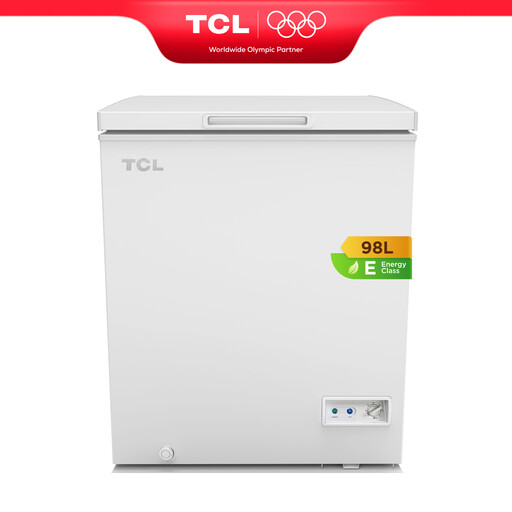 Image unavailable
TCL CF126EWE0FR, 98 L chest freezer
This chest freezer has a limited capacity, making it suitable for occasional extra storage if a basket is enough to keep smaller items separate.
The product name lists a counterbalanced lid, temperature control, adjustable feet and energy class E. Check the dimensions, lid clearance, annual energy consumption and ambient temperature range before installation.
View on Joybuy
 Image unavailable
CHiQ JR99DWE, 99 L chest freezer
The removable basket can make it easier to find smaller items in a smaller food stock.
The product name lists an adjustable thermostat, a four-star rating and energy class E. Allow room for top access, and check the manual for maintenance instructions and the ambient temperature range for your room.
View on Joybuy
Frequently asked questions
Can I put a freezer in an unheated garage or cellar?
Yes, but only if the model’s specified ambient temperature range covers the temperatures in that room. For example, Bosch states a range of 10 to 32 °C for climate class SN, while Liebherr gives the CFe 1870 Pure FrostProtect down to −15 °C. Always check the manual and rating plate for the exact model you’re considering rather than relying on its chest design alone.
Is an upright freezer more practical than a chest freezer for everyday portions?
An upright freezer with drawers is generally more convenient if you want to organise and regularly retrieve small portions. A chest freezer is still an option for bulkier supplies, as long as you arrange them so they’re easy to reach from the top.
How can I compare the energy consumption of two freezers?
Compare their stated energy consumption in kWh/year, taking capacity and format into account, rather than looking at the energy label letter alone. In France, the DGCCRF says the energy label and product information sheet available through EPREL show the specifications of new appliances.
What should I check if there’s a risk of a power cut?
Check the stated storage time during a power cut for the exact model, and avoid opening the freezer unnecessarily during an outage. Bosch gives 9 h for the GSN33VWEP, Whirlpool 11 h for the WHFF 6403 W4E and 32 h for the WHM4612. These figures apply to specific models and aren’t enough on their own to compare all chest and upright freezers.
What should I do with my old freezer when replacing it?
Arrange for it to be collected as electrical and electronic equipment rather than putting it out with ordinary household waste. The French Ministry for Ecological Transition outlines collection options; you can also check whether collection of your old appliance is offered when you buy a new one.


