Households that cook and freeze food regularly
If you prepare several portions in advance, drawers can help you keep meals separate and find the ones you take out regularly.


To make more room for meals and food supplies, choose an upright freezer if you regularly need to access and organise food, a chest freezer if you mainly want plenty of storage, or an under-counter model for extra capacity in a tight space. Whichever you choose, measure the clearance needed to open it and check that the model’s permitted ambient temperature range suits the room where it will be installed.
If you prepare several portions in advance, drawers can help you keep meals separate and find the ones you take out regularly.
If you want to stock up on food or store bulky items, check how much floor space is available. In an unheated room, also check the temperatures the model can operate in.
A space under the worktop may be suitable for a small freezer. However, distinguish between a freestanding appliance and a built-in model, and check the dimensions and ventilation requirements.
Choose this if: you regularly take out meals and want to organise them in drawers.
Bear in mind: each drawer needs enough room to open and slide out where you plan to position the appliance.
Choose this if: you want plenty of storage or need to store bulky items.
Bear in mind: you’ll need floor space and a way to find food at the bottom of the compartment.
Choose this if: you need extra storage in a space with limited height.
Bear in mind: capacity and installation requirements vary by model; freestanding and built-in appliances are not interchangeable.
| Consideration | What to check | Consumers concerned |
|---|---|---|
| Space and installation | Measure the width, depth and height, along with the clearance needed to open the appliance; check the model’s ventilation requirements. | If your kitchen is small or a space has fixed dimensions, you need to make sure you can install and open the appliance first. Around 42% of consumers rank compatibility with the room as their top priority. |
| Access and storage | Compare drawers and baskets according to how often you take food out; check how easy it is to reach the bottom of a chest freezer. | If you regularly take out prepared portions, you want to find them without rummaging through your supplies. Access and organisation are the main priority for around 33% of consumers. |
| Storage capacity | Compare the net capacity with the amount you want to store, and check there’s room for bulky items. | If you want to store more food supplies or prepared meals in larger quantities, storage capacity is your priority. This is the main concern for around 25% of consumers. |
According to Que Choisir, a chest freezer is on average 110 to 140 cm wide and 70 cm deep. Its capacity will only be useful if you can get it into the room and open the lid.
Measure the space, the delivery route and the clearance needed for the door, lid or drawers.
Bosch Electroménager and Whirlpool France point out that a climate class indicates the ambient temperatures the appliance is designed for. A model’s ability to operate in a cold room does not apply to other models.
Note the room’s minimum and maximum temperatures, then compare them with the information on the product page or in the manual for the exact model.
Drawers make it easier to separate food, while an open compartment offers more flexibility for bulky items. Neither advantage alone determines how much capacity you need.
Before choosing a style, make a list of what you want to store, how big it is and how often you’ll take it out.
NoFrost and SmartFrost are features advertised by manufacturers on certain product ranges; they don’t replace checking the model’s other specifications.
Also check the net capacity, energy label, dimensions and installation requirements.
Worth considering for an upright freezer with compartmentalised storage.
Worth considering for a chest freezer for food supplies, particularly if an outbuilding might get cold.
Worth considering for a built-in freezer for extra capacity or a range with an ice-reduction feature.
This selection includes compact and medium-capacity upright freezers, as well as chest freezers for extra storage or stocking up on supplies. Compare their storage features and dimensions with the space you have available.
 Image unavailable
For extra storage with food organised in separate drawers. This freestanding model has three drawers, a reversible door and an E energy rating; check the clearances before placing it under a worktop.
 Image unavailable
For plenty of storage, provided there’s enough floor space. This model offers fridge and freezer modes, a removable basket, interior lighting and an E energy rating; you’ll need a good system for organising food at the bottom of the compartment.
 Image unavailable
For a little extra storage in a chest freezer format. The product title lists a removable basket, sliding lid and E energy rating; bear in mind that the description specifies manual defrosting.
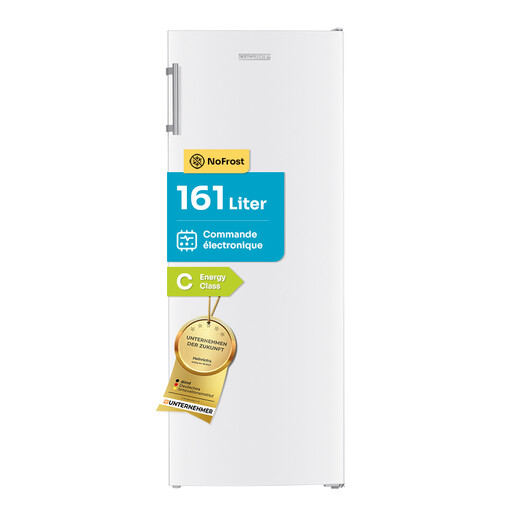 Image unavailable
For organising meals and food supplies in an upright freezer. The product title lists drawers, a No Frost function and a C energy rating; check the appliance dimensions and clearances before deciding where to put it.
 Image unavailable
For extra storage in a space that can accommodate a chest freezer. The model has a counterbalanced lid and an E energy rating. The title mentions a basket, while the description says one can be added: confirm what’s included before buying.
No. A chest freezer can offer space for bulky items, but it takes up floor space and food at the bottom is less easy to reach. If you regularly take out small portions, compare the storage in an upright freezer too.
No. Check the permitted ambient temperature range for the exact model and compare it with the temperatures in your cellar. For example, Beko France specifies a minimum ambient temperature of −15 °C for the HSM14540; this does not apply to other freezers.
Measure the available height, width and depth, then check the opening clearance, ventilation and required installation type. As an example for this specific model, Liebherr specifies a niche measuring 87.4 to 89 cm high, 56 to 57 cm wide and 55 cm deep for its IFSd 3904 built-in freezer.
No. ADEME notes that freezers are covered by the energy label; consider it alongside the model’s net capacity, dimensions, storage features and permitted ambient temperatures. Two appliances won’t necessarily meet the same storage needs.
For a purchase from a professional seller in France, check your rights under the legal guarantee of conformity. The Ministry of the Economy states that this guarantee is compulsory for new, second-hand and refurbished goods. Keep a copy of the product description and tell the seller about the discrepancy.