Households preparing several portions in advance
You need to store and retrieve individual or family-sized portions regularly: everyday access, drawers, labelling and stock rotation matter just as much as the total capacity.


Choose an upright freezer if you regularly take out portions and want to organise them in drawers; a chest freezer is better suited to a large stock when you have enough floor space. A compact model is mainly useful as an extra appliance, while a larger fridge freezer only avoids the need for a second appliance if its freezer compartment genuinely meets your needs.
You need to store and retrieve individual or family-sized portions regularly: everyday access, drawers, labelling and stock rotation matter just as much as the total capacity.
You buy large packs or store lots of meals and frozen food for long periods, and have a pantry, cellar or garage available: a chest freezer can provide more space, provided the room temperature is suitable for the model.
You are mainly looking for a compact extra appliance or replacing your existing fridge: compare the freezer capacity you will actually have in an under-counter appliance or larger fridge freezer before adding a separate appliance.
Start by estimating how much food you need to store, then check how easily you can access portions and consider the conditions in the room where the appliance will be installed.
| Priority | What to check | Your needs |
|---|---|---|
| Usable capacity | Compare the usable capacity with the portions, dishes and frozen food you usually store. According to Que Choisir, chest freezers can reach 600 L, while upright freezers are often around 200 L and can reach up to 400 L in the largest models. | I want to store the amount I need without stacking boxes where they are difficult to reach or buying an unnecessarily large appliance. |
| Access and organisation | For an upright freezer, check the drawers, large compartments and removable shelves. For a chest freezer, check the number of baskets and plan to use boxes or labels to organise the depth. | My portions should be easy to find, rotate and remove without having to move a large part of the stock. |
| Installation room | Note the room’s minimum and maximum temperatures, then compare them with the model’s climate class. ADEME recommends checking this range for the kitchen, cellar or any other room where the appliance will be installed. | I am looking for an appliance that can operate at the actual temperatures in my kitchen, pantry, cellar or garage. |
| Energy use and continuity | Compare the energy label for appliances of a similar size and capacity. Also check the stated energy consumption, storage time in the event of a power cut, noise level and any alarms. | I want to compare an appliance that runs continuously without focusing solely on its energy rating letter. |
A chest freezer can offer plenty of space, but food at the bottom is less convenient to reach. An upright freezer generally makes it easier to rotate portions thanks to its drawers, although it does not offer the same maximum capacity.
Make a list of your containers and how often you take meals out. If you will be retrieving food several times a week, check access to the drawers and large compartments; for long-term storage, plan to use baskets and labels in a chest freezer.
The climate class defines the ambient temperatures the appliance is designed to operate in. Temperatures outside this range can affect performance and increase energy consumption.
Measure the lowest and highest temperatures in your cellar, garage or conservatory, then check the climate class for the exact model. Do not assume that a chest freezer is suitable for a garage unless the manufacturer explicitly says so.
Installing an appliance in an unsuitable room may mean moving it or reconsidering where it is placed.
The A to G scale helps you compare appliances, but size, usable capacity and features can vary significantly between models. The DGCCRF states that labelling for household refrigeration appliances has been governed by Delegated Regulation (EU) 2019/2016 since 1 March 2021.
Compare the energy label of appliances of the same type and with a similar capacity, then look at stated energy consumption, usable capacity, noise level, storage time and dimensions.
Capacity does not replace good organisation or food hygiene practices. Anses points out that breaks in the cold chain, poor storage and cross-contamination increase microbiological risks.
Label portions with their contents and date, rotate your stock and maintain the cold chain. Anses recommends eating defrosted food promptly, within a maximum of three days, and never refreezing it.
A useful reference for an upright freezer designed for frequent access and portion storage: the GSN58AWCV showcases a 366 L upright model with No Frost, drawers and removable shelves, Big Box and alarms.
A useful reference for high-capacity chest freezers and cooler rooms when the model has a function specifically designed for low temperatures, such as FrostProtect.
A useful reference for a high-capacity chest freezer if you are looking for a clearly stated low-temperature function and an advertised storage time in the event of a power cut.
Joybuy options including upright freezers, compact and medium-sized chest freezers, and a small under-counter model for storing portions and frozen food.
 Image unavailable
A vertical option for organising portions you take out regularly, with three drawers and two advertised shelves.
No Frost, LED display, alarm, reversible door and an advertised temperature range of -14 °C to -22 °C. Check the dimensions, climate class, energy consumption and storage time in the event of a power cut before installation.
 Image unavailable
A compact extra appliance for a few prepared portions when space is limited.
Three drawers, adjustable thermostat, reversible door, advertised dimensions of 44,5 × 47,5 × 84,5 cm and energy rating E. Its 60 L capacity is not suitable for a large family stock; also check the climate class, energy consumption and storage time.
 Image unavailable
A compact chest freezer for creating extra storage, with a removable basket for food you want to keep close to the top.
Adjustable thermostat, sliding lid, castors and an advertised freezing capacity of 4,5 kg/24 h; energy rating E. Organise the bottom of the compartment with labels and check climate compatibility with the chosen room.
 Image unavailable
A medium-sized separate freezer for prepared meals and frozen food, with a basket for items you take out regularly.
Storage basket, lid that stays open, castors, adjustable feet and advertised dimensions of 637 × 556 × 846 mm; energy rating E. Plan how to organise food stored at the bottom and check the climate class and storage time.
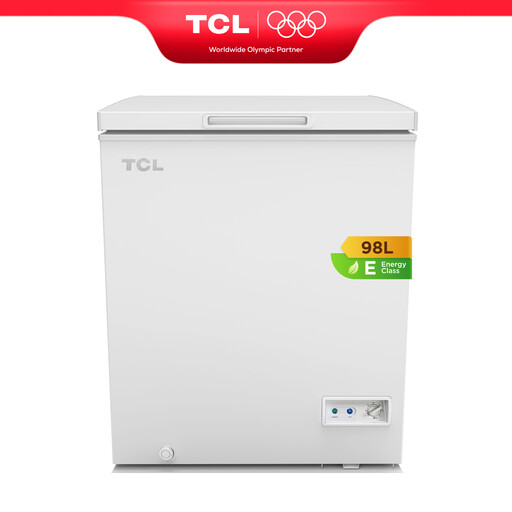 Image unavailable
A compact extra appliance for a small stock of prepared portions, with a basket to help separate items at the top.
Switchable zone, adjustable thermostat, lid that stays open, castors and adjustable feet; energy rating E. Check that the Switch Zone is set to freezer mode, and check the dimensions, climate class and storage time.
No. Check the climate class for the exact model and compare its temperature range with the temperatures actually recorded in the room. Bosch, for example, lists classes ranging from SN 10–32 °C to SN-T 10–43 °C; certain chest freezers state compatibility down to -15 °C, but this feature is not universal.
It can be suitable for large volumes and big packs, but it is not automatically more convenient. Its open space is flexible, while an upright freezer with drawers makes it easier to organise and retrieve portions. Choose according to how often you access the food and how you organise it, not simply by capacity.
Compare the A to G scale and the stated data for appliances with comparable capacities and dimensions. For household refrigeration appliances, this labelling is governed by Delegated Regulation (EU) 2019/2016, applicable since 1 March 2021 according to the DGCCRF; also check the capacity, dimensions and suitability for the room.
In France, the retailer must offer free take-back on a “like-for-like” basis when you buy an equivalent new appliance, according to ecosystem. Check the arrangements before ordering, particularly for a large appliance delivered to your home.
Label portions, rotate your stock and maintain the cold chain. Anses points out that poor storage conditions and breaks in the cold chain increase microbiological risks; it recommends eating defrosted food promptly, within a maximum of three days, and never refreezing it.