For easy access to individual portions
If you prepare several dishes or individual portions, check the drawers and compartments, including their dimensions. Vertical storage can help you sort meals by dish or date, as long as your containers fit.


Choose a freezer based on the portions and containers you need to store at the same time, then consider the space available and how easy it is to access. An upright freezer makes it easier to organise food, while a chest freezer offers plenty of storage if you have enough room. An under-counter freezer suits a small stock of food. A fridge-freezer could save you from needing a separate appliance, provided its freezer compartment has enough capacity for your meals and other frozen food.
The number of meals you prepare matters, but how you store them and how much room you have for the appliance can also influence your choice.
If you prepare several dishes or individual portions, check the drawers and compartments, including their dimensions. Vertical storage can help you sort meals by dish or date, as long as your containers fit.
A chest freezer is worth considering if you have a utility room or another suitably spacious spot. UFC-Que Choisir points out that it takes up more floor space than an upright freezer. Also check that the lid can open fully and that the room temperature is within the permitted range.
An under-counter freezer or the freezer compartment of a fridge-freezer may be enough if you only keep a few portions at a time. Compare the freezer capacity—not the total capacity of a fridge-freezer—with the containers and other food you want to store at the same time.
Consider one if: you want to organise labelled portions and reach a dish without moving all your frozen food.
Bear in mind: capacity and compartment layouts vary by model. Remember to measure the space needed to open the door, too.
Consider one if: you need to store large dishes or containers and have a suitable amount of floor space.
Bear in mind: portions at the bottom are less easy to reach. Baskets and labels can help you find what you need.
Consider one if: you have limited space and only need to store a small number of portions.
Bear in mind: check the internal space, not just the external dimensions, especially if you use large containers.
Consider one if: you also need to replace your fridge and the freezer compartment has enough room for your planned stock.
Bear in mind: the appliance’s total capacity is not the same as its freezer capacity.
Before comparing product details, make a list of the portions and other frozen food you expect to have in the appliance at the same time.
| Priority | What to check | My needs |
|---|---|---|
| Freezer capacity | Check the net capacity of the freezer compartment, then compare it with the dimensions and number of your containers. With a fridge-freezer, distinguish this from the fridge capacity, as shown on the energy label described by the European Commission. | I want enough room for prepared meals as well as the frozen food I already have, without relying on the appliance’s total capacity alone. |
| Storage | Check the number and size of the drawers, drop-down compartments or baskets. Make sure large dishes will fit without making smaller portions difficult to reach. | To find a particular portion, I need to separate the dishes and read their labels without emptying the freezer. |
| Installation | Measure the height, width and depth, delivery access and space needed to open the appliance. If you’re putting it in a cellar or garage, compare the room temperature with the ambient temperature range permitted for the model. | My appliance needs to open fully without blocking the way. If the room isn’t heated, I also need to check that it’s suitable for the model I choose. |
| Everyday use | Compare annual energy consumption in kWh, noise levels and the capacities shown on the European energy label. If keeping food frozen during a power cut matters to you, compare storage times under similar test conditions. | In an open-plan kitchen, noise could affect my choice. Where power cuts are possible, I also want to check how long food stays frozen rather than assuming this from the appliance’s capacity. |
| Freezing meals | Check the recommended compartment setting and the freezing capacity in kg/24 h, if stated. Anses recommends planning to freeze food when you buy or prepare it, rather than waiting until its use-by date is approaching. | When I prepare several portions, I need to plan how to cool, package and freeze them without breaking the cold chain. |
The fridge and freezer have separate capacities. So even a large fridge-freezer may have less room than you expect for frozen meals.
Count your portions, measure your containers and compare them with the capacity and layout of the freezer compartment alone.
UFC-Que Choisir says chest freezers take up more floor space than upright models. If the lid can’t open fully, it can also be harder to reach food at the bottom.
Measure the space, delivery access and clearance needed for the lid. If you’re putting the freezer in a cellar or garage, check the permitted ambient temperature range for the model.
Defrosting, noise, energy consumption, freezing capacity and how long food stays frozen all depend on the model. UFC-Que Choisir assesses these factors separately in its freezer testing protocol.
Compare the specifications of the exact models you’re considering and, for measured performance, look at tests carried out using comparable methods.
A freezer doesn’t remove the need to follow food dates and storage instructions. Anses recommends freezing food when you buy or prepare it, rather than waiting until its use-by date is approaching.
Plan how to cool and package portions, label them and follow the instructions for the foods you’re using.
These examples relate to specific ranges or models. They’re no substitute for comparing the appliances you’re considering.
Beko offers upright freezers with different layouts and installation requirements depending on the model.
Liebherr offers chest freezers for spaces with enough floor area for this style of appliance.
Whirlpool offers upright freezers and presents this style as a good choice for seeing and organising your food.
The models below include a chest freezer and two fridge-freezers. For each one, compare the space available for portions with your containers and the space you have for the appliance.
 Image unavailable
This fridge-freezer may be worth considering if you want a single appliance for both fresh and frozen food. Check how much space is set aside for frozen portions.
The model name indicates a total capacity of 262 L, a 70/30 split, a width of 54 cm and a height of 176 cm. It also specifies Low Frost and a black finish. Remember to measure the depth and the space needed to open the door.
 Image unavailable
This chest freezer may be worth considering if you’d prefer separate freezer storage. Check that your dishes will fit and remain easy to reach once they’re stored inside.
The product name specifies a capacity of 99 L, a four-star compartment, an adjustable thermostat, a removable wire basket, a sliding lid and an E energy rating. Measure the space and the clearance needed for the lid. Before installing it in a cellar or garage, check the permitted ambient temperature range.
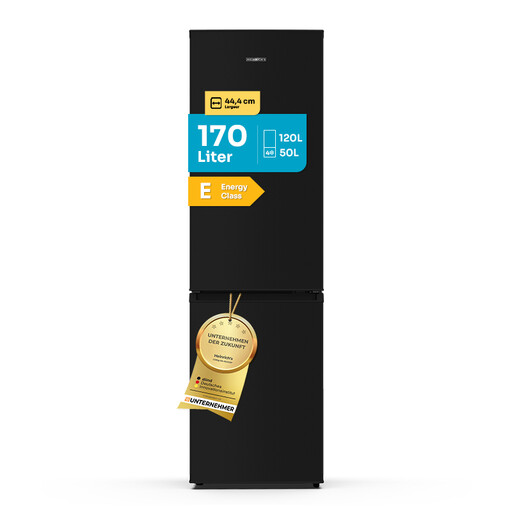 Image unavailable
This fridge-freezer could suit a small stock of prepared meals, provided its freezer compartment also has room for your other frozen food.
The product name specifies 120 L for the fridge and 50 L for the freezer. It also indicates a noise level of 40 dB and an E energy rating. Check the dimensions and permitted ambient temperature range before choosing where to put it.
Yes, if its freezer compartment has enough room for your portions and the other frozen food you’ll be storing at the same time. Compare its capacity—which is separate from the fridge’s—with the dimensions of your containers and the layout of the model’s interior.
For home freezing, Anses recommends a temperature of -18 °C. Check the recommended setting for the compartment in the model’s specifications. This temperature doesn’t remove the need to maintain the cold chain and follow food storage guidelines.
No. According to Anses, low temperatures slow the growth of microorganisms, but the size of the appliance doesn’t replace properly cooling prepared food or maintaining the cold chain.
Compare annual energy consumption, storage capacities and noise levels between models that suit your needs. The European Commission says this information appears on the energy labels for fridges and freezers. The EPREL database provides more details about specific models.
Only if the ambient temperature range permitted for the model is suitable for the room. For example, Beko states that the RFNM200T40WN has a minimum operating temperature of -15 °C. This figure doesn’t apply to other freezers.