What to check before choosing
Upright freezer
Consider it if: you often take out individual portions and want to keep them in compartments you can access from the front.
Bear in mind: you’ll need room to open the door and pull out the drawers. Also check that the room temperature is within the model’s climate class range.
Chest freezer
Consider it if: you store large packs and have enough room on the floor and above the appliance.
Bear in mind: food at the bottom needs to be organised carefully, and the lid must be able to open without obstruction.
Compact or under-counter model
Consider it if: you need extra storage and don’t have room for a larger appliance.
Bear in mind: check that the usable capacity will genuinely be enough for your storage needs before choosing this format.
Fridge freezer
Consider it if: you’re also replacing your fridge and only have space for one appliance.
Bear in mind: compare the usable capacity of the freezer compartment, as the total capacity also includes the fridge section.
Que Choisir Ensemble highlights format, capacity and climate class among the factors to consider. The priorities below help you relate these checks to the way you’ll use your freezer.
| Criteria |
What to check before buying |
Who is it particularly relevant to? |
| Finding and organising food |
The number and layout of drawers or baskets, and how the door or lid opens. |
I want to find the portions I use often quickly, without rummaging at the bottom of a chest. Easy organisation and frequent access are priorities for around 36% of consumers. |
| Making room for your supplies |
The usable capacity in litres and the dimensions needed to store your bulky packs. |
I store bulk buys or large packs and can dedicate floor space to the appliance. Capacity for larger quantities is a priority for around 29% of consumers. |
| Choosing an appliance that suits the room |
The dimensions of the route in and the space available, the model’s climate range, the room temperature and the clearances specified in the manual. |
I need to install the appliance in a particular spot where the temperature may vary throughout the year. Suitability for the available space and room temperature is a priority for around 21% of consumers. |
| Comparing energy use and holdover time |
The annual energy consumption shown on the energy label and the stated holdover time in the event of a power cut for the exact model. |
I want to compare the stated energy use and holdover time without choosing a capacity that doesn’t suit my storage needs. These criteria come first for around 14% of consumers. |
Freezers and fridge freezers on Joybuy
This selection includes upright and chest freezers for extra storage, as well as fridge freezers for households replacing their main appliance too.
 Image unavailable
Heinrich’s Freezer 161 L, No Frost
The upright design and compartments are a good fit if you want to organise your supplies.
The product name lists 161 L, No Frost, 3 freezer drawers and 2 additional drawers.
View on Joybuy
 Image unavailable
Sonlu CC-520WE, 444 L fridge freezer
Worth considering if you’re replacing your fridge too and want an all-in-one solution.
The product name lists a total capacity of 444 L: 276 L for the fridge and 168 L for the freezer.
View on Joybuy
 Image unavailable
TCL CF182EWE0FR, 140 L chest freezer
A chest freezer may suit you if you have floor space available and want extra storage.
The product name lists 140 L, a storage basket and a counterbalanced lid.
View on Joybuy
 Image unavailable
AUCMA, 291 L convertible chest freezer
Compare this model if you store larger quantities and have room for a chest freezer.
The product name lists 291 L, a fridge-to-freezer conversion feature and a removable basket.
View on Joybuy
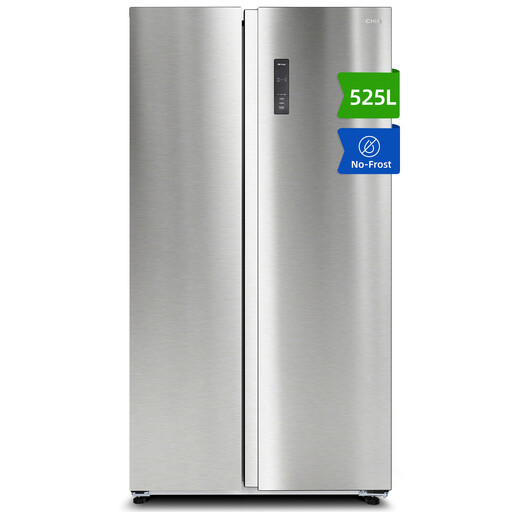 Image unavailable
CHiQ JR525WSE, 525 L fridge freezer
This all-in-one option is worth comparing if you’re also replacing your fridge and can’t add a separate appliance.
The product name lists a total capacity of 525 L: 333 L for the fridge and 192 L for the freezer.
View on Joybuy
Frequently asked questions
Can you install a freezer in an unheated cellar or garage?
It depends on the temperatures the room actually reaches and the range specified for the model you choose. Beko says the RFNE448E45W can operate down to −15 °C, while the stated range for the ESSENTIELB ECC85-95hob2 E is 10 to 38 °C. Check the documentation for the exact model: a mention of “garage” alone isn’t enough.
What should you measure before installing a freezer?
Measure the space where it will go, the route it needs to take for delivery and the room needed to open the door or lid. The appliance dimensions may not include all the clearances required, so check the manual for the model you choose.
How can you compare the energy use of different formats?
Compare the annual energy consumption shown on the energy label with the usable capacity you need, rather than relying on the class letter alone. Your Europe, the European Union’s portal, states that the appliances concerned must display their energy label at the point of sale, including online.
What warranty and after-sales information should you check in France?
When you buy from a professional seller, the statutory legal guarantee of conformity applies to new, second-hand and refurbished goods. The Ministry of the Economy and Finance states that you have two years to make a claim. Check the terms of any commercial warranty separately. The DGCCRF says that sellers must tell you how long spare parts will be available if the manufacturer has provided them with this information.
What happens to your old appliance when you replace your fridge freezer?
The DGCCRF reiterates the principle of free “one-for-one” take-back of an equivalent used appliance when you buy a new one. Ask the seller how the take-back service works before delivery.


