What should you check before choosing?
Start with how much you need to store and the space available, then look at the installation and usage requirements for each appliance.
| Consideration |
What to check |
What I need |
| Capacity and space |
Compare the usable capacity with what you plan to store. Measure the appliance, the route to its position and the clearance needed for the door or lid. |
I want to store bulk purchases or bulky food without taking up more space than my room allows. |
| Access to food |
Look at the drawers or baskets, access to the bottom and the direction the door opens. UFC-Que Choisir notes that ease of use also matters when choosing between a chest and an upright freezer. |
For portions I use often, I’d prefer to find each category quickly. For larger packs, a chest may suit the way I organise my food better. |
| Room temperature |
Compare the room’s minimum and maximum temperatures with the range specified in the manual. A model’s stated ability to operate down to −15 °C does not apply to every appliance from the same brand. |
If my freezer is going in a garage, cellar or unheated utility room, it needs to be designed for the temperatures that room can reach. |
| Power cuts |
Compare the stated storage time in hours for each model and check what type of alarm it has. UFC-Que Choisir’s test protocol assesses how long food stays below −9 °C during a simulated power cut. |
If I’m storing a lot of food or the appliance is away from the main living areas, I want to be able to prepare for a loss of power. |
| Energy use and maintenance |
Compare the kWh/year for appliances with similar capacities, and check the noise level if it will be placed somewhere noise matters. Find out whether defrosting is manual or whether the model has a frost-reduction feature. |
My freezer will stay plugged in all year round. I also need to consider noise near living areas and how much time defrosting will take. |
If you’re considering a large fridge freezer instead, compare the capacity of its freezer compartment alone with the extra storage you need. This option makes most sense if you also need to replace your fridge.
A guide to some of the brands
The features and installation requirements mentioned here apply to specific ranges or models, not every freezer from a particular brand.
Beko
In France, Beko offers chest and upright freezers, with features that vary by model.
- Beko states that Freezer Guard works down to −15 °C on selected models, and that No Frost is available on some upright models.
- Check the chosen model’s product details for its ambient temperature range, capacity and storage time during a power cut. These features are not available across the whole range.
Liebherr
Liebherr offers chest, upright and integrated freezers; features depend on the model.
- The brand states that FrostProtect works down to −15 °C on some chest freezers. It also offers SmartFrost and NoFrost on different models.
- For an integrated appliance, check the dimensions of the housing unit and the installation instructions for the exact model. Don’t assume it will fit based on the range name alone.
Whirlpool
In France, Whirlpool offers chest and upright freezers with different configurations.
- According to Whirlpool’s product details, the W3RHS37EW1 chest freezer has a 371 L capacity, three baskets and a stated storage time of 36 h. The WHFF6403W4E upright freezer has a 404 L capacity, six drawers and a stated storage time of 11 h.
- These figures apply to these two models. Before choosing a type, also compare their dimensions, energy consumption and installation requirements.
Freezers for different needs
This Joybuy selection includes a small upright model for extra storage, an upright freezer with compartments and two chest freezers under 100 L. Compare their capacities and how you access the contents, then check the installation requirements for the model you’re interested in.
 Image unavailable
COMFEE' RCU60WH2(E), 60 L upright freezer
This freestanding model is designed to provide extra storage with food kept separate, and features three drawers and a reversible door. Check that its 60 L capacity is enough for your needs, and that its dimensions, required clearances and ambient temperature range suit the space you have in mind.
View on Joybuy
 Image unavailable
Heinrich´s, 161 L No Frost upright freezer
This type of freezer suits compartmentalised storage. The product title lists three drawers, a reversible door hinge and No Frost. An alarm is also mentioned, although its type is not specified. Check this detail, along with the dimensions and installation requirements, before choosing.
View on Joybuy
 Image unavailable
CHiQ JR99DWE, 99 L chest freezer
This 99 L chest freezer has a removable basket, described as keeping some food within easy reach. Plan how to organise the bottom of the freezer too, and allow enough space to open the lid. The product description states that defrosting is manual.
View on Joybuy
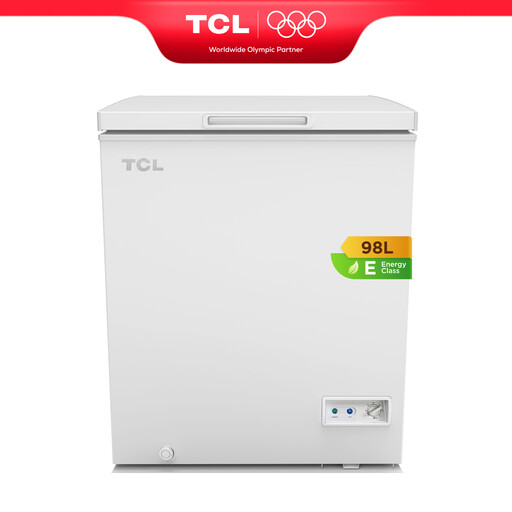 Image unavailable
TCL CF126EWE0FR, 98 L chest freezer
This 98 L chest freezer has a storage basket and a counterbalanced lid. The basket alone won’t organise all your supplies, so plan how you’ll arrange them and check the floor space it will take up, as well as the clearance needed to open the lid.
View on Joybuy
Frequently asked questions
Can you put a freezer in a garage or cellar?
Yes, provided the ambient temperature range specified for the model covers the temperatures the room can reach. Compare the room’s minimum and maximum temperatures with the manual. Beko or Liebherr models described as able to operate down to −15 °C are not necessarily representative of other models.
What temperature should you aim for when storing frozen food?
For home freezing, Anses recommends −18 °C. This temperature stops bacteria from multiplying, but most micro-organisms survive freezing. So follow good freezing and defrosting practices, and don’t automatically refreeze food once it has thawed.
Why check how long food stays frozen during a power cut?
The stated storage time helps you compare models if you plan to keep a lot of food in the freezer, particularly if the appliance is away from the main living areas. Check the figure for the model you’re considering and, if it has an alarm, find out exactly what it alerts you to.
Does No Frost mean you don’t need to compare other features?
No. Beko and Liebherr describe No Frost as a feature that prevents frost from forming on some models, while other systems are designed to reduce it. Compare the usable capacity, kWh/year, noise level, storage time during a power cut and storage layout for each model too.


