Buying priorities
Start by measuring the space and working out the capacity you genuinely need, then compare the usage specifications of models in a similar format.
| Priority |
What to check |
Your needs |
| Usable capacity |
Compare the freezing capacity in litres and the space available for your packaging. An open chest freezer accommodates bulky containers more easily, while an upright freezer’s drawers provide more structured storage. |
I want to build up supplies suited to my shopping habits, without choosing a capacity that is impossible to fill or install. |
| Access and storage |
Look at the drawers, baskets, removable shelves, lighting and door alarm where available. With a chest freezer, plan an arrangement that still lets you reach items at the bottom. |
I want to find food quickly and avoid leaving products forgotten at the bottom of the freezer. |
| Energy consumption and noise |
For appliances with a similar type and capacity, compare the A to G energy class, kWh/year, volume and noise level. The European energy label brings this information together; the QR code provides access to the model’s EPREL product sheet. |
My freezer will run continuously, sometimes near a kitchen or living area, so both noise and energy consumption matter. |
| Installation and power cuts |
Check the stated storage time in the event of a power cut, the climate class, ambient temperature range and required ventilation clearances. Check these points for the exact model, particularly if it will be installed in a garage or cellar. |
I want the appliance to suit the actual temperature of the room and protect my supplies better during a power cut. |
Joybuy products
Joybuy options covering upright freezers, additional chest freezers and a compact vertical model to increase frozen-food storage, depending on the space available.
 Image unavailable
Heinrich’s 161 L No Frost upright freezer
An option for organising everyday supplies with drawers and easy vertical access.
Advertised features include 161 L, three drawers, two shelves, LED display, alarm, reversible door and C energy class. Check the dimensions, storage time, annual consumption, climate class and that the functions match this variant.
Joybuy
 Image unavailable
CHiQ JR99DWE 99 L chest freezer
A compact chest freezer for creating additional supplies when space is limited.
Advertised features include 99 L, a removable wire basket, sliding lid, 39 dB, 4.5 kg/24 h and E energy class; advertised dimensions: 54.5 × 47.6 × 83.5 cm. Manual defrosting is indicated when the ice exceeds 5 mm; also check the climate class and storage time before installing it in a cellar or garage.
Joybuy
 Image unavailable
TCL CF182EWE0FR 140 L chest freezer
A chest-freezer format for larger reserves, while still providing a basket for smaller items.
Advertised features include 140 L, storage basket, lid that stays open, castors, front water drain and E energy class. Advertised dimensions: 63.7 × 55.6 × 84.6 cm; plan how you will organise food at the bottom and check ventilation, noise, consumption, storage time and climate class.
Joybuy
 Image unavailable
COMFEE’ RCU60WH2(E) 60 L vertical freezer
An upright extra freezer for a small kitchen or under-counter space.
Advertised features include 60 L, two compartments with flaps, a bottom drawer, reversible door, adjustable feet, up to 6 kg/24 h and E energy class. Advertised width: 47.5 cm; advertised height: 84.5 cm. This capacity remains limited for large bulk purchases.
Joybuy
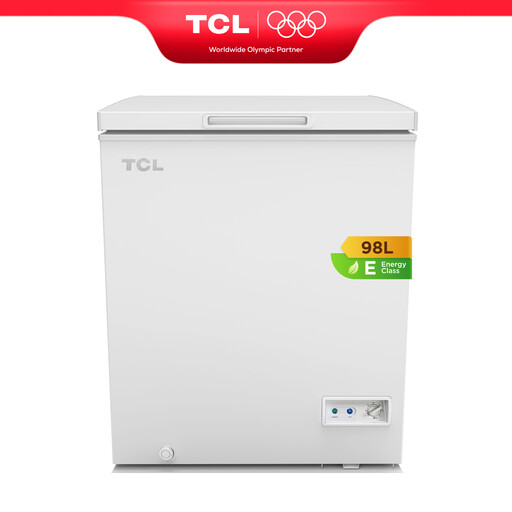 Image unavailable
TCL CF126EWE0FR 98 L chest freezer
An additional chest-freezer compartment with a basket and advertised temperature adjustment.
Advertised features include 98 L, basket, castors, adjustable feet, front drainage and adjustable thermostat. The Switch Zone function is advertised as allowing you to switch between chilled and frozen storage: consult the instructions for its conditions of use and check the dimensions, consumption, noise, storage time and climate class.
Joybuy
Frequently asked questions
Should you choose a chest or upright freezer for storing lots of frozen food?
Choose a chest freezer if maximum capacity and bulky packaging are your priorities, provided you have enough floor space. Choose an upright freezer for drawers, visibility and frequent access: according to UFC-Que Choisir, chest freezers can reach 600 l, while upright models generally hold around 200 l and can reach up to 400 l in the largest versions.
Which figures on the energy label should you compare?
Compare the A to G class, annual consumption in kWh, compartment capacity and noise level between appliances with a similar capacity and format. The European Commission states that this information appears on the labels of freezers and fridge freezers sold in the EU; the QR code links to the model’s EPREL product sheet.
Can you install a freezer in an unheated garage or cellar?
This depends on the model’s ambient temperature range and climate class, not simply on whether it is a chest freezer. Liebherr states that the CFe 2500 Pure features FrostProtect down to -15 °C; nevertheless, check the product sheet and instructions for your chosen model before installing it in an unheated room.
What protection applies if a new freezer does not match its description?
In France, the statutory guarantee of conformity applies automatically to goods sold by a professional to a private individual. The Ministry of the Economy states that it covers, among other things, a product that does not match its description or an installation that falls within the seller’s responsibility; submit your claim to the professional seller.
How should you dispose of an old freezer in France?
An old freezer falls under the waste electrical and electronic equipment stream. It must be taken to an appropriate collection and treatment service rather than put in household rubbish, because these appliances contain components that require specialist handling, according to the ministry responsible for ecological transition.


