Households that freeze portions every day
If you prepare meals or freeze leftovers, an upright’s compartments make it easier to organise food and reach it from the front. Just check that the drawers are large enough for your containers.


If your current freezer compartment is no longer big enough, start by thinking about what you store and how often you need to access it. A chest freezer suits bulky supplies, while an upright makes it easier to organise portions you use regularly. A compact appliance may be all you need for a little extra space. If you’re also replacing your fridge, compare the freezer capacity of a fridge-freezer before adding a second appliance. In every case, check the available space, the recommended ambient temperature range, energy consumption, noise level and stated storage time during a power cut.
If you prepare meals or freeze leftovers, an upright’s compartments make it easier to organise food and reach it from the front. Just check that the drawers are large enough for your containers.
For bulk shopping or bulky packs, it’s worth comparing a chest freezer’s storage well with the drawers of an upright. You’ll need enough floor space and a way to reach food stored at the bottom.
If you only need a little extra capacity in a kitchen or small alcove, consider a compact freezer or the freezer capacity of a fridge-freezer, rather than starting with a large standalone appliance.
Start with what you need to store and how you want to access it, then measure the space available. For every model you’re considering, also check the climate class, annual energy consumption, noise level and stated storage time during a power cut. You can’t tell these features from the format alone.
| Feature | What to check | Who it matters to |
|---|---|---|
| Access and organisation | Compartment layout and the space needed to open the door and remove the drawers. | When I freeze portions for meals during the week, I want to find each container quickly without moving everything else. Around 28% of consumers would put easy everyday access first. |
| Storing large quantities | Usable capacity, shape of the storage well, floor space and access to food at the bottom. | If my shopping includes large packs or bulky prepared foods, I need space without being limited by drawer size. This would be the priority for around 22% of consumers. |
| Compact extra capacity | Appliance or alcove dimensions, installation instructions and net freezer capacity. | I want to freeze a few extra items, but I only have room for a small appliance. Around 17% of consumers would prioritise this space constraint. |
| Installation room | Typical ambient temperatures and the recommended range for the exact model; also compare the noise level and stated storage time during a power cut. | If the room is unheated or subject to significant temperature changes, I need to know whether the appliance is suitable for that location. Around 17% of consumers would put this compatibility first. |
| Replacing a fridge-freezer | Net capacity of the freezer compartment, separate from the total fridge-freezer capacity. | If I also need to replace my fridge, I’d rather check whether a fridge-freezer can hold my supplies before planning for a second appliance. Around 16% of consumers would prioritise this option. |
A chest freezer has room for large packs, but needs enough floor space and makes food at the bottom harder to reach. An upright makes everyday sorting easier, though it may not offer the same flexibility for storage.
Measure the appliance, the space available and the delivery route. Allow room for the door or lid to open, and check that the drawers can be removed.
The climate class defines the ambient temperature range the appliance is designed for. An unheated room doesn’t automatically make a freezer suitable.
Check the room’s usual temperatures, then compare them with the instructions for the exact model, including if it’s advertised as suitable for use in a cold room.
The energy rating letter doesn’t tell you everything about the model’s capacity, annual energy consumption or noise level.
Compare models by net capacity, kWh/year, dB(A), stated storage time during a power cut and dimensions, as well as the displayed rating.
Total capacity includes the fridge compartment too. For example, Electrolux gives the ENS3SE18S a total capacity of 249 L, of which 70 L is the freezer compartment.
Compare the capacity of the freezer compartment alone with the amount of prepared food and frozen goods you want to store.
Upright models to consider if compartmentalised storage and frequent access are important to you.
Chest freezers to consider when your priority is storing a large quantity in a single compartment.
Models to compare for a built-in installation or when replacing a fridge-freezer.
Chest freezers to consider for an unheated room, provided you choose a model explicitly designed for those conditions.
These models include chest freezers for storing different quantities and upright freezers with compartmentalised storage. Compare their capacity and layout with the space you have available. Check that the chosen model is suitable for the room’s temperature and review its stated storage time during a power cut.
 Image unavailable
Worth considering for storing a large quantity if you have enough room to open a chest freezer from the top.
The title lists freezer or fridge mode, a removable basket, LED lighting and five-level digital controls. Check the dimensions, clearance, climate class and stated storage time during a power cut for this model before installation.
 Image unavailable
Worth considering if you’d rather organise food in an upright appliance than in a chest freezer.
The title mentions drawers, No Frost, a reversible door and a C energy rating. Check the drawer layout, dimensions, climate class and stated storage time during a power cut for the exact model.
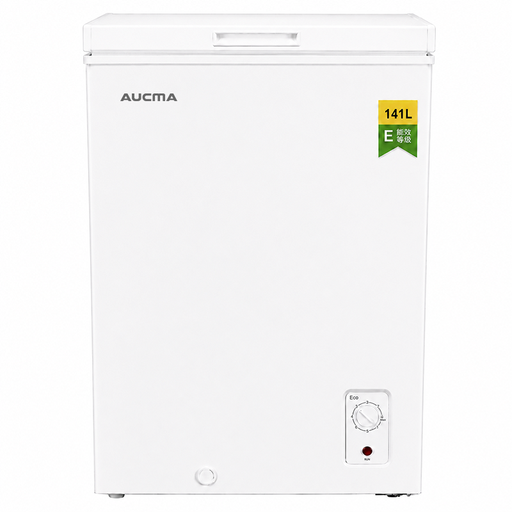 Image unavailable
Worth comparing if you want a chest freezer for a little extra space without choosing AUCMA’s 291 L model.
The title lists freezer or fridge mode, a seven-level thermostat and a removable basket. Measure the space available and check the clearance, climate class and stated storage time during a power cut before choosing this model.
 Image unavailable
Worth considering for a little extra freezer space if there’s room for a freestanding appliance.
The title lists a reversible door and an E energy rating. The compartment description differs from the number of drawers given in the title, so check the actual layout, as well as the dimensions and installation instructions.
 Image unavailable
Worth comparing if you need a chest freezer for a little extra space and want to keep the amount you store to a minimum.
The title mentions a removable basket, adjustable thermostat and sliding lid. Check how much space you’ll need to use the lid, the climate class and stated storage time during a power cut. Also allow for the maintenance involved in the manual defrosting specified for this model.
Choose a model whose ambient temperature range covers the room’s usual temperatures. Bosch gives a range of 10 to 32 °C for climate class SN and 16 to 32 °C for class N. Beko says some chest freezers with Freezer Guard can be used at temperatures as low as −15 °C. Always check the instructions for the specific model.
Yes. Compare the annual energy consumption in kWh, net capacity and stated noise level for each model too. According to ADEME, large domestic appliances sold in France display an energy label in shops and online. The rating letter alone doesn’t tell you about their capacity or energy consumption.
Use it to compare models before buying, but don’t confuse it with advice on what to do during an actual power cut. Bosch gives 11 hours for the GSV36VWEV and Electrolux gives 12.7 hours for the LUB3AE88S. These figures apply to those specific models.
Ask the retailer how to arrange collection of your old equivalent appliance when you place your order. According to ecosystem, free ‘one-for-one’ take-back must be offered when you buy a new electrical appliance, including online. If your new appliance is being delivered to your home, confirm the collection arrangements for delivery day.