If you’re adding another appliance, choose an upright freezer if easy access and drawer storage are your priorities. Consider a chest freezer for storing larger quantities, provided you have enough floor space and room above the lid. A larger fridge-freezer is worth comparing if you also need to replace your fridge, but check the capacity of its freezer compartment alone. In every case, check the installed dimensions, the room’s temperature conditions and the stated power-cut storage time.
Who are these options suited to?
Households that buy in bulk or prepare meals in advance
If your groceries, batch-cooked meals or home-grown produce are overflowing from your current freezer, compare the open storage space of a chest freezer with the drawer storage of an upright model.
Households with limited space
Measure the space available, as well as the room needed to open the door or lid, remove food and allow for the ventilation clearances specified in the manual.
Households considering a cellar or garage
Check the room temperature before choosing: the operating range must match that specified for the exact model, particularly in an unheated space.
What should you compare before choosing?
Upright freezer
Consider one if: you open the appliance often and want to organise food in drawers.
Bear in mind: check that the door opens wide enough to access the drawers and that the capacity suits the amount of food you store.
Chest freezer
Consider one if: you store large quantities or bulky packaging and have enough suitable floor space.
Bear in mind: you’ll need to be able to lift the lid, reach the bottom and organise food so you can find what you need.
Larger fridge-freezer
Consider one if: you also need to replace your fridge and don’t want to add a second appliance.
Bear in mind: its total capacity doesn’t tell you how much space is available for frozen food.
| Factor | What to check | How it suits my needs |
|---|
| Freezer capacity |
Compare the litres available in the freezer compartment, not the total capacity of a fridge-freezer. Check there’s room for the packaging you usually store, and consider whether drawers or baskets would work best for you. |
I shop in bulk or prepare meals in advance: how much extra space do I actually need? |
| Access and dimensions |
Measure the height, width and depth, and allow room to open the door or lid. Follow the ventilation clearances specified in the model’s manual. |
In the space I have, I want to reach my food without blocking walkways or getting in the way of nearby furniture. |
| Location and power cuts |
Compare the room’s minimum and maximum temperatures with the appliance’s stated operating range. Check its stated storage time during a power cut separately, and find out how that figure was measured. |
If the appliance is going in a garage or cellar, I need to make sure it’s designed for the temperatures in that room. Storage time also matters if I’m concerned about power cuts. |
| Everyday use |
Compare annual energy consumption and noise levels across models with the capacity you need. Check whether defrosting is manual or automatic. |
If it’s near living areas, noise matters to me. I also want to know what maintenance the appliance will need. |
What mistakes should you avoid?
-
Relying on a fridge-freezer’s total capacity
Some of that space is reserved for fresh food, so the extra room for frozen food may be less than you expect. For example, Bosch lists 129 L of freezer capacity and 311 L of fridge capacity for the KGN492IAF.
Compare your current appliance’s freezer capacity with the model you’re considering, then compare both with a dedicated freezer.
-
Choosing a freezer for the garage without checking its operating temperature
Whether an appliance can be used in an unheated room depends on the model. Beko states that the HSM27050 can operate at a minimum ambient temperature of -15 °C; this doesn’t apply to its entire range.
Check the room temperature and compare it with the operating range in the manual for the appliance you choose.
-
Forgetting how difficult it can be to reach the bottom of a chest freezer
The open storage space makes it easy to store bulky items, but food at the bottom takes more organising to find.
Measure the floor space and the room above the lid, then check whether baskets could help you separate the food you use most often.
-
Assuming storage time during a power cut depends on the freezer’s style
It varies by model: Bosch states 14 h for the GSN54EWCV upright freezer, while Beko states 41 h for the HSM27050 chest freezer. These stated figures aren’t a general rule for upright and chest freezers.
Compare the stated storage time for each model, regardless of its capacity or defrosting type.
Which brands should you look at?
These brands give you a starting point for comparing formats and specifications; the details below apply only to the models named.
Bosch
Upright freezers and fridge-freezers to consider if you’re deciding between adding another appliance and replacing your fridge.
- Bosch states that the GSN54EWCV upright freezer has 328 L of freezer capacity and 14 h of storage time during a power cut.
- For the KGN492IAF fridge-freezer, the stated 129 L refers to the freezer compartment only. Compare this figure with your current capacity.
Beko
A brand to look at for chest freezers, particularly if the space you have in mind is unheated.
- For the HSM27050 chest freezer, Beko states a capacity of 284 L, 41 h of storage time during a power cut and a minimum operating ambient temperature of -15 °C.
- Check the temperature range for each model: the HSM27050’s specification doesn’t apply to other models.
Electrolux
Its guides can help you look at storage in upright and chest freezers, as well as installation requirements.
- Electrolux’s guide presents a chest freezer as an option for storing large quantities.
- For installation, Electrolux advises keeping air circulating around the appliance. Check the manual for your chosen model to find out how much clearance it needs.
Appliances to compare on Joybuy
This selection includes upright and chest freezers for adding extra storage, as well as a fridge-freezer to consider if you’re also replacing your fridge. Compare their freezer capacities and installation requirements with the space you have available.
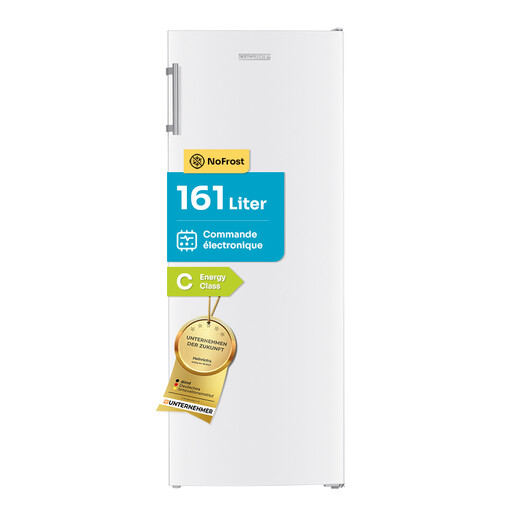 Image unavailable
Heinrich´s, 161 L No Frost upright freezer
Worth comparing if you want to add an upright freezer with separate storage compartments. The title lists a capacity of 161 L, No Frost technology and an energy rating of C. Check the dimensions, clearances and permitted temperature range for your space.
View on Joybuy
 Image unavailable
Haier HTW5618ENMG, 360 L three-door fridge-freezer
Consider this if you also need to replace your fridge. The stated 360 L capacity is for the whole appliance, so compare the freezer compartment’s capacity separately with that of your current fridge-freezer. The title lists Total No Frost and an energy rating of E.
View on Joybuy
 Image unavailable
COMFEE' RCU60WH2(E), 60 L upright freezer
This 60 L model is worth comparing for extra storage rather than large quantities of food. The title lists a reversible door, adjustable thermostat and an energy rating of E. Check the internal layout before choosing, then make sure you allow the necessary installation clearances.
View on Joybuy
 Image unavailable
TCL CF182EWE0FR, 140 L chest freezer
Worth comparing if you want extra chest freezer storage: the title lists a capacity of 140 L, a basket, a counterbalanced lid and an energy rating of E. Allow enough space to open the lid and reach your food.
View on Joybuy
 Image unavailable
CHiQ JR99DWE, 99 L chest freezer
This 99 L chest freezer is worth comparing if you’re looking for extra storage with a removable basket. The title lists an adjustable thermostat, sliding lid and an energy rating of E. Check that you can reach the contents easily and that the installation conditions suit the room you have in mind.
View on Joybuy
Frequently asked questions
What capacity should I compare across chest freezers, upright freezers and fridge-freezers?
Compare the usable capacity reserved for frozen food, not the total capacity of a fridge-freezer. UFC-Que Choisir says chest freezers can hold up to 600 L, while upright models are generally around 200 L, with some models reaching 400 L. Then check the capacity and layout of each appliance you’re considering.
Can a freezer operate in an unheated garage?
Yes, if the model’s stated temperature range covers the actual temperatures in your garage. Beko states that its HSM27050 chest freezer can operate at a minimum ambient temperature of -15 °C, but this doesn’t apply to all freezers. Check the manual for the model you’re considering.
What does storage time during a power cut mean?
It’s the length of time an appliance can keep food cold, measured using a stated or tested method. It isn’t the same for all chest or upright freezers. In its test procedure, UFC-Que Choisir measures how long food stays below -9 °C after a power cut. Bear the method in mind when comparing the stated times.
How much space should I allow for ventilation?
Allow for the clearances specified in the manual for your chosen model rather than applying the same distance to every appliance. Electrolux notes that air needs to circulate around the appliance. Check these clearances as well as the space needed to open the door or lid before you order.


