If you often reach for individual portions or prepared meals, choose an upright freezer with drawers. For larger quantities, consider a chest freezer if you have enough floor space. A compact or under-counter model is better for extra storage, provided you check its dimensions, ventilation requirements and usable capacity. Whatever the format, also check the permitted room temperature and the stated storage time in the event of a power cut.
Who is each format suited to?
Households that freeze meals in portions
If you often take out bags, tubs or prepared meals, an upright freezer’s drawers make it easier to organise and access everything from the front. Check the usable dimensions first to make sure they’ll fit the containers you use.
Households that stock up in bulk
A chest freezer gives you more flexibility for storing bulky food. In return, you’ll need to allow for its floor space and plan how to reach food stored at the bottom.
People short on space
A compact or under-counter freezer can provide extra storage. Before choosing, compare its net capacity with your needs and measure the space, including clearance and room to open the door.
How do the formats compare?
If you’re adding a separate freezer for groceries or prepared meals, start with your main need: easy access to food, space for larger quantities or a freezer that fits its location. Check the other criteria against the specific model you’re considering.
| Priority |
What to check |
Who is this for? |
| Easy access to portions |
Number of drawers and their usable dimensions; net capacity suited to your containers. |
If I freeze meals in small portions, I want to find a tub quickly without rummaging through a chest freezer. Around 37% of consumers prioritise this kind of everyday access. |
| Storing larger quantities |
Net capacity, floor space and access to food at the bottom of the chest freezer. |
For bulky groceries, I’m mainly looking for a freezer compartment that can accommodate their size, even if I need to organise smaller items in baskets. This is the main requirement for around 36% of consumers. |
| Fitting the available space |
Dimensions and required clearances; permitted room temperature and stated storage time during a power cut. |
When space is limited or the freezer needs to go in an unheated room, I first need to know whether it can be installed there in line with the instructions. The available space is the top priority for around 27% of consumers. |
Mistakes to avoid before buying
-
Choosing capacity before measuring
A generous capacity is no use if the appliance won’t fit through the door or its lid can’t open in the space you’ve chosen.
Measure the access route, the appliance’s footprint and the space needed for the lid to open and for ventilation, as set out in the instructions.
-
Assuming every freezer is suitable for a garage
The temperature in a garage or cellar may fall outside the ambient range a model is designed for. If one model is rated to operate in below-zero temperatures, that doesn’t mean others are too.
Compare the room’s usual temperatures with the model’s climate class and instructions.
-
Assuming a large capacity means easy organisation
Small portions can be harder to reach at the bottom of a chest freezer, while the drawers in an upright freezer may make it tricky to store larger items.
Make a list of the sizes of items you’ll store most often, then look at the internal layout rather than net capacity alone.
-
Overlooking details specific to each model
Storage time during a power cut, noise and energy consumption can’t be inferred from whether a freezer is upright or chest-style.
Compare the figures on the model’s product information and energy label, and distinguish declared figures from independent test results.
Brands and models to know
These examples show different formats and features to compare. Their specifications don’t apply to every freezer from the same brand.
Bosch
The GSV36VWEV is an example of a freestanding upright freezer to consider if you want vertical storage.
- Bosch lists a usable capacity of 249 L and a storage time of 11 h during a power cut for this model.
- The GSV36VWEV is listed as having no No Frost function, so check the defrosting method for the model you choose.
Beko
The FSE1174N is an example of a compact freezer for extra storage in a tight space.
- Beko lists a net capacity of 95 L, a width of 54 cm and a storage time of 12 h during a power cut for the FSE1174N.
- Before installing it under a worktop or in a cold room, check the required clearances and permitted ambient temperatures in the instructions.
Liebherr
The CFe 1870 Pure is an example of a chest freezer to consider for storing larger quantities.
- Liebherr lists a capacity of 281 L for this model and specifies FrostProtect down to −15 °C.
- This stated temperature range applies to the CFe 1870 Pure; it doesn’t show that another chest freezer is suitable for an unheated room.
Freezers available on Joybuy
This selection includes one compact upright freezer and four chest freezers for adding extra storage at home. Match the format to the food you’ll store and the space available. Capacity alone won’t tell you the permitted ambient temperature or how long food will stay frozen during a power cut.
 Image unavailable
COMFEE' RCU60WH2(E) — 60 L upright freezer
Worth considering for extra storage and portions you can divide between its three compartments. The product details mention a reversible door and adjustable temperature control. Check the space needed to open the door, as well as the ambient temperature range and storage time that suit your needs.
View on Joybuy
 Image unavailable
TCL CF182EWE0FR — 140 L chest freezer
Consider this model if you want a freezer compartment for extra supplies: a basket lets you separate some of the smaller items. The product title mentions a counterbalanced lid and adjustable temperature control. Measure the clearance needed to open the lid, and check the storage time during a power cut and permitted ambient temperature before choosing a location.
View on Joybuy
 Image unavailable
AUCMA — 291 L convertible chest freezer
Its freezer mode and 291 L compartment make it suitable for storing larger quantities, while the removable basket helps keep smaller items separate. This model can also switch to fridge mode. Make sure you select the mode that suits what you’re storing and allow for the 10 cm ventilation clearance specified by the manufacturer. Also check the storage time during a power cut and permitted ambient temperature.
View on Joybuy
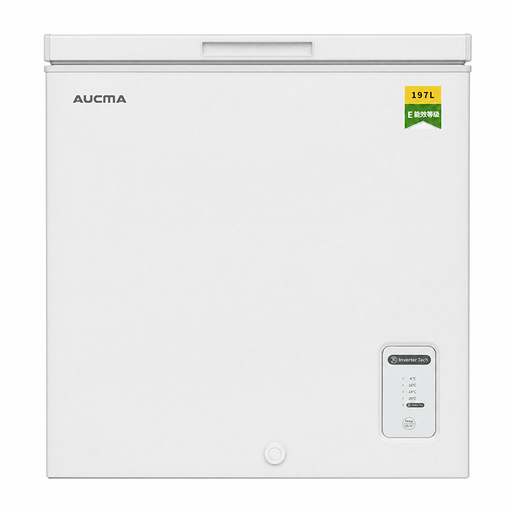 Image unavailable
AUCMA — 197 L convertible chest freezer
This convertible chest freezer offers 197 L in freezer mode and has a removable basket for smaller items. If it fits your space, allow for the 10 cm ventilation clearance specified by the manufacturer. Before installation, also check the storage time during a power cut and the permitted ambient temperature range.
View on Joybuy
 Image unavailable
CHiQ JR99DWE — 99 L chest freezer
Worth considering if you want a small chest freezer rather than an upright model with drawers. This 99 L model has a removable metal basket and adjustable thermostat. Allow space for the lid to open and for ventilation, then check the permitted ambient temperature and stated storage time during a power cut.
View on Joybuy
Frequently asked questions
Upright, chest or under-counter: how do you choose?
Choose an upright freezer if easy access to portions is your priority, a chest freezer if you mainly store larger quantities and have enough floor space, or a compact or under-counter model for extra storage. Then compare net capacity only between appliances that can be installed in your chosen location.
Can you put a freezer in a garage or cellar?
Yes, provided the model’s permitted ambient temperature range covers the room’s temperature and you can follow its installation instructions. Check the climate class and any specific suitability for cold conditions in the manual. For example, Liebherr specifies FrostProtect down to −15 °C for the CFe 1870 Pure; this doesn’t apply to all freezers.
What does storage time during a power cut mean?
It helps you compare how long each appliance is stated to keep food cold under defined conditions. Check the conditions behind the stated figure. As part of its test protocol, Que Choisir measures how long it takes for the temperature to rise from −17 °C to −9 °C without power.
How can the energy label help you choose?
It helps you compare the energy consumption and noise levels of the models you’re considering; ADEME recommends checking the information it provides. Consider these details alongside net capacity and installation requirements, rather than choosing based on the rating letter alone.


