If you need to store plenty of meals and frozen shopping, choose a chest freezer when capacity and space for bulky containers matter most, or an upright freezer if you need to find separately stored portions regularly. An under-counter model is better suited to compact, additional storage; if you also want to update your refrigeration space, consider a large fridge-freezer. In every case, compare the net freezer capacity, the space needed for opening and ventilation, the permitted room temperature, kWh/year and the stated power-cut storage time.
Who is each type best suited to?
Households that freeze prepared meals
If you prepare several meals in advance, an upright freezer with drawers can help you keep portions separate and find them without rummaging through a large chest. Do check that your containers fit in the compartments. UFC-Que Choisir highlights the organisation and access to food offered by upright freezers.
Bulk buyers with a spare room
If you buy large packs or store bulky containers, the open space in a chest freezer can be useful. Having enough room is not the only consideration: in a pantry, cellar or garage, also check that the room temperature is suitable for the model you choose.
Households short on space or mindful of energy use
If every centimetre counts, measure the space the appliance will occupy, as well as the clearance needed to open its door, drawers or lid. For an appliance that runs continuously, compare the kWh/year with the net freezer capacity you actually need, as ADEME advises when discussing freezer energy use.
What sets each type apart?
UFC-Que Choisir’s guide contrasts the generous storage space of chest freezers with the more organised access offered by upright models. The other two types suit different needs: extra capacity in a small space, or keeping fresh and frozen food together in one appliance.
Chest freezer
Consider it: for large quantities or bulky containers, if you have enough floor space and room to lift the lid.
Bear in mind: food at the bottom takes more organising to keep it within easy reach.
Upright freezer
Consider it: if you want to sort portions into drawers and access frozen meals regularly.
Bear in mind: the size and layout of the compartments may limit the space available for large containers.
Under-counter freezer
Consider it: if you need extra storage that will fit beneath a worktop.
Bear in mind: check its capacity carefully before relying on it to store regular batches of meals.
Large-capacity fridge-freezer
Consider it: if you also need to replace or combine your fresh and frozen food storage.
Bear in mind: the total capacity is not the same as the space available in the freezer compartment alone.
| Consideration |
What to check before buying |
Who is it for? |
| Storage and access |
Compare the net freezer capacity and the layout of drawers or baskets with the size of your portions and containers. |
When I prepare several meals in advance, I want to find a portion without moving everything else. Around 37% of consumers prioritise easy-to-access storage. |
| Large capacity and location |
Measure the appliance and the space needed to open it; check the room temperature and ventilation clearances against the model’s instructions. |
When storing a large food shop in a spare room, I prioritise the space available for food, provided the appliance can operate there. Capacity and location come first for around 27% of consumers. |
| Energy use and power cuts |
Compare the kWh/year for appliances of a similar type and capacity, then check their stated storage time in the event of a power cut. |
If I’m adding an appliance that will stay plugged in all the time, I want to know how much energy it uses and take possible power cuts into account. This is the top concern for around 18% of consumers. |
| Space in your home |
Check the floor space required, delivery access and clearance needed for the door, drawers or lid. |
When my kitchen is short on space, I need an extra freezer that will still be practical once installed, even if it has a more modest capacity. Around 18% of consumers prioritise how well it fits into their home. |
Mistakes to avoid before you buy
-
Focusing on capacity in litres without checking the inside
A large chest freezer can hold bulky items, but food at the bottom is harder to reach. Drawers in an upright freezer make it easier to organise food, but may not fit every large container.
Measure your usual containers and check the layout of the baskets, drawers and shelves before choosing a type.
-
Assuming any freezer is suitable for a garage
The temperature in a garage or cellar may fall outside the range permitted for a particular model. UFC-Que Choisir recommends checking the climate class; a stated ability to operate in a cold room applies to certain appliances, not an entire range.
Compare the room temperature with the range stated in the documentation for the exact model, and follow its ventilation instructions.
-
Comparing only the energy label rating
Energy ratings alone do not make it useful to compare two freezers of different capacities. ADEME points out that a freezer runs continuously, so its annual energy consumption is worth checking separately.
Compare the kWh/year and net freezer capacity of similar appliances, then consider how much energy the model is likely to use in your own circumstances.
-
Forgetting about maintenance and large batches of food
A manual-defrost model needs to be checked for frost build-up. If you add a lot of prepared meals or groceries at once, storage capacity alone does not tell you how much the appliance can freeze in a day.
Check the defrosting method and the model’s freezing capacity, then plan your storage so you can identify each portion.
Brands to consider
These ranges offer a useful comparison between types; check the features and installation requirements for each specific model.
Liebherr
Liebherr offers chest, upright and compact freezers, in freestanding models and, depending on the range, built-in versions.
- The range includes NoFrost models and compact options.
- Operating conditions in a cool room and dimensions vary by model. Check the documentation before planning to install one in a cellar or garage.
Beko
Beko’s range includes upright freezers with a variety of storage configurations.
- For certain models, Beko states that they can be used at an ambient temperature as low as −15 °C.
- This temperature does not apply to all Beko upright freezers. Check the exact model and its other installation requirements.
Whirlpool
Whirlpool France offers chest and upright freezers, as well as different installation types.
- The brand describes chest freezers as an option for bulk storage and upright models as a way to organise food vertically.
- Compare the net capacity, kWh/year, storage time during a power cut and dimensions of the models you are considering, rather than assuming these features from the type alone.
Bosch
Bosch offers upright freezers, with different storage options depending on the model.
- Some models feature No Frost and flexible interior layouts.
- Check the bins and shelves of the specific model if you freeze large dishes: a compartmentalised upright freezer does not necessarily offer the same open space as a chest freezer.
Freezers to compare on Joybuy
This selection includes chest freezers for extra freezer capacity, two compact chest freezers for additional storage, and an upright model for organising portions by compartment. For convertible chest freezers, check that they can be set to freezer mode before comparing them with your needs.
 Image unavailable
AUCMA convertible chest freezer, 291 L
This chest freezer is suited to storing larger quantities, provided its top-opening lid and dimensions work for your space.
Stated capacity of 291 L, energy rating E, removable basket, LED lighting and a defrost drain. It can operate as either a fridge or freezer: select the setting that suits the food you want to store.
If you plan to keep it in a spare room, check the permitted ambient temperature, ventilation instructions and stated storage time in the event of a power cut.
View on Joybuy
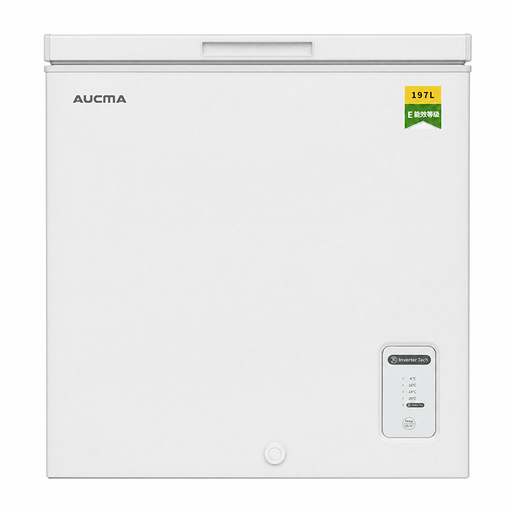 Image unavailable
AUCMA convertible chest freezer, 197 L
This chest freezer adds extra storage space and includes a basket to keep smaller items separate from the rest of your food.
Stated capacity of 197 L, energy rating E, removable basket and a defrost drain. The model can switch between fridge and freezer modes.
Before placing it in a cellar or garage, check the permitted ambient temperature range, ventilation clearance and stated storage time in the event of a power cut.
View on Joybuy
 Image unavailable
Heinrich´s 161 L No Frost upright freezer, stainless steel
This upright freezer is suited to households that want to organise portions and access them from the front, rather than stacking them in a chest.
Stated capacity of 161 L, drawers, No Frost protection, energy rating C and a reversible door hinge. Check the exact interior layout if the number of compartments is important to your choice.
Also compare the kWh/year, installation dimensions, permitted ambient temperature and stated storage time in the event of a power cut in the model’s documentation.
View on Joybuy
 Image unavailable
CHiQ JR99DWE 99 L chest freezer
This compact chest freezer is better suited to extra storage than to holding a large number of bulky dishes.
Stated capacity of 99 L, removable wire basket, sliding lid, adjustable thermostat and energy rating E. Defrosting is manual.
Check that it can hold your containers, then look at the kWh/year, permitted ambient temperature and installation clearances for the model.
View on Joybuy
 Image unavailable
AUCMA convertible chest freezer, 95 L
This compact chest freezer is a handy extra if your portions and frozen shopping fit within its stated capacity.
Stated capacity of 95 L, energy rating E, removable basket, seven-level thermostat and a defrost drain. Select freezer mode for the intended use.
Before choosing where to place it, check the documentation for the compatible ambient temperature, ventilation clearances and stated storage time in the event of a power cut.
View on Joybuy
Frequently asked questions
Can you install any freezer in a garage or cellar?
No. The location must meet the permitted ambient temperature range and ventilation requirements for the exact model. UFC-Que Choisir highlights the importance of the climate class. While some Beko models are stated to work at ambient temperatures as low as −15 °C, this does not apply to every freezer.
Which figures should you compare on a freezer’s energy label?
Compare the kWh/year and net freezer capacity of models of a similar type, then use the energy rating as an additional guide. For a large fridge-freezer, assess the capacity of the freezer compartment, not the total capacity.
Do you need No Frost to freeze prepared meals?
No. It is mainly useful if you want to reduce the need for manual defrosting. When choosing an appliance for storing meal portions, also look at the size of the compartments, the net freezer capacity and the model’s annual energy consumption.
How should you factor in storage time during a power cut?
Check the stated storage time for each model and compare it separately from its capacity. UFC-Que Choisir includes a simulated power cut in its freezer test procedure, so bear the test conditions in mind when comparing times from different sources.


