Households storing large harvests
If you need to store bags of fruit or vegetables and large containers, a chest freezer offers open space, provided you have enough floor space. Also think about how you’ll reach food stored at the bottom.


For large harvests or bulky containers, go for the capacity and open space of a chest freezer. If you often reach for prepared portions, the drawers in an upright freezer make it easier to keep everything organised. An under-counter model is better suited to extra storage, while a fridge freezer may be enough if you’re replacing your fridge too and its freezer compartment alone can hold your supplies. Whatever you choose, check the dimensions and the permitted ambient temperature range for the installation location.
If you need to store bags of fruit or vegetables and large containers, a chest freezer offers open space, provided you have enough floor space. Also think about how you’ll reach food stored at the bottom.
If you regularly take out prepared portions, an upright freezer with drawers makes it easy to sort them into categories. Just check that each compartment can accommodate your containers and bags.
If there’s no room for a large separate appliance, compare an under-counter freezer with the freezer compartment of a fridge freezer, especially if you also need to replace your fridge. In either case, focus on the capacity actually available for frozen food.
To choose between a chest freezer, upright freezer, compact extra freezer and fridge freezer, start with the factor that matters most for your supplies: capacity, how often you need access, the room temperature or the space available.
| Criteria | What to check | Who it’s for |
|---|---|---|
| Capacity and large containers | Compare the stated freezer capacity in litres and the usable internal dimensions, then measure the floor space it will take up and the clearance needed to open it. | When storing a harvest or large dishes, I want my containers to fit without needing several appliances. Around 29% of consumers put capacity first. |
| Storage and access | Check the size of the drawers and how easily they slide out. For a chest freezer, consider using baskets or labelled containers. | When I often take out prepared portions, I want to find them without moving all my other supplies; around 29% of consumers prioritise easy, organised access. |
| Room temperature | Check the temperature in the installation location and compare it with the ambient temperature range stated for the exact model. | If the appliance is going in a garage or cellar where the temperature varies, I need to know whether it can operate there; around 24% of consumers put this compatibility first. |
| Space available | Measure the space and required clearances. For a combined appliance, compare the freezer capacity alone with the amount you need to store. | With limited space, I’m mainly looking for extra storage that fits in without giving up an entire spot to a large chest freezer. Around 18% of consumers prioritise a compact footprint. |
The open space can accommodate a range of containers, but food at the bottom is harder to reach, especially if you open the freezer often to take out a portion.
Sort your supplies into baskets or labelled containers. If easy everyday access matters more than fitting large containers, compare an upright freezer with drawers too.
The climate class depends on the model. An SN-T rating alone doesn’t confirm that an appliance can operate in a room that drops below 10 °C, according to the temperature ranges listed by Beko France.
Check the temperature in the room, then consult the operating range for the exact model. For a colder space, look for an explicitly stated low-temperature rating.
The total capacity of a fridge freezer includes the fridge compartment too, so it doesn’t represent the space available for harvests or frozen meals.
Compare the freezer compartment’s capacity alone with the amount you need to store, and check that its compartments can accommodate your containers.
An under-counter model can provide extra storage, but may not meet your needs if you have a lot to store. The Bosch GTV15NWEB, for example, has a stated usable capacity of 83 L, according to Bosch Électroménager France.
First work out how much capacity you need, then compare it with the space available under your worktop.
The specifications below apply to the models mentioned, not to every appliance from each brand.
The range includes chest and upright freezers, with layouts and operating ranges that vary by model.
The GTV15NWEB offers a useful point of comparison if you need an under-counter freezer.
Electrolux France offers upright freezers, compact built-in models and chest freezers, giving you a range of installation options to compare.
These Joybuy models include an upright freezer for organising portions, three chest freezers with different stated capacities, and a fridge freezer to consider if you’re replacing your fridge too. Compare the freezer capacity and installation requirements before you choose.
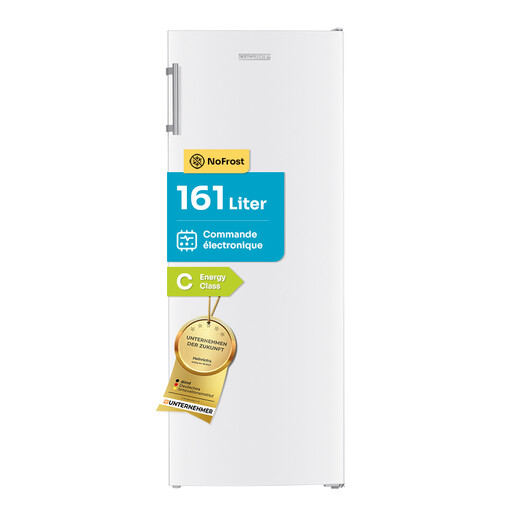 Image unavailable
Worth considering if you want to organise portions in a dedicated appliance: the product title states that it has three freezer drawers and a capacity of 161 L.
Check that the dimensions, door clearance and ambient temperature range are suitable for your chosen location.
 Image unavailable
This chest freezer has a stated capacity of 95 L and could provide extra storage if you prefer top access. The product title mentions a removable basket, a seven-setting thermostat, and selectable fridge and freezer modes.
Check the net capacity, internal dimensions and ambient temperature range, particularly if you plan to install it in a garage or cellar.
 Image unavailable
Worth considering if you’re also replacing your fridge and want to avoid buying a separate freezer. The stated capacity of 495 L is for the whole appliance, not just the freezer.
Compare the freezer compartment’s capacity and layout with the portions you need to store, then check the appliance dimensions and ambient temperature range.
 Image unavailable
This dedicated chest freezer is worth considering if you need more room for supplies than a small extra freezer can provide. The product title states that it has a capacity of 140 L, a basket and a counterbalanced lid.
Check the net capacity, internal dimensions, clearance needed to lift the lid and ambient temperature range.
 Image unavailable
This chest freezer has a stated capacity of 99 L and a removable basket, making it an option if you need extra storage. The product title also mentions a four-star freezer rating.
Check that its net capacity and internal dimensions are suitable for your supplies, and check the ambient temperature range if you’re installing it somewhere that isn’t temperature-controlled.
Not if the garage temperature falls below the range permitted for that model. Beko France gives a range of 10 to 43 °C for SN-T climate class. If your space gets colder, look for an explicit low-temperature rating for the model you’re considering.
An upright freezer with drawers makes it easier to organise and access food if you often take out portions. A chest freezer is still a good choice if you mainly need open space and organise what’s inside using baskets, containers or labels.
Consider how easy it is to reach your food, the energy consumption shown on the energy label, the stated noise level, the stated storage time in the event of a power cut, and the defrosting method. Que Choisir includes storage, opening and cleaning among its criteria for assessing freezer ergonomics.
Ask the retailer about taking it back before your new appliance is delivered. An FAQ from the French ministries responsible for the ecological transition explains the “one-for-one” take-back scheme when buying an appliance of the same type. Ask the retailer about collection arrangements and any preparation needed.