Which type and features should you prioritise?
First decide whether you only need more space for frozen food, or whether you also need more room for fresh food. Then compare the storage options, location and specifications of the exact model.
Upright freezer
Choose this if: you often take out portions and want to organise them in drawers.
Bear in mind: make sure there’s enough room to open the door and access the drawers once the appliance is in place.
Chest freezer
Choose this if: you store large quantities or bulky containers and have enough floor space.
Bear in mind: you’ll need to organise the food at the bottom of the freezer so it stays easy to reach.
Large fridge freezer
Consider this if: you’re short of space for both fresh and frozen food.
Check: a large total capacity doesn’t necessarily mean a large freezer compartment.
| Priority |
What to check |
Depending on your needs |
| Capacity and space |
Compare freezer capacity in litres, the appliance dimensions and the clearance needed to open it. For a fridge freezer, check the freezer capacity separately: Whirlpool lists 79 L of freezer space out of 300 L total for the WHC20D011B1 FR. |
‘I want to store more meals without choosing an appliance that blocks the way or won’t fit in the space available.’ |
| Access to food |
Check the number and layout of the drawers or baskets, and how easy it is to see and take out your containers. Que Choisir recommends considering ease of access as well as capacity. |
‘For portions I use every week, I’d rather be able to find what I need quickly.’ |
| Where you’ll install it |
Compare the room’s minimum and maximum temperatures with the operating temperature range specified for the model. If you’re comparing models with similar capacities, also check their annual energy consumption and energy rating. |
‘If I’m putting the appliance in my garage or cellar, it needs to be suitable for the temperatures in that room.’ |
| Temperature and power cuts |
Check the stated storage time in the event of a power cut, and whether the appliance has an alarm or fast-freeze function. Que Choisir’s test protocol assesses factors including temperature stability, storage time and freezing performance when food is added. |
‘I sometimes add several portions to freeze and want to know how I’ll spot a temperature problem.’ |
Upright freezers to consider on Joybuy
These two upright freezers suit different needs: 161 L for extra meal storage, or 60 L for a smaller top-up. If you’d prefer a chest freezer or also need more fridge space, compare those options separately before choosing.
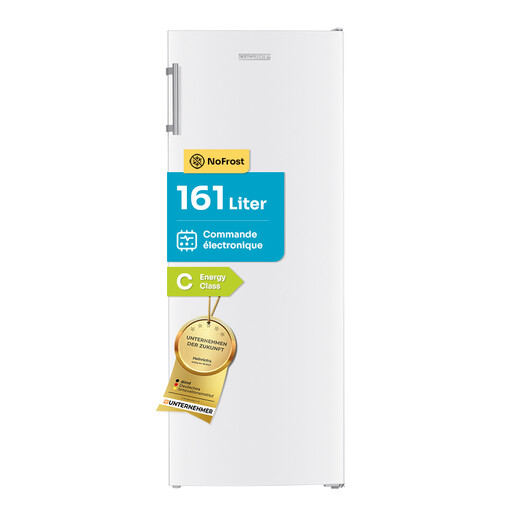 Image unavailable
Heinrich´s 161 L No-Frost upright freezer
With a capacity of 161 L, this model can hold more portions than a small supplementary freezer. Check that it’s suitable for the amount of food you want to store. The product title lists No-Frost protection, a C energy rating, a reversible door and an alarm function. If you plan to install it in an unheated room, check the ambient temperature range specified for this model.
View on Joybuy
 Image unavailable
COMFEE' RCU60WH2(E) 60 L upright freezer
At 60 L, this model is better suited to extra storage than to holding a large stock of prepared meals. The product title lists three drawers, a reversible door and an E energy rating. Check that its capacity suits the meals you want to store, and check the permitted ambient temperature range if you plan to install it in a cellar or garage.
View on Joybuy
Frequently asked questions
Can you put a chest freezer in a garage or cellar?
Yes, as long as the model’s operating temperature range covers the temperatures in the room. Compare the room’s seasonal temperatures with the product specifications. For example, Liebherr says the CFe 2500 Pure can be installed in an unheated room where temperatures fall as low as -15 °C, but this doesn’t apply to every chest freezer.
What should you look at besides capacity in litres?
Check access to the drawers or baskets, the dimensions and clearance needed to open the appliance, as well as its climate class, energy consumption and storage time during a power cut. Que Choisir’s test protocol also considers temperature stability, freezing performance when food is added, noise and ease of use.
Can you refreeze food once it has thawed?
Avoid refreezing food once it has thawed. The French Ministry of Agriculture explains that thawing and then refreezing food encourages bacteria to multiply, particularly if it has been left to thaw at room temperature for a long time.
What should you do with your old freezer when replacing it?
Use a suitable take-back, reuse or collection service for electrical and electronic equipment rather than putting it in general waste. The French Ministry for Ecological Transition describes a collection and treatment scheme for household appliances of this kind.


