Who is each type best suited to?
The amount you need to store matters, but how often you open the freezer and the space available can also affect which type is right for you.
Households storing large quantities
If you receive harvests, batch-cooked food or bulk buys in large quantities, look for a freezer with enough capacity and compartments for your containers. A chest freezer is worth considering if you don’t need to reach every bag each day. Make sure you also have room to open the lid.
Households that open the freezer often
If you regularly need to find and remove food, look at how the drawers, baskets and shelves are arranged. An upright freezer can make it easier to separate different types of food, provided its compartments can actually fit your items.
Households with limited space
In a small kitchen, pantry, cellar or garage, measure the appliance and the space needed to use it. The room temperature must also be within the model’s climate class, and you’ll need to leave enough room for ventilation as set out in the manual.
What should you check before choosing?
Start with the quantities you need to store and freeze in one go, then compare each type with the access you want and the space you actually have.
| Criteria |
What to check |
How it suits my needs |
| Storage |
Compare the usable capacity, the size of your containers and the number of baskets or drawers. UFC-Que Choisir points out that ease of use matters just as much as the stated capacity. |
I keep large quantities in reserve: can I store them without losing access to the food at the bottom? |
| Fresh food deliveries |
Compare the stated freezing capacity in kg/24 h with the amount you expect to freeze in a day. Check the stated storage time during a power cut separately. |
After a harvest or bulk buy, I may have a lot of fresh food to freeze on the same day. |
| Location |
Measure the space for the appliance, opening it and the clearances specified in its manual. Check that the room’s ambient temperature is within the model’s climate class, particularly if it won’t be in a heated kitchen. |
I might install my freezer in a pantry or garage: is the temperature in that room suitable for the model I’m considering? |
| Access and maintenance |
Check the drawers, baskets and compartments of the specific model. Look at its defrosting system and the space needed to remove food or clean the inside. |
If I open the freezer often, I want to find food without having to move an entire batch. |
| Energy use and noise |
Compare the annual consumption in kWh and the capacity of similar models. The EU energy label is a useful comparison guide, according to Your Europe; also check the noise level stated for each appliance. |
If the appliance is near a living area, noise matters to me, as does its annual energy consumption. |
A guide to some of the brands
These examples highlight features to compare on specific models; they don’t represent every range from each brand.
Beko
Beko offers a range of freestanding chest freezers. For the CF200EWN, the brand states a climate class of SN-T, suitable for an ambient temperature of 10 to 43 °C.
- This stated temperature range can help you check whether the model is suitable for your chosen location.
- Also check the interior layout and installation clearances for the chest freezer you choose: the climate class won’t answer these questions.
Bosch
Bosch states that its freestanding GSN58AWCV upright freezer has a usable capacity of 366 L, a freezing capacity of 26 kg/24 h and dimensions of 1 910 × 700 × 780 mm.
- These figures can help you assess whether this model suits large deliveries and the space available.
- Check its height, door clearance and access to the compartments at the planned location.
Whirlpool
Whirlpool describes its upright freezers as appliances designed to make food easier to see and organise. This is the brand’s description, and you should assess it against the layout of each model.
- If you separate different types of food, take a look at the drawers and compartments in an upright freezer.
- Check the usable capacity, dimensions and annual energy consumption of the model you choose rather than assuming them based on its upright design.
Electrolux
The built-in Electrolux LUB3AE88S is 87.3 cm high. The brand states that this model has a net capacity of 98 L, uses 177 kWh/year and has a freezing capacity of 4.5 kg/24 h.
- Its dimensions and capacity can be compared with the requirements of a low niche and smaller deliveries.
- Before choosing it for under-counter installation, check the niche dimensions and the model’s ventilation instructions.
Extra freezers available on Joybuy
These models include chest freezers for extra storage and upright designs that make it easier to separate food. Their capacities vary, so compare each one with the quantities you need to store and the space you have available.
 Image unavailable
CHiQ JR99DWE, 99 L chest freezer
This 99 L chest freezer can provide extra storage for batches you don’t need to access all the time. Its product description mentions a removable basket, adjustable thermostat, 4-star freezing rating and E energy rating. Check the space needed to open the sliding lid, as well as whether the model’s climate class suits the room you have in mind.
View on Joybuy
 Image unavailable
COMFEE' RCU60WH2(E), 60 L upright freezer
This 60 L upright freezer is designed for organised extra storage rather than large batches. Its product description lists three drawers, a reversible door, adjustable temperature and an E energy rating. Before installing it in a pantry or garage, check its climate class and ventilation requirements.
View on Joybuy
 Image unavailable
Heinrich´s, 161 L No Frost upright freezer, stainless steel
This 161 L model may suit households that want to store their supplies in drawers. Its product description mentions No Frost technology, a reversible door, an adjustable temperature range of −14 to −22 °C and a C energy rating. Measure the space and door clearance, then check the model’s climate class.
View on Joybuy
 Image unavailable
TCL CF182EWE0FR, 140 L chest freezer
This 140 L chest freezer offers a capacity worth considering for storing harvests or bulk buys. Its product description mentions a basket, counterbalanced lid, adjustable feet and an E energy rating. If you expect large deliveries of fresh food, also compare its freezing capacity in kg/24 h with your needs.
View on Joybuy
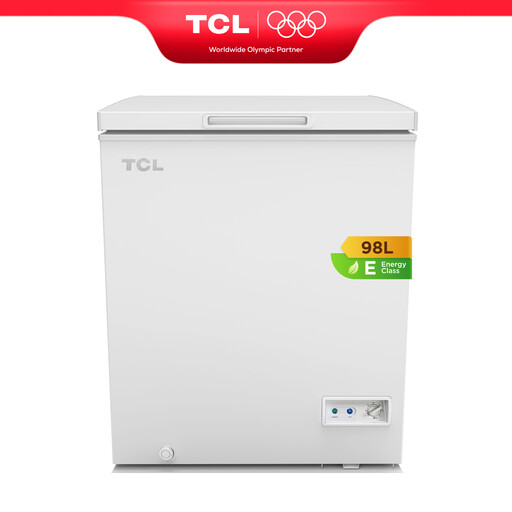 Image unavailable
TCL CF126EWE0FR, 98 L chest freezer
This 98 L chest freezer can provide extra storage, as long as the quantities you need to store fit its capacity. Its product description lists a basket, counterbalanced lid, adjustable feet and an E energy rating. Measure the available space with the lid open, and check the freezing capacity if you expect large deliveries.
View on Joybuy
Frequently asked questions
Can you install a freezer in a cellar or garage?
Yes, provided the room temperature stays within the range specified for the model and its manual allows this type of installation with the necessary clearances. For example, Bosch gives a temperature range of 10 to 43 °C for climate class SN-T. Check the class stated for the freezer you choose rather than assuming that every model is suitable for a garage.
Is a chest freezer always suitable for storing harvests?
No. It’s best suited to storing larger quantities when you don’t need frequent access to food at the bottom. If you often take out small amounts, consider an upright freezer and its compartments too. UFC-Que Choisir recommends considering ease of use, not just capacity.
What should you check on a No Frost model?
Check the usable capacity, the layout of the compartments, the dimensions and the annual energy consumption, even if the manufacturer describes No Frost as a way to avoid manual defrosting. If you freeze large batches of fresh food, also check the freezing capacity in kg/24 h.
How do you compare the energy use of two freezers?
Compare the kWh/year shown on their energy labels, ideally for appliances with capacities that meet the same needs. According to Your Europe, the EU label rates appliances from A to G and lets you compare their energy use; the letter alone doesn’t replace the annual figure for each model.


