A fridge freezer may be enough if your portions and frozen food fit in its freezer compartment. If bulk shopping or prepared meals regularly fill that space, consider a separate appliance: an upright freezer makes portions easy to access, while a chest freezer offers room for larger batches, provided you have the space and keep its contents organised. Then check the freezer capacity, the permitted room temperature, annual energy consumption and the model’s storage time in the event of a power cut.
Who is this choice for?
Households that buy in bulk
If you buy larger quantities less often, compare the space they take up with the freezer capacity of your fridge freezer, then measure the space available for a separate appliance. Que Choisir highlights capacity and size as key differences between upright and chest freezers.
People who prepare portions in advance
If you often take out frozen meals, drawers or compartments can make them easier to organise. Before choosing an upright freezer, check that your containers and bags will fit in the drawers and be easy to remove.
Households with a utility room or outbuilding
A cellar, utility room or garage can free up space in the kitchen, but its temperature must stay within the operating range specified for your chosen appliance. Whether a model is suitable for an unheated room depends on the specific model, not simply on whether it’s a chest or upright freezer.
Which features should you prioritise?
Start by working out how much frozen food you need to store and how often you’ll access it. Then choose a format that suits the room where the appliance will be used.
Fridge freezer
Consider it if: you only need a modest amount of freezer space and want to keep just one appliance.
Bear in mind: the total capacity of a fridge freezer isn’t the same as the capacity of its freezer compartment alone.
Upright freezer
Consider it if: you organise portions and regularly take them out of drawers or compartments.
Bear in mind: compartments can limit the space available for bulky items. Que Choisir notes that chest freezers can offer more capacity than the largest upright models.
Chest freezer
Consider it if: you store larger batches and have enough floor space for a freezer that opens from the top.
Bear in mind: items at the bottom need to be organised carefully so you can find them easily.
Under-counter freezer
Consider it if: you need a compact model to fit under a worktop and want some extra freezer space.
Bear in mind: check the freezer capacity and required clearances rather than assuming it will replace a large freezer.
| Feature |
What to check |
Who is it for? |
| Storage capacity |
Compare the freezer capacity in litres, not the total capacity of a fridge freezer, with the space your batches and containers will take up. Also measure the space the appliance will occupy. |
When I buy in bulk, I want to fit everything I’ve planned to store without filling the freezer to capacity straight away. Around 33% of consumers put storage capacity first. |
| Access to portions |
Check the layout and ease of use of an upright freezer’s drawers. For a chest freezer, see how much room there is for baskets or storage bins. |
If I often take out a portion, I want to find it without moving everything else. Access and organisation would be the priority for around 27% of consumers. |
| Suitability for the room |
Measure the appliance, the delivery route and the clearance needed to open it. In an unheated room, check the permitted ambient temperature range for the exact model. |
If I want to install the appliance in a cellar or garage, I first need to know whether it will fit and work there. This would be the main consideration for around 20% of consumers. |
| Energy use and power cuts |
Compare the kWh/year and noise levels listed for each model, then check its storage time in the event of a power cut in the technical specifications. |
As an appliance runs continuously, I pay attention to its energy use and how long it can keep food frozen during a power cut. Around 20% of consumers would consider this their main concern. |
Mistakes to avoid
-
Choosing based on the energy rating alone
The European Commission says the label also provides information on annual energy consumption, storage volumes and noise. The rating letter alone won’t tell you whether the freezer compartment can hold your supplies.
Compare the kWh/year and freezer capacity of models that genuinely meet your storage needs.
-
Assuming a chest freezer will suit any garage
An unheated garage or cellar may fall outside the ambient temperature range an appliance is designed for. For example, Beko says its HSM14540 can operate at temperatures as low as −15 °C, but this feature doesn’t apply to other models.
Check the possible temperatures in the room and compare them with the climate class or operating range specified for your chosen model.
-
Choosing a large chest freezer without organising its contents
A chest freezer’s capacity is useful for larger batches, but portions at the bottom are less easy to reach than those in drawers.
If you choose a chest freezer, plan to organise it with baskets or storage bins and label your portions. If you take food out every day, compare upright models too.
-
Forgetting storage time during a power cut
Que Choisir points out that storage time varies between freezers; you can’t work it out from the capacity or energy rating.
Check the number of hours for the exact model and see whether it has a temperature alarm if that feature matters to you.
Brands to know when comparing freezers
Bosch
The range includes upright and chest freezers. The GSN29EWEV is a useful example for looking at the features of an upright model, but it doesn’t represent the entire range.
- Bosch lists the GSN29EWEV with a freezer capacity of 200 L, No Frost, a noise level of 39 dB, 9 h of storage time and a freezing capacity of 16 kg/24 h.
- Check these features and the appliance’s suitability for the room separately for any other Bosch model you’re considering.
Beko
The range includes chest and upright freezers, with some models marketed by Beko as suitable for installation in an unheated room.
- Beko says its HSM14540 chest freezer can operate at an ambient temperature as low as −15 °C.
- This feature doesn’t apply to the whole range. Check the operating range, defrosting method and noise level of each model you’re considering.
Liebherr
The range includes chest freezers that may be worth considering if you need extra storage in a separate room.
- Liebherr describes some of its chest freezers with FrostProtect as suitable for unheated cellars and garages.
- Check the permitted ambient temperature, capacity and storage time for the exact model before deciding where to put it.
Appliances to consider on Joybuy
These models show a few different ways to manage your frozen food: chest freezers for larger batches, an upright model for organising portions, a compact upright freezer for extra space and a fridge freezer for an integrated solution. Compare their freezer capacity and installation requirements with the amount you need to store.
 Image unavailable
AUCMA, 291 L convertible chest freezer
Worth considering if you need a dedicated freezer for bulk shopping: it has a listed capacity of 291 L and a removable basket to keep some items separate.
This model is described as convertible between fridge and freezer modes, with LED lighting, a five-level digital control, a defrost drain and an E energy rating. Before installing it in a separate room, check its dimensions, the space needed to open the lid and its permitted ambient temperature range.
View on Joybuy
 Image unavailable
Heinrich´s, 161 L upright freezer, stainless steel finish
Its compartments are worth considering if you want to organise portions and take them out regularly.
The model name lists three freezer drawers, No Frost, a reversible door and a C energy rating. If you’re planning to install it outside the kitchen, check its external dimensions, permitted ambient temperature range and storage time during a power cut.
View on Joybuy
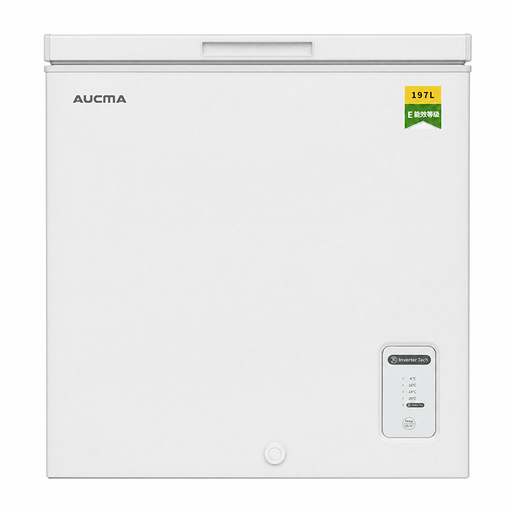 Image unavailable
AUCMA, 197 L convertible chest freezer
This chest freezer may suit a household looking for separate storage for bulk shopping, with a removable basket to keep some items within easy reach.
It has a listed capacity of 197 L and can be switched between fridge and freezer modes. It also features a five-level digital control, a defrost drain and an E energy rating. Check its dimensions and operating range for your chosen location. If you plan to freeze large quantities of fresh food at once, check its freezing capacity in kg/24 h too.
View on Joybuy
 Image unavailable
COMFEE' RCU60WH2(E), 60 L upright freezer
If you’re looking for extra storage rather than a large freezer for less frequent shopping trips, compare its 60 L capacity with the amount of food you need to store.
The model has three drawers, a reversible door and an E energy rating. If you plan to place it under a worktop, check its dimensions and the required clearances. Also check its annual energy consumption and permitted ambient temperature.
View on Joybuy
 Image unavailable
AEG NSC6M18FES, 249 L built-in fridge freezer
This fridge freezer is worth considering if you’d rather keep your freezer space integrated into your kitchen appliance than add a separate freezer.
The 249 L refers to the stated capacity of the fridge freezer, not its freezer compartment alone. The model features TwinTech No Frost and has an E energy rating. Before deciding whether it offers enough space, check the capacity of the freezer compartment itself, as well as the niche dimensions and installation instructions.
View on Joybuy
Frequently asked questions
What should I compare on a freezer’s energy label?
First compare the freezer capacity and annual energy consumption in kWh of appliances that offer enough space for your needs. The European Commission says the label also provides information on the energy rating and noise, so the rating letter alone won’t tell you whether two appliances with different capacities are equally suited to your needs.
Can a chest freezer run in any garage?
No. It depends on the ambient temperature range specified for the exact model. Que Choisir explains that the climate class indicates the minimum and maximum room temperatures. Compare these limits with the temperatures in your garage or cellar, even if a manufacturer says some of its models are suitable for unheated rooms.
Why check storage time during a power cut?
Storage time tells you how long food can stay frozen during a breakdown or power cut. It varies between models, as Que Choisir points out. Check the number of hours listed in the specifications for the model you’re considering rather than trying to work it out from its capacity or energy rating.
What should I do with an old freezer in France?
You can take an old freezer to a collection point for electrical and electronic equipment. The French Ministry for Ecological Transition lists collection points and waste recycling centres, retailers and certain social and solidarity economy organisations. Ask the retailer about the practical arrangements for taking your old appliance away when your new one is delivered.


