Which type is right for you?
The amount of food you want to store isn’t the only thing to consider: the size of the packaging and how often you look for something also affect which type will suit you best.
Households that stock up
If you buy in bulk or freeze pre-prepared portions, estimate how much space your food takes up when your freezer is full. For larger packs, check that they’ll fit in the drawers of an upright freezer or the compartment of a chest freezer.
People who access frozen food often
An upright freezer lets you sort food into drawers, making smaller portions easier to find. In a chest freezer, baskets and organising food by zone can help keep items at the bottom within easy reach.
Households replacing their fridge
If you don’t have space for a second appliance, compare the freezer compartment in fridge-freezers with your usual and maximum stock levels. The total capacity quoted for a fridge-freezer also includes the fridge section.
What should you compare before choosing?
First decide whether a fridge-freezer can hold your supplies, then choose between the drawer access of an upright freezer and the open space of a chest freezer. Next, compare the specifications of models that will actually fit in your home.
Upright freezer
Consider one: if you want to organise portions and bags of food that you use regularly.
Bear in mind: check that bulky packs will fit in the drawers and that the door can open where you plan to put it.
Chest freezer
Consider one: for bulk buys or bulky items, if you have enough floor space.
Bear in mind: food at the bottom takes more organising to keep it easy to find.
Fridge-freezer
Consider one: if you’re replacing your main fridge and its freezer compartment can hold your supplies.
Bear in mind: a large total capacity doesn’t mean a large freezer capacity; check the two separately.
| Feature |
What to check |
Based on your needs |
| Freezer capacity |
Compare the litres available for frozen food, not just the total capacity of a fridge-freezer. Also measure your largest packs and check the usable space in the drawers. |
I want my shopping and pre-prepared portions to fit, even when my freezer is full. |
| Storage and access |
Look at the drawers and compartments in an upright freezer, or the baskets and depth of a chest freezer. Que Choisir also points out that chest freezers take up more floor space than upright models. |
If I open the freezer often, I’d rather be able to find smaller portions without moving all my stock around. |
| Installation |
Measure the appliance, access routes, door or lid clearance and the ventilation space required in the instructions. Compare the room’s minimum and maximum temperatures with the range approved for the model. |
Is the space large enough, and will its temperature stay within the recommended range throughout the year? |
| Freezing capacity and power cuts |
Check the freezing capacity in kg/24 h if you’ll be adding a large amount of food, then check how long it can keep food frozen during a power cut. Before comparing storage times, check how they were measured; Que Choisir’s test, for example, tracks the temperature rise during a simulated power cut. |
After a big shop, I need to compare the amount I want to freeze with the stated capacity. Storage time matters to me too if power cuts are a concern. |
| Energy use and maintenance |
Compare the kWh/year shown on the energy labels of appliances with similar types and capacities. Check whether defrosting is manual or the model has a No Frost system. |
I want to factor in the cost of running an extra appliance continuously and the time needed to maintain it. |
A guide to selected brands
These examples show three different configurations; their features won’t necessarily apply to other models from the same brand.
Beko
The RFNE448E55W upright freezer is an example of a vertical model for organising a large stock of food.
- Beko France lists a capacity of 404 l and a freezing capacity of 20 kg/24 h for this model.
- Beko says that Freezer Guard allows this specific model to operate at ambient temperatures down to -15 °C. Check that the feature and approved temperature range apply to any other model you’re considering.
Liebherr
The CFd 2085 Plus is an example of a chest freezer to consider for bulky packs and rooms where the temperature varies.
- Liebherr lists a capacity of 248 l and FrostProtect down to -15 °C for this model.
- A chest freezer needs enough floor space and requires you to organise items stored at the bottom.
Bosch
The KGN39VLCT is worth considering if you want to replace your fridge without adding a separate appliance.
- Bosch Électroménager France lists a fridge capacity of 260 l and a freezer capacity of 103 l for this model.
- If you need to store a lot of food, compare the 103 l of freezer space with your maximum stock rather than the fridge-freezer’s total capacity.
Freezing options on Joybuy
This selection includes upright freezers to add to your home and fridge-freezers for keeping frozen food in a single appliance. Their capacities suit different stock levels, so compare the space available for frozen food before choosing.
 Image unavailable
Haier HTW5618ENMG, 3-door fridge-freezer, 360 L
Worth considering if you’re replacing your fridge and want to keep frozen food in the same appliance. The model name lists a total capacity of 360 L, Total No Frost, energy class E, Wi-Fi and My Zone. Compare the freezer compartment’s capacity separately with the amount you need to store.
View on Joybuy
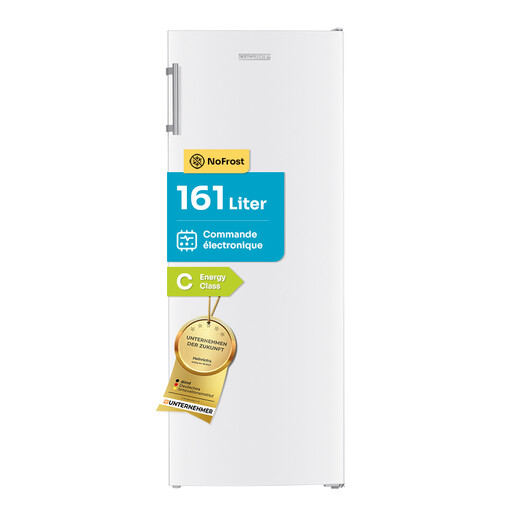 Image unavailable
Heinrich´s, 161 L No Frost upright freezer
A separate appliance to consider if you’d rather organise your supplies in compartments than in an open chest. The product name lists a capacity of 161 L, No Frost, drawers, a reversible door and energy class C. Check its dimensions and the approved ambient temperature range for the space you have in mind.
View on Joybuy
 Image unavailable
CHiQ JR263LGE, 262 L Low Frost fridge-freezer
This fridge-freezer is better suited to a moderate amount of frozen food than to the needs of a large separate freezer. The product name lists a total capacity of 262 L, a 70/30 split, a width of 54 cm, a height of 176 cm and Low Frost. Check the exact capacity of the freezer compartment and the defrosting requirements before choosing.
View on Joybuy
 Image unavailable
COMFEE' RCU60WH2(E), 60 L upright freezer
Its 60 L capacity is better suited to a small amount of extra storage than a large stock of food. The product name lists three drawers, a reversible door and energy class E. If you plan to install it in an unheated room, check the ambient temperature range approved for this model.
View on Joybuy
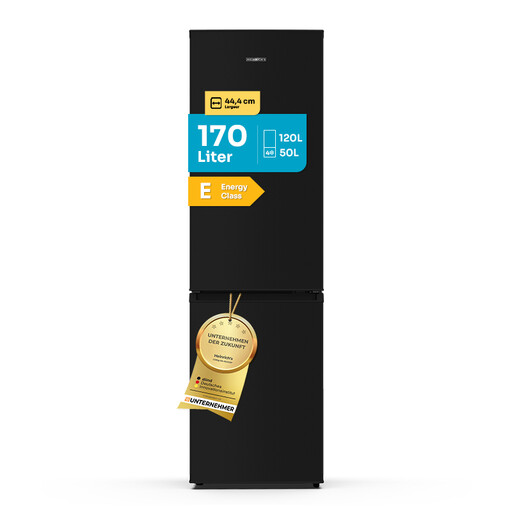 Image unavailable
Heinrich´s, 170 L fridge-freezer with 50 L of freezer space
This model combines both functions in one appliance, but its 50 L of freezer space is suited to a limited amount of frozen food. The product name lists 120 L of fridge space and 50 L of freezer space, as well as a noise level of 40 dB and energy class E. Check its dimensions against the space you have in mind.
View on Joybuy
Frequently asked questions
When is a fridge-freezer enough without a separate freezer?
A fridge-freezer may be enough if its freezer compartment can hold your supplies even when you have the most to store. This can be a good option if you’re already replacing your fridge and don’t have room for a second appliance. For example, Bosch lists 103 l of freezer space for the KGN39VLCT. Compare this figure with your needs, and don’t confuse it with the fridge capacity.
Can you put a chest freezer in a garage or cellar?
Yes, as long as the room’s actual temperatures stay within the operating range approved for your chosen model. EU regulations define a climate class by this range of ambient temperatures. Liebherr states that FrostProtect works down to -15 °C on the CFd 2085 Plus, but this feature shouldn’t be assumed to apply to every chest freezer.
Which figures should you check after a big shop or in case of a power cut?
Check the freezing capacity in kg/24 h for the amount you’ll be adding, then look at how long the specific model can keep food frozen during a power cut. Before comparing this figure between appliances, check how it was measured: Que Choisir’s test, for example, measures how the temperature changes when the power is off.
How do you choose between the drawers in an upright freezer and the compartment in a chest freezer?
Choose based on the type of food you store and how often you need to access it. The drawers in an upright freezer make it easier to separate smaller portions. A chest freezer’s open compartment can hold bulky items, as long as you organise the baskets and the bottom so you can find what you need.
What should you do with an old fridge or freezer in France?
In France, old appliances are covered by the national collection scheme for waste electrical and electronic equipment, as described by the ministry responsible for the ecological transition. Before replacing your appliance, check the retailer’s take-back arrangements or find a suitable collection service. Don’t put it out with ordinary household waste.


