Households that prepare several portions in advance
If you often take out pre-prepared meals, an upright freezer with drawers can make them easier to organise and access. Also check that there’s enough room for the dishes you freeze in one go.


If you want to store a large stock of food, consider a chest freezer if you have enough floor space and can keep its contents organised. An upright freezer makes it easier to access portions you’ve prepared; an under-counter model is better for a little extra storage, while a fridge-freezer may be enough if its freezer compartment meets your needs. Whichever type you choose, check the usable capacity, overall dimensions and permitted ambient temperature for the model.
If you often take out pre-prepared meals, an upright freezer with drawers can make them easier to organise and access. Also check that there’s enough room for the dishes you freeze in one go.
If you want to shop less often or store large packs, start by comparing usable capacity and the space needed for the appliance. A chest freezer offers an open interior, but you’ll need a way to organise it so you can find food at the bottom.
In a narrow kitchen, garage or cellar, dimensions are only part of the picture. Check that the appliance can be moved into place and opened, allow for the clearances specified in the manual, and make sure the room’s ambient temperature is within the permitted range for the exact model.
Start by working out how much you want to store and how often you’ll take food out. Then check that the type of freezer you choose can be installed in the space you have in mind.
Worth considering: for a large stock of food or bulky containers, if you have enough floor space.
Bear in mind: it opens from the top, so you’ll need to organise it in a way that lets you reach food at the bottom.
Worth considering: if you want to organise food by category and regularly take out portions.
Bear in mind: check the drawer dimensions if you use large dishes.
Worth considering: as extra storage when kitchen space is limited.
Bear in mind: check that its usable capacity will be enough before relying on it for bulk buys.
Worth considering: if you also need to replace your fridge and don’t need a large, separate freezer.
Bear in mind: compare the capacity of the freezer compartment alone, not the total capacity of the appliance.
| What to consider | What to check | Who is this important for? |
|---|---|---|
| Storage capacity | Usable freezer capacity, space for large containers and overall dimensions. | If I shop less often, I want to be able to put my food away without immediately filling the appliance. Around 36% of consumers put this storage capacity first. |
| Access to portions | Layout and dimensions of drawers or baskets; access to food stored at the bottom. | If I regularly take out a pre-prepared meal, I want to find the right portion without moving all my other food. Easy everyday access is the priority for around 29% of consumers. |
| Where it will go | Access route and door opening, required clearances and permitted ambient temperature. | In a small kitchen or unheated room, I first need an appliance that can be installed and operate in that space. For around 21% of consumers, suitability for the location comes first. |
| Energy use and power cuts | Energy use in kWh/year, storage time during a power cut and freezing capacity in kg/24 h. | If I’m keeping food in storage for a long time, I want to know how much energy the appliance uses and how long it can keep food frozen during a power cut. Around 14% of consumers prioritise these practical details. |
When comparing energy use, the European Commission says that the energy label includes information such as the energy rating, energy consumption, capacity and noise level. Storage time during a power cut is listed separately, so check the specifications for each model.
A large chest freezer can hold bulky containers, but it takes up a lot of floor space and can make it harder to reach food at the bottom. An upright freezer may be more convenient if you take out portions every day.
Measure the space, the route to the room and the clearance needed to open the appliance. Also think about how you’ll organise your food.
The temperature in a cellar or garage can fall outside the recommended operating range. Beko states that the RFNM200T40WN can operate at an ambient temperature as low as −15 °C, but this feature doesn’t apply to other models.
Before deciding where to put it, check the permitted ambient temperature range and the manual for the exact model.
The rating letter alone doesn’t tell you the annual energy consumption or usable capacity. The European Commission lists these separately among the details shown on the energy label.
Note the kWh/year and usable capacity for the models you’re considering, then compare them in light of the type of freezer you want.
Storage time during a power cut and freezing capacity, measured in kg/24 h, answer two different questions: how long food stays frozen without power, and how much food the appliance can freeze.
Check both figures in the product specifications if you keep a large stock of food or add lots of items after shopping.
Beko’s range in France includes upright freezers. Depending on the model, they may have drawers, a reversible door or features to help manage ice build-up.
Bosch offers freezers with different interior layouts and features, including adjustable drawers and No Frost, depending on the model.
Liebherr’s range includes chest freezers, such as the CFd 2505 Plus, which opens from the top.
This selection includes an upright freezer for organising easy-to-reach portions, as well as several chest freezers ranging from extra storage to larger-capacity options for stocking up. For each model, compare its stated capacity with the space you have and how you want to access your food.
 Image unavailable
Worth considering if you want to store portions in compartments and find them easily when you need them.
The product name states a capacity of 161 l, No Frost, a reversible hinged door and an energy rating of C. Before choosing where to put it, check its dimensions and the permitted ambient temperature. Also check its annual energy consumption and storage time during a power cut.
 Image unavailable
This chest freezer could suit a larger food shop if you have enough floor space and plan how to organise its contents.
The product is listed with a capacity of 291 l, a removable basket, convertible fridge-freezer operation and an energy rating of E. Before choosing this model, check the clearance needed to open the lid, the permitted ambient temperature and its storage time during a power cut.
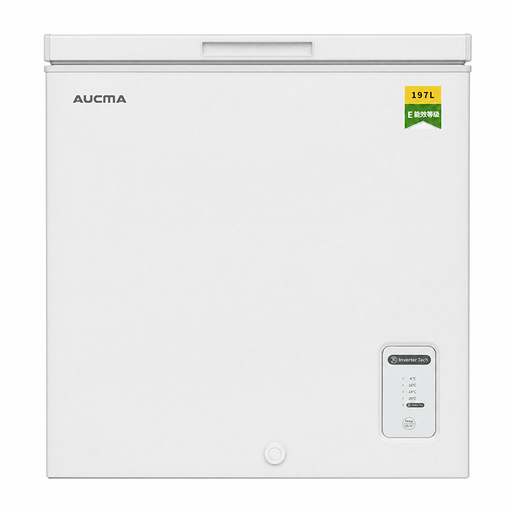 Image unavailable
This chest freezer is worth comparing if you want dedicated storage but don’t need the capacity of the 291 l AUCMA model.
The product name states a capacity of 197 l, a removable basket, two modes (fridge and freezer) and an energy rating of E. Make sure you can access it from above, and check the permitted ambient temperature and storage time during a power cut for the room where you plan to put it.
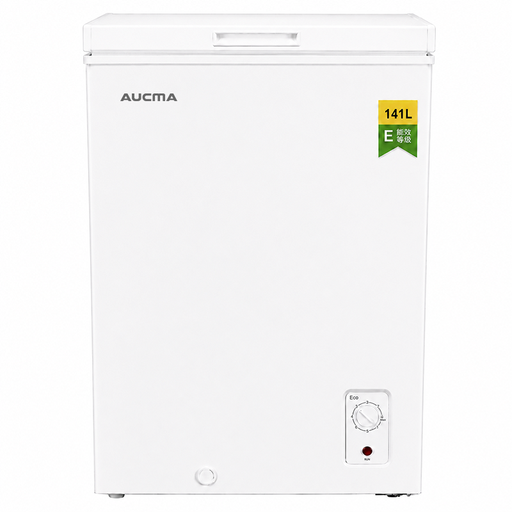 Image unavailable
This size could provide dedicated storage for portions and groceries if a capacity of 141 l meets your needs.
The product is listed with a removable basket, a seven-level thermostat, two modes (fridge and freezer) and an energy rating of E. Allow enough space to open the lid, and check the permitted ambient temperature and storage time during a power cut.
 Image unavailable
Consider this for a little extra storage rather than for large quantities of food.
The product name states a capacity of 99 l, a removable basket, an adjustable thermostat and an energy rating of E. The stated freezing capacity for this model is 4,5 kg/24 h; also check its annual energy consumption, storage time during a power cut and permitted ambient temperature.
Consider a separate appliance if your fridge-freezer’s freezer compartment no longer has enough room for the portions and groceries you want to store. Que Choisir highlights the benefit of the larger capacity offered by dedicated freezers for greater storage needs. Even so, compare the actual freezer capacity in litres before replacing a fridge-freezer or adding another appliance.
Compare the energy rating, annual energy consumption, freezer capacity and noise level. The European Commission says this information appears on the label for refrigerating appliances. When comparing models, don’t focus on the rating letter alone.
Yes, if the permitted ambient temperature range for the model covers the conditions in the room. Beko states a lower limit of −15 °C for the RFNM200T40WN, and Liebherr does the same for the CFd 2505 Plus. Check the product details and manual for the model you plan to install, and don’t assume these specifications apply to every model from either brand.
It can help you choose between models if you plan to store a large amount of food and are concerned about a power cut. The testing method can make a difference: in its test procedure, Que Choisir measures how long it takes for the temperature to rise from −17 °C to −9 °C without power. Check the figure and the conditions it’s based on in the product details.
If you want to avoid manual defrosting, check that the model you choose is specifically listed as having a No Frost function. For an appliance that needs manual defrosting, Que Choisir recommends doing so when the layer of frost reaches 3 mm, as frost increases electricity consumption.