What should you look for?
Upright freezer
Consider it if: you often take out a particular portion and want to organise it in a drawer or compartment.
Bear in mind: larger dishes need to fit in the drawers, and the door must open far enough for you to handle them.
Chest freezer
Consider it if: you store large batches or bulky containers and have enough floor space.
Bear in mind: the open storage space needs to be organised so portions at the bottom are still easy to reach.
Small freezer
Consider it if: space is limited and you only keep a small supply of prepared meals.
Bear in mind: portions and other frozen food will have to share limited capacity.
Fridge-freezer
Consider it if: you freeze portions occasionally and would rather use the freezer compartment in a combined appliance.
Bear in mind: the freezer capacity, which is separate from the appliance’s total capacity, needs to accommodate the portions you usually store.
| What to consider |
What to check |
Who is this important for? |
| Access to portions |
The size and layout of the drawers or baskets, and access to food stored at the bottom. |
If I take a different meal each day, I want to identify and remove the right portion without moving all my food around. Around 36% of consumers prioritise easy access and organisation. |
| Usable capacity |
The net freezer capacity, the space available for your containers and, for large batches, the freezing capacity in kg/24 h. |
When I prepare lots of meals at once, my larger dishes need to fit alongside the frozen food I usually keep. Storing large batches comes first for around 29% of consumers. |
| Location |
The installed dimensions, how far the door or lid opens, the required clearances and the model’s ambient temperature range. |
In a narrow kitchen or a cold room, I first need to be able to install and use the appliance there. This compatibility is the top priority for around 21% of consumers. |
| Maintenance and use |
The cooling system, kWh/year and noise level on the label, as well as the stated power-cut storage time. |
If defrosting, noise or energy use affects my choice, I prefer to check these details before choosing a capacity. Around 14% of consumers put these practical considerations first. |
The European Commission says that the energy label for household refrigeration appliances includes details such as an A to G rating, energy consumption, capacity and noise. Compare these details for the exact model: the same rating does not tell you how it is organised or whether it needs defrosting.
Freezers and fridge-freezers on Joybuy
These appliances cover upright storage, chest freezer storage and occasional use of a fridge-freezer compartment. To compare them, start with your containers and the space available rather than focusing only on the stated capacity.
 Image unavailable
Heinrich´s Inox 161 L No Frost upright freezer
Worth considering if you want to keep portions separate and access them regularly in an upright freezer.
The product name specifies a capacity of 161 L, No Frost protection, drawers, an LED display, a reversible door and an energy rating of C. Measure the space and check the noise level and power-cut storage time if these matter to you.
View on Joybuy
 Image unavailable
AUCMA 291 L convertible chest freezer
Worth considering for large batches if you have enough floor space for the chest freezer and can organise portions under its lid.
The product name lists a capacity of 291 L, fridge and freezer modes, a removable basket, five-level digital temperature control and an energy rating of E. If the room is cold, check the permitted ambient temperature range for this model.
View on Joybuy
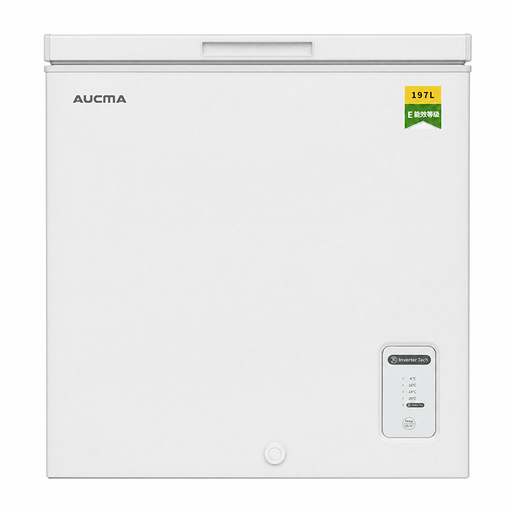 Image unavailable
AUCMA 197 L convertible chest freezer
This chest freezer is for anyone who wants to store portions in batches while considering a lower stated capacity than the AUCMA 291 L model.
The product name lists a capacity of 197 L, fridge and freezer modes, a removable basket, five-level digital temperature control and an energy rating of E. Check the space needed to open the lid and the maintenance required for the appliance.
View on Joybuy
 Image unavailable
CHiQ JR227LSE 227 L fridge-freezer
Worth considering if you want to store a few prepared meals in a fridge-freezer rather than a separate freezer.
The product name specifies 74 L of freezer capacity and 153 L of fridge capacity. It also lists a width of 54 cm, Low Frost and an energy rating of E. Compare the 74 L with the space already taken up by your other frozen food.
View on Joybuy
 Image unavailable
COMFEE' RCU60WH2(E) 60 L upright freezer
Worth considering for organising a small supply of portions when space and freezer capacity are limited.
The product name specifies a capacity of 60 L, three drawers, a reversible door and an energy rating of E. Check that your containers fit in the drawers and that there is enough room for your meals as well as other frozen food.
View on Joybuy
Frequently asked questions
Upright or chest freezer: which should you choose for make-ahead portions?
An upright freezer is better if you often look for and take out a particular portion. A chest freezer is worth comparing if you mainly store large batches or bulky containers. In that case, baskets and labels can help you organise the open space. Also check the location and access to food, as recommended by UFC-Que Choisir.
How should you factor in frost before buying?
Check the model’s cooling system and defrosting instructions. Liebherr describes NoFrost as protection against frost build-up on the relevant models. An appliance that needs manual defrosting calls for a different maintenance routine. When removing ice, Electrolux advises against using sharp objects.
What should you look for on a freezer’s energy label?
Compare the A to G rating, annual energy consumption in kWh, freezer capacity and noise level. According to the European Commission, these details appear on the labels of the relevant household refrigeration appliances in the European Union. They do not replace checking the dimensions and storage layout.
Can you put a freezer in a garage or cellar?
Yes, if the model’s operating range covers the room’s actual temperatures and you install it according to the instructions. Beko says the HSM14540 can operate at ambient temperatures as low as −15 °C, as does Whirlpool for the WHM2112. Do not assume the same applies to another appliance.
Why compare power-cut storage time?
It gives you an idea of how long a freezer can keep its contents cold without power, under the conditions stated for the model. UFC-Que Choisir assesses this in a simulated power cut. Compare the figures and the conditions under which they were measured for the appliances you’re interested in.


