Which criteria should you prioritise?
To choose between a chest freezer, an upright model, a small freezer and a larger fridge freezer, start with the maximum amount of food you need to store. Then compare each option with the space available and how often you need to access your food.
| Criteria |
What to check |
Who is this for? |
| Storage capacity and bulky items |
Compare the freezer capacity and the shape of the interior with the maximum amount of food you need to store. Don’t rely on the litre capacity alone. |
If I freeze bulk purchases or large cuts of meat, I want to store them without having to split them between several small compartments. Around 29% of consumers would put this extra storage capacity first. |
| Access and organisation |
Check the drawers or baskets, as well as the clearance needed to open the door or lid fully. |
If I take frozen food out almost every day, I’d rather be able to find each category quickly than rummage at the bottom of a chest freezer. Around 29% of consumers would prioritise access and organisation. |
| Installation location |
Measure the space and the clearances specified in the instructions. Compare the room temperature with the model’s stated operating range and check how long it can keep food frozen during a power cut. |
In my garage or cellar, I need an appliance that can cope with the temperatures it actually reaches, while also taking possible power cuts into account. Around 24% of consumers would make this their priority. |
| Use and maintenance |
Compare annual energy consumption, noise levels and defrosting method across models that already meet your capacity needs. |
If the appliance is near living areas, I want to consider its noise and defrosting requirements as well as its energy consumption. Around 18% of consumers would prioritise these everyday considerations. |
To compare the energy information for specific models, the European Commission explains that the label includes details such as energy consumption and storage volume. Assess a large fridge freezer by the capacity of its freezer compartment, not its total capacity.
Freezers for different needs
These Joybuy freezers offer options for organised storage, chest-freezer capacity and a little extra space. If you’re thinking of replacing your fridge freezer instead, compare the freezer capacity of each model separately with the amount you need.
 Image unavailable
Heinrich’s, 161 L No Frost upright freezer, stainless steel
Worth considering if you want to keep a variety of frozen foods separate and reduce manual defrosting, provided 161 L is enough for the maximum amount you need to store.
The product name lists three drawers, a reversible-hinge door, an alarm and energy rating C. Check the dimensions, ambient temperature range and power-cut storage time for your chosen location.
View on Joybuy
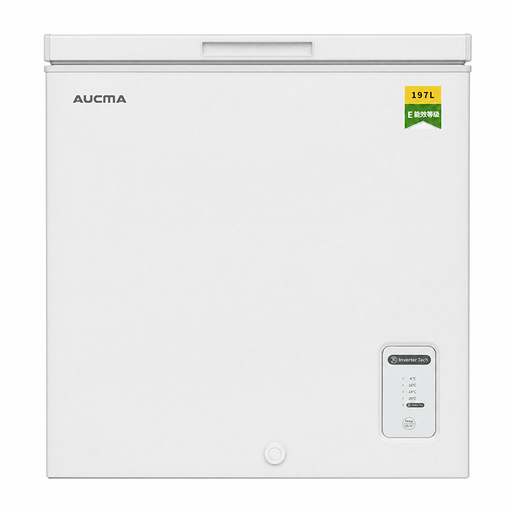 Image unavailable
AUCMA, 197 L convertible chest freezer
Worth considering if you prefer open storage space and have room for a chest freezer. Also think about how easy it will be to reach food at the bottom.
The product name lists fridge or freezer modes, five-level digital controls, a removable basket, a defrost drain and energy rating E. Before installing it in an outbuilding, check the ambient temperature range and power-cut storage time.
View on Joybuy
 Image unavailable
TCL CF182EWE0FR, 140 L chest freezer
Worth considering to add to your storage if 140 L is right for the extra food you want to keep, and you have enough space to open the lid.
The product name lists a storage basket, counterbalanced lid, temperature control and energy rating E. Allow for manual defrosting, and check the climate class and power-cut storage time for your chosen location.
View on Joybuy
 Image unavailable
CHiQ JR99DWE, 99 L chest freezer
This chest freezer is better suited to providing a little extra space than storing large amounts for a big household. Compare its 99 L capacity with the size of your usual bulk purchases.
The product name lists a removable basket, adjustable thermostat and energy rating E. Allow for manual defrosting, and check the ambient temperature range and power-cut storage time.
View on Joybuy
 Image unavailable
COMFEE' RCU60WH2(E), 60 L upright freezer
Only worth considering for a small amount of well-organised extra storage: 60 L may not be enough for bulk purchases or large items.
The product name lists three drawers, a reversible door, freestanding installation and energy rating E. If you plan to put it under a worktop, check its dimensions and required clearances, along with its climate class and power-cut storage time.
View on Joybuy
Frequently asked questions
Can you put a freezer in a garage or cellar?
Yes, as long as the model’s recommended ambient temperature range covers the temperatures the room actually reaches. As a guide, Beko France states 10 to 32 °C for climate class SN and 10 to 43 °C for SN-T. Check models advertised for lower temperatures individually.
How should you compare storage time during a power cut?
Compare figures measured under similar conditions, rather than looking at the times alone. In its test procedure, UFC-Que Choisir measures how long it takes for food to warm from −17 °C to −9 °C without power. Check the basis used for each stated figure.
What should you look for on a freezer’s energy label?
Look at annual energy consumption, freezer capacity and noise information, as well as the energy rating. The European Commission presents these details as useful for comparing appliances. First, make sure the models meet the same storage needs and are suitable for their intended locations.
Do you need No Frost in a spare freezer?
No, it isn’t essential for a small amount of extra storage. It’s worth considering if you want to reduce frost build-up and manual defrosting. Check that the feature is listed for the specific model rather than assuming it comes with a particular brand or style.


