What should you check before choosing?
First decide whether you need extra freezer storage or want to replace your fridge-freezer. Then compare the capacity you want with how you access your food and the space available.
Chest freezer
Consider it: for extra storage for bulky items or food bought in bulk.
Bear in mind: it takes up floor space and opens from the top, so food can be harder to find at the bottom.
Upright freezer
Consider it: for extra storage you’ll access frequently, with food organised in compartments.
Bear in mind: the door and drawers need clearance in front.
Large fridge-freezer
Consider it: if you’re replacing your main appliance and want refrigeration and freezing in one unit.
Bear in mind: the appliance’s total capacity isn’t the same as its freezer capacity. Check that the freezer section is large enough before deciding against a separate freezer.
| Consideration |
What to check |
What consumers say |
| Storage capacity |
Compare the usable capacity with the amount of food you usually store, and check there’s room for larger packs. |
If bulk buys and large batches of food quickly fill my current freezer, I mainly want more storage space. Around 33% of consumers would make this their top priority. |
| Access to food |
Check the layout of the drawers, compartments or baskets, and how easy it is to reach items stored at the bottom. |
If I open the freezer often, I want to find what I need without moving everything else. Around 33% of consumers would put organisation first. |
| Where you’ll put it |
Measure the appliance and the space needed to open it; check the required clearances and the permitted ambient temperature in the manual. |
If the room is small or unheated, I need to be able to install and open the appliance as specified for that model. Around 17% of consumers would prioritise this over other considerations. |
| Use and power cuts |
Check the stated energy consumption, noise level and storage time during a power cut for the exact model. |
If it’s near a living space, or I’m concerned about power cuts, I want to balance energy use, noise and storage time. Around 17% of consumers would make this their top priority. |
Freezers for extra storage
These Joybuy models include chest and upright freezers designed to give your household extra storage. Their stated capacities range from 95 to 161 L: compare them with the amount of food you want to store, particularly if you’re looking for a large family freezer.
 Image unavailable
CHiQ JR99DWE chest freezer, 99 L
Worth considering for a little extra storage rather than large family-sized quantities.
Features listed include a removable basket, sliding lid and E energy rating. Check the manual for the space needed to open the lid, installation requirements and storage time in the event of a power cut.
View on Joybuy
 Image unavailable
Heinrich´s upright freezer, 161 L, No Frost
Worth considering if you want to access your extra freezer storage frequently and organise food in drawers.
Features listed include No Frost and a C energy rating. Measure the clearance in front of the door, and check the dimensions and storage time for this model.
View on Joybuy
 Image unavailable
AUCMA convertible chest freezer, 95 L
This compact chest freezer is suited to a little extra storage; compare its 95 L capacity with the amount of food your household needs to store.
Features listed include switchable fridge and freezer modes, a removable basket and an E energy rating. Check the permitted ambient temperature before installing it in a cold room.
View on Joybuy
 Image unavailable
TCL CF182EWE0FR chest freezer, 140 L
Worth comparing if you’re looking for a separate, moderately sized freezer with a basket to keep frequently used items within easy reach.
Features listed include a counterbalanced lid, adjustable thermostat and E energy rating. Measure the space and check the storage time for this model before choosing.
View on Joybuy
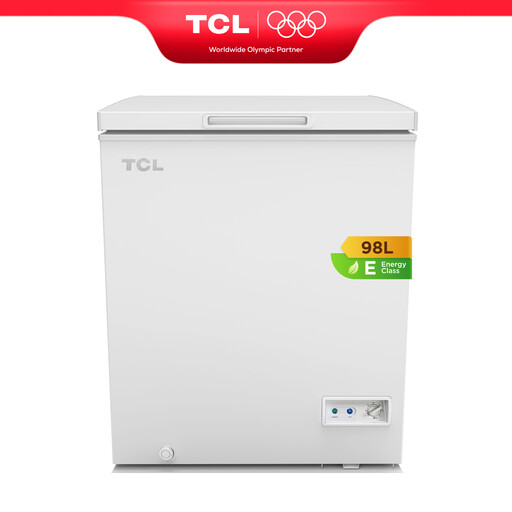 Image unavailable
TCL CF126EWE0FR chest freezer, 98 L
Worth considering as a small additional freezer rather than for storing large family-sized quantities.
Features listed include a storage basket, adjustable thermostat and E energy rating. Check the dimensions, lid clearance and installation requirements for this model.
View on Joybuy
Frequently asked questions
Is a chest or upright freezer better for family food supplies?
A chest freezer is a better choice if you prioritise a large storage compartment for bulky purchases and have space to open it from the top. An upright freezer makes it easier to organise food and access it from the front, especially if you open it often. UFC-Que Choisir distinguishes between the two types, but you’ll still need to compare usable capacity and layout model by model.
How can I check whether a freezer will open in my home?
Measure the height, width and depth of the model you’ve chosen, as well as the delivery route and the clearance needed to open its door or lid. For an upright freezer, allow enough room to pull out the drawers too, and follow the ventilation clearance guidance in the manual.
Can I install a freezer in an unheated garage?
Yes, but only if the model’s stated ambient temperature range covers the conditions in the room and you can follow its installation instructions. Features listed by Whirlpool or Liebherr for certain appliances don’t guarantee that other models are suitable.
How do I compare storage time during a power cut?
Compare the published storage time for each model and check how it’s measured. UFC-Que Choisir’s test measures how long it takes for the temperature to rise from −17 °C to −9 °C with the power off. A figure for another model shouldn’t be taken as a guarantee for the one you’re considering.
What should I look for on a freezer’s energy label?
Check the energy rating and consumption information for the exact model, then consider capacity and noise level separately in light of how you’ll use it. Your Europe describes the energy label as a way to compare the energy consumption of the appliances it covers; it doesn’t replace checking capacity or whether the appliance will fit your space.


