Which format suits each household?
The amount of storage you need isn’t the only factor: how often you access your food and how much space you have also matter.
Households that prepare meals in advance
If you store portions that you’ll want to find regularly, consider the layout of the compartments and how the drawers open. An upright freezer can make it easier to organise food by category, as long as you can still open its drawers once the appliance is in place.
Households that buy frozen food in bulk
For bulk buys or bulky food, compare the usable capacity with the amount you expect to store. A chest freezer offers open storage, but you’ll also need to think about how to reach food at the bottom.
Households with limited space
Whether it’s going in a kitchen, under a worktop, in a pantry or in a garage, measure the access route and the space needed to open the door or lid. If the room is unheated, also check that the ambient temperature range stated in the manual covers the temperatures in that space.
What should you check before choosing?
Start with what you need to store and how you’ll access it, then check the installation requirements and features of the model you’re considering.
| Criteria |
What to check |
For my needs |
| Format and access |
Compare the open space in a chest freezer with the drawers in an upright model. Check access to the bottom, how the drawers open and how much room the baskets take up. |
I want to find portions easily when I take them out each week; if I mainly store bulky items, open space may suit me better. |
| Usable capacity |
Compare the usable capacity in litres with what you realistically plan to store. For a table-top model or a fridge freezer, check the capacity of the freezer compartment, not just the appliance’s total capacity. |
A few portions for occasional use won’t need as much space as prepared meals and regular bulk shopping. |
| Installation |
Measure access routes, floor space and the clearance needed for the door or lid. Check the manual for ventilation requirements and the permitted ambient temperature range. |
If my freezer is going in an unheated garage or pantry, I need to make sure the model is suitable for the temperatures in that room. |
| Energy use and noise |
Check the energy rating, kWh/year, usable capacity and noise level. Compare appliances with similar formats and capacities; the European Commission’s EPREL database lets you view public information about the models listed. |
I want to check the energy use of an appliance that will stay plugged in all the time, rather than judging its energy consumption by the rating letter alone. |
| Power cuts |
Look for the stated storage time during a power cut and check how it’s defined in the product information or manual. Que Choisir’s test protocol includes measuring how long food takes to rise from −17 °C to −9 °C without power. |
As I’ll be storing prepared meals, I want to know this duration before choosing and be able to identify which food to check after a power cut. |
Freezers available on Joybuy
These options include an upright freezer for organising portions and chest freezers in a range of capacities to add extra freezer space at home. Compare the format with what you plan to store, then check the installation requirements for each model.
 Image unavailable
Heinrich´s, 161 L No Frost upright freezer, C rated
An upright freezer is a good fit if you want to organise portions in separate compartments. The model name lists three freezer drawers, an alarm, a reversible door and a stated temperature range of −14 °C to −22 °C. Check the dimensions, ambient temperature range and storage time during a power cut to make sure it suits your installation.
View on Joybuy
 Image unavailable
AUCMA, 291 L convertible chest freezer, E rated
This 291 L chest freezer could suit your bulk storage needs if you have enough floor space and plan how you’ll reach food at the bottom. The product title says it can switch between freezer and fridge modes, and mentions a removable basket and five-level digital control. Check the ambient temperature range and storage time before installing it in a garage or cellar.
View on Joybuy
 Image unavailable
CHiQ JR99DWE, 99 L chest freezer, E rated
At 99 L, this chest freezer is better suited to extra storage than regular, large bulk shops. The product title mentions a removable metal basket, sliding lid and four-star rating. Think about how you’ll organise food under the basket, and check the model’s annual energy consumption, climate class and storage time during a power cut.
View on Joybuy
 Image unavailable
TCL CF182EWE0FR, 140 L chest freezer, E rated
This 140 L chest freezer offers a mid-sized capacity to compare with the amount of food and shopping you plan to store. The product title mentions a basket, a counterbalanced lid and temperature control. Check the clearance needed to open the lid, as well as the annual energy consumption, climate class and storage time during a power cut.
View on Joybuy
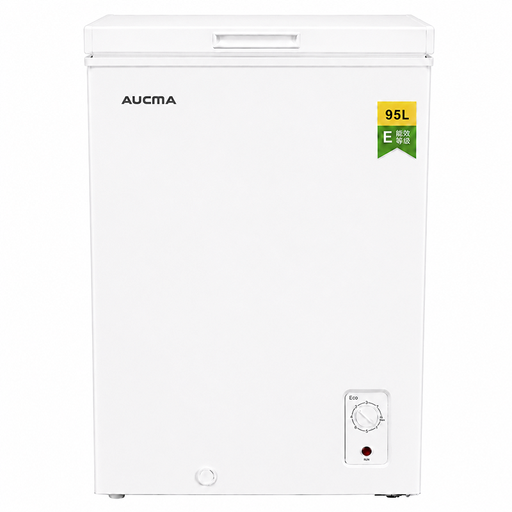 Image unavailable
AUCMA, 95 L convertible chest freezer, E rated
This 95 L chest freezer is worth considering for extra storage rather than large, regular shops. The product title says it can switch between fridge and freezer modes, and lists a seven-level thermostat and removable basket. Check that its capacity, climate class and storage time are right for the intended use and location.
View on Joybuy
Frequently asked questions
Chest or upright freezer: which should you choose for prepared meals?
An upright freezer makes it easier to organise portions in drawers and access them regularly; a chest freezer offers open space for bulkier items. In either case, compare the usable capacity with what you plan to store, and check that you’ll be able to open the appliance and reach its contents where you intend to put it.
Can you put a freezer in an unheated garage?
Yes, if the permitted ambient temperature range for the model covers the temperatures in your garage. Que Choisir warns that below the manufacturer’s stated minimum, cooling can slow down and food may defrost. Check the manual and the temperatures in the room before installation.
What should you compare on the energy label?
Check the A to G rating, energy consumption in kWh/year, usable capacity and noise level, comparing models with similar formats and capacities. The European Commission’s EPREL database lets you view public information about the models listed; the rating letter alone is no substitute for comparing kWh/year.
How can you compare storage time during a power cut?
Look for the stated duration in the product information or manual, then check which temperatures and test protocol it refers to. Que Choisir measures the time it takes for the temperature to rise from −17 °C to −9 °C without power as part of its own test protocol. Don’t confuse this with a duration measured in a different way.
Can you refreeze meals after they’ve defrosted?
No. Anses advises against refreezing defrosted food and recommends eating it promptly. After a power cut, identify the portions affected rather than relying only on the appliance’s stated storage time.


