Keep a fridge freezer if its freezer compartment covers your usual rotation of portions; choose a dedicated appliance when that compartment is regularly full. An upright freezer makes drawer storage easier, while a chest freezer prioritises reserve capacity, and a compact model is mainly suitable as an extra: also check the dimensions, opening clearance, usable capacity, energy label and ability to maintain -18 °C.
Who could benefit from extra freezer space?
People who prepare several portions in advance
You cook in batches and want to store labelled portions for several days or weeks. The key question is whether your current compartment is regularly full and whether easily accessible drawers would be more convenient than deep storage.
Households buying lots of frozen food or family-sized packs
You are mainly looking for extra capacity for bulk purchases and bulky foods. A chest or dedicated upright freezer may be more suitable than a fridge freezer, provided you have enough floor space and the required clearance for opening.
People with limited space but an occasional need for extra capacity
You have a functional fridge freezer but occasionally run out of room for prepared meals or a few frozen items. A compact freezer for occasional extra storage may be enough if its capacity and dimensions genuinely meet your needs.
Priorities when choosing the right format
Start by estimating how much food you really want to store, then check everyday accessibility and installation requirements before comparing models.
| Priority |
What to check |
Your needs |
| Maintaining the cold |
Check that the temperature setting can maintain -18 °C or below, as well as the temperature alarm and stated storage time in the event of a power cut if you are storing a large quantity of food. |
I want to store prepared meals in suitable conditions. According to Anses, at -18 °C freezing stops microbial growth, although it does not necessarily destroy most germs. |
| Capacity and access |
Compare usable capacity in litres, the number of drawers or baskets, and access to the bottom of the storage area. A chest freezer requires layered storage, while an upright freezer makes it easier to organise portions. |
My portions need to remain visible and easy to find, or I primarily want a large reserve for bulky purchases. |
| Continuous consumption |
Compare the energy label, declared annual consumption in kWh/year, capacity and format among appliances intended for the same use. |
I want to assess the appliance over time, as ADEME points out that fridges and freezers run continuously. |
| Real-world installation |
Measure the height, width, depth, delivery route and opening clearance. Check the manual for ventilation requirements and the permitted ambient temperature. |
The appliance must fit in my home and be usable without obstructing a door, lid or movement around the room. |
Mistakes to avoid before buying
-
Choosing a large chest freezer without planning access to the bottom
A chest freezer can offer plenty of space, but older portions become harder to find when they are stored beneath more recently purchased items. Its top-opening lid also requires clear space above it.
Measure the width, depth, available height and delivery route. If you will be removing portions several times a week, plan to use baskets, labelled containers or an upright freezer with drawers.
-
Confusing freezing at -18 °C with eliminating microbiological risks
According to Anses, freezing at -18 °C stops microbial growth, but most germs survive freezing. The appliance therefore does not replace hygienic preparation and handling.
Choose a model that can maintain -18 °C, use suitable containers and organise your supplies to avoid forgetting food at the bottom.
-
Comparing energy classes alone
A freezer runs continuously, but two appliances with different capacities and formats will not meet the same needs. The class letter alone is not enough to compare their declared consumption.
At a minimum, compare usable capacity, declared annual consumption, noise level, dimensions and maintenance features between models intended for the same use.
-
Installing the appliance in a cold room without checking the permitted temperature
A garage or outbuilding may fall outside the temperature range specified for certain appliances. A stated low-temperature rating remains a characteristic of the particular model concerned.
Check the manual and the climate class of the exact model, then compare them with the temperatures recorded in the installation room.
Brand guide for comparing formats
Bosch
In the French market, Bosch offers upright and integrated freezers, as well as fridge freezers. The brand may be worth considering if you are planning to replace your entire refrigeration setup rather than add a dedicated appliance.
- Depending on the model, Bosch product pages provide details of dimensions, capacity, noise level, energy class, No Frost functions, alarms and removable drawers.
- These are manufacturer specifications that must be checked for the model you choose; they do not support any general conclusion that the brand is superior.
Liebherr
Liebherr lets you compare very different formats, from compact freezers to large-capacity uprights and chest freezers designed for household storage.
- The models cited by the manufacturer include capacities of 75 l, 277 l and 359 l, with dimensions and noise levels specific to each reference.
- NoFrost, SmartFrost and FrostProtect functions vary by model. Claims about frost, opening or consumption should be read in the conditions specified by the manufacturer.
Beko
Beko is a brand worth considering for chest freezers and the frost-reduction, alarm or fast-freezing functions available on certain models in France.
- The Beko CF200EWN offers 198 l, energy class E, declared consumption of 199,94 kWh/year, 36 hours of storage time and temperature warning indicators.
- These figures relate to this specific model: capacity, consumption and functions may vary from one Beko freezer to another.
Joybuy products for preparing and storing meals
These Joybuy options include an upright freezer, a chest freezer, a compact model for extra storage and fridge freezers, helping you match freezer capacity to the amount of food you prepare and the space available.
 Image unavailable
Heinrich´s 161 L No Frost upright freezer
Worth considering if your fridge freezer compartment is no longer large enough and you want drawer storage for prepared portions.
161 L, three drawers, two shelves, LED display, alarm, reversible door hinge and a stated temperature range of -14 °C to -22 °C.
Check the dimensions, door clearance, climate class and annual consumption before installation. The Fast Freeze function then returns to its initial setting.
Joybuy
 Image unavailable
CHiQ JR263LGE 262 L fridge freezer
This fridge freezer may suit you if you are also replacing your fridge and 75 L of freezer space covers your usual rotation of portions.
75 L freezer compartment with three drawers, stated consumption of 215 kWh/year, class E, Low Frost, dimensions of 1760 × 540 × 550 mm and a stated ambient temperature range of 16 to 38 °C.
It is not suitable for a room where the temperature may fall below 16 °C. If prepared meals regularly fill the 75 L compartment, a dedicated appliance would be more suitable.
Joybuy
 Image unavailable
COMFEE' RCU60WH2(E) 60 L upright freezer
This compact format provides extra storage for a few portions or frozen products, rather than substantial family-sized storage.
60 L, 4-star freezing down to -24 °C, three storage zones, reversible door, adjustable feet and dimensions of 44,5 × 47,5 × 84,5 cm.
Check the annual consumption, climate class, noise level and ventilation clearances for the room where you plan to install it.
Joybuy
 Image unavailable
CHiQ JR99DWE 99 L chest freezer
Consider it for creating dedicated storage for prepared meals or bulky food, provided you have enough floor space and top access to the chest.
99 L, 4-star freezing at -18 °C or below, removable basket, sliding lid, castors, adjustable thermostat and dimensions of 54,5 × 47,6 × 83,5 cm.
Deep storage is less convenient when you need to remove small portions very frequently. Check the manual for the climate class and required clearances.
Joybuy
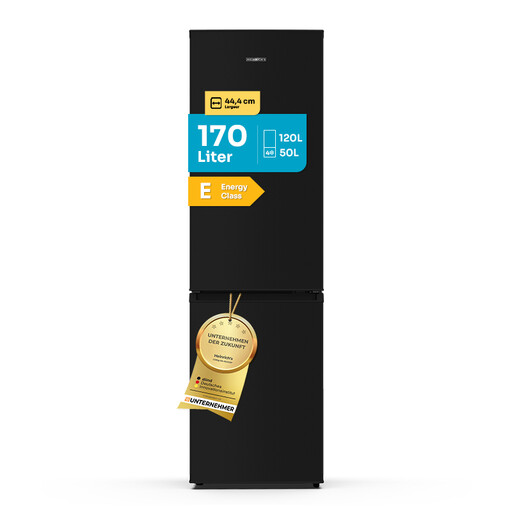 Image unavailable
Heinrich´s 170 L fridge freezer
This fridge freezer combines fresh and frozen storage in one appliance when your freezer needs are modest.
120 L fridge capacity, 50 L freezer capacity, 4-star compartment at ≤ -18 °C, three freezer drawers, removable shelves, LED lighting and a stated noise level of 40 dB.
The 50 L capacity may be limiting for large batches of meals or bulky family-sized purchases. Check the dimensions, annual consumption and climate class before choosing where to install it.
Joybuy
Frequently asked questions
Does a freezer set to -18 °C make food sterile?
No. Anses states that domestic freezing at -18 °C stops microbial growth, but most germs survive freezing. You must also follow hygiene rules when preparing and storing food.
Can I install a freezer in a garage or outbuilding?
Yes, but only if the manual or product specifications confirm that it can operate within the minimum and maximum temperatures of that room. This capability is not universal: the Liebherr FNd 522i, for example, states that it has components designed to operate down to -15 °C, but this indication cannot be applied to other models.
Which energy figures should I compare before buying?
Compare the energy label and EU product information sheet for the exact model, then consider declared annual consumption, usable capacity, noise level and format together. Do not choose based solely on the class letter when the capacities or intended uses being compared are different.
Which figures are useful in the event of a power cut?
Check the cold-storage time stated in the product information. UFC-Que Choisir assesses, among other things, how long it takes for the temperature to rise from -17 °C to -9 °C without power, showing that storage time is a separate criterion from capacity or energy class.


