If you want to grab a prepared portion regularly, choose an upright freezer with drawers. For storing batches and large containers, consider a chest freezer instead. A compact freezer can provide extra capacity when space is tight, while a built-in model needs a suitably sized housing unit. Whatever type you choose, check the usable capacity against your containers, the clearance required and the model’s climate class for the room where you plan to put it.
Who is each type best suited to?
People who take out a portion every day
If you prepare several meals to take out individually, check how the drawers are arranged and whether you can remove each container without moving everything else. Que Choisir also recommends checking that the drawers are easy to use in the space where you plan to put the freezer.
Households that freeze food bought in bulk
For large dishes or food reserves, compare the net capacity and the shape of the interior, not just the advertised litres. In a pantry, cellar or garage, also check the temperatures the model can handle. A storage room is not automatically suitable for installing a freezer.
Households with limited kitchen space
A compact appliance can provide extra capacity, as long as you leave enough room to open the door, allow for ventilation and handle food. For a built-in model, measure the housing unit and check how the cabinet door is attached.
Which criteria will help you decide?
For meals prepared in advance, first think about how you’ll need to access your food. Then check that the type you’ve chosen suits your containers and the space available. Que Choisir highlights ease of use as well as capacity.
Under-counter freezer
Consider it: for extra compact capacity when the available space is beneath a worktop.
Bear in mind: its capacity is more limited for batch cooking; the Bosch GTV15NWEB under-counter model, for example, is listed at 83 L by Bosch.
Upright freezer
Consider it: if you regularly take out a particular portion and want to store it in a separate compartment.
Bear in mind: drawers keep food organised, but their dimensions may not accommodate very large containers. Que Choisir recommends trying them out.
Chest freezer
Consider it: for bulk shopping or large dishes, if you have enough floor space and room to open the lid.
Bear in mind: food at the bottom takes more organising to keep it accessible.
Built-in freezer
Consider it: if your kitchen already has a housing unit designed for an integrated freezer.
Bear in mind: the housing unit dimensions, ventilation and cabinet door fittings must match the instructions. A freestanding model is not automatically a suitable replacement.
| Criterion |
What to check |
Who is this important for? |
| Access to portions |
Drawer dimensions and ease of removal; space to open the door. |
If I take out a different container each day, I want to find it without moving the whole stock of food. Around 30% of consumers make easy access to portions a priority. |
| Usable capacity |
Net capacity and internal dimensions, compared with your largest containers. |
For freezing family meals and bulk buys, what matters most to me is being able to fit my containers in and reach them easily. Capacity is the top criterion for around 30% of consumers. |
| Location |
Clearance, ventilation and climate class in relation to the room’s actual temperatures; noise level if it’s near a living area. |
If the only available space is in a small kitchen or a room that isn’t kept at a steady temperature, I first need to know whether the appliance can be installed there. Around 20% of consumers prioritise this compatibility. |
| Maintenance and energy use |
Cooling type, defrosting instructions and annual consumption in kWh on the energy label. |
I’d prefer to minimise defrosting while comparing the electricity used by an appliance that stays plugged in all the time. This combination comes first for around 20% of consumers. |
What pitfalls should you avoid before buying?
-
Choosing a chest freezer based on capacity alone
Its open interior can accommodate bulky containers, but stacked portions can be difficult to find.
Check the internal depth and the clearance needed for the lid. If you open the freezer often, plan to organise it with baskets or bins.
-
Assuming every model is suitable for a garage
According to Liebherr and Whirlpool, a climate class specifies the ambient temperature range an appliance is designed for. A cellar, conservatory or garage may fall outside that range.
Note the room’s minimum and maximum temperatures, then compare them with the specifications for the exact model before choosing where to put it.
-
Assuming No Frost means low energy use
The cooling type tells you about frost and maintenance, but not how much electricity the appliance uses. ADEME reminds us that a freezer runs continuously.
Compare the annual consumption in kWh and the energy labels of appliances with a similar type and capacity. Check their defrosting instructions separately.
-
Measuring the appliance without allowing room to open it
A door, lid or drawer may not have enough clearance even if the freezer fits in the space you measured. Noise is also worth considering near a living area.
Check the appliance dimensions, access routes, clearances specified in the instructions and the model’s stated noise level.
Brands to compare when choosing a model
Bosch
Its under-counter and upright models let you compare compact storage with drawers and features in larger appliances.
- Bosch lists the under-counter GTV15NWEB as having a usable capacity of 83 L; the GSN29EWEV is an upright model with No Frost.
- Capacity and cooling type vary between these models, so check the details for the one you’re considering.
Beko
A brand to look at for chest and upright models, especially if frost and the location will influence your choice.
- Beko describes the CF200EWN chest freezer as featuring MinFrost, which is designed to reduce frost build-up.
- Que Choisir notes that a different Beko upright model, the BRFNE214M23WN, is suitable for installation in an unheated garage. This does not mean the CF200EWN is suitable too.
Whirlpool
Its upright models offer useful points of comparison for capacity and drawer layout.
- Whirlpool lists the WHFF6403W4E upright freezer as having a capacity of 404 L and No Frost.
- For a cellar or garage, Whirlpool recommends checking the climate class of the specific appliance rather than relying on its type alone.
Electrolux
A brand to consider if your kitchen has a housing unit for a built-in freezer.
- According to Electrolux, the built-in EUN7NE18S model has a capacity of 212 L and a noise level of 35 dB.
- Before considering installation, check the instructions for the housing unit, ventilation and cabinet door fitting requirements.
Liebherr
The brand’s guidance on climate classes can help you assess whether a room that isn’t kept at a steady temperature is suitable for installation.
- Liebherr specifies, for example, the ambient temperature ranges for SN, from +10 °C to +32 °C, and N, from +16 °C to +32 °C.
- These ranges describe climate classes; they don’t mean every Liebherr freezer is suitable for a particular garage.
Freezers for portions and batch storage
These chest and upright freezers let you compare two ways of storing prepared meals: setting aside space for batches or separating portions into compartments. Compare their dimensions and installation requirements before choosing a model for your room.
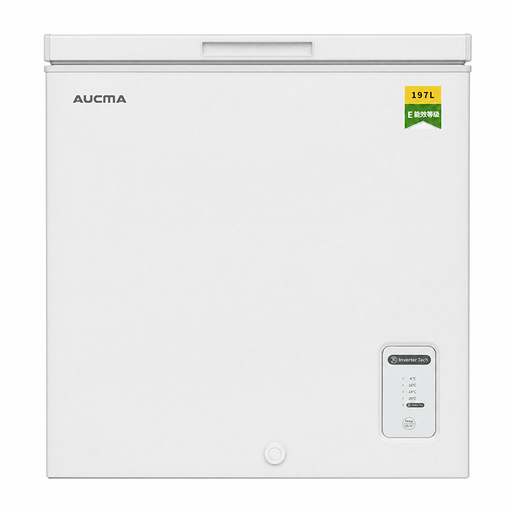 Image unavailable
AUCMA, convertible chest freezer, 197 L
Consider this if you want a dedicated space for portions or bulk buys, and don’t mind reaching for food stored at the bottom.
The product title lists a removable basket, five-level digital control, a defrost drain and an E energy rating. You can switch between fridge and freezer modes. Check the defrosting instructions and the ambient temperature range the appliance can handle in your room.
View on Joybuy
 Image unavailable
AUCMA, convertible chest freezer, 291 L
This chest freezer could suit batches or large dishes, as long as you have enough floor space, room to open the lid and easy access to the bottom.
The product title lists a removable basket, LED lighting, five-level digital control, a defrost drain and an E energy rating. You can switch the appliance from freezer to fridge mode. Check its climate class and maintenance instructions for the way you plan to use it.
View on Joybuy
 Image unavailable
Heinrich´s, upright freezer, 161 L, No Frost, stainless steel
The drawers provide separate spaces to consider if you want to find prepared portions regularly.
The product title lists a No Frost function, a reversible door and a C energy rating. Measure the space and check door clearance and climate class before buying.
View on Joybuy
 Image unavailable
CHiQ JR99DWE, chest freezer, 99 L
This compact chest freezer is worth considering for extra storage rather than lots of large containers. Leave enough room to open the lid.
The product title lists a removable metal basket and an E energy rating. It needs to be defrosted manually, so factor in this maintenance and check the climate class for your intended location.
View on Joybuy
 Image unavailable
COMFEE' RCU60WH2(E), upright freezer, 60 L
For a small amount of extra capacity, its compartments let you separate portions. However, 60 L may limit how much you can prepare in large batches.
The product title lists three drawers, a reversible door and an E energy rating. Check the dimensions, door clearance and installation requirements if you’re thinking of placing it under a worktop.
View on Joybuy
Frequently asked questions
Can I put a freezer in a garage or cellar?
Yes, if the room’s temperature stays within the range permitted for the model you choose. Whirlpool and Liebherr refer to its climate class. For example, Liebherr gives a range of +10 °C to +32 °C for climate class SN and +16 °C to +32 °C for class N. Measure the temperature in your room rather than assuming an unheated garage will be suitable.
Does a No Frost freezer need no maintenance at all?
No. No Frost mainly relates to frost build-up and manual defrosting; cleaning and any other checks specified in the instructions are still necessary. If you’re considering an appliance without this feature, check the defrosting instructions before you buy.
How do I compare the energy use of two freezers?
Compare the kWh per year shown on their energy labels, taking into account each appliance’s type and capacity. ADEME reminds us that a freezer runs continuously; the figure shown for a model does not, on its own, predict how much energy it will use in your home.
What should I do with my old freezer when replacing it in France?
Ask the retailer to take it back when you buy a new appliance of the same type. The FAQ published by the Ministry for Ecological Transition in 2023 describes this as a « one-for-one » take-back scheme. Check the practical arrangements when you place your order.


