The freezer compartment in a fridge freezer may be enough if your portions and frozen food fit without making everything difficult to organise, and you regularly use up and replenish your stock. If your batch cooking or shopping often fills the compartment, a separate freezer could be a better fit: choose an upright model for easy access to portions, a chest freezer for bulky items, or an under-counter model if space is limited. Compare usable capacity, and check the appliance’s dimensions and the ambient temperature range it is designed for, as recommended by UFC-Que Choisir and ADEME.
Who this choice is for
Households that often batch-cook portions
If you regularly freeze meals in small portions, being able to find each container without moving everything else can matter just as much as capacity. Drawers and well-designed bins can make it easier to keep things organised, depending on the model.
Households that keep a large stock of food
For bulk buys or large packs, start with the usable capacity you need and the space available. UFC-Que Choisir highlights, among other differences, how upright and chest freezers store food and make it accessible.
Households with limited space
A narrow kitchen, an appliance housing unit or awkward access can limit your options before you even compare capacities. Measure the appliance, its intended space and the route to it. If it will be in a cold room, also check the ambient temperature range it is designed for.
The criteria that make a difference
Start by noticing when the fridge freezer’s compartment becomes too full, then compare the different styles based on how you access your food and the space you have. The total capacity of a fridge freezer is not the same as the usable capacity of its freezer compartment.
| Criterion |
What to check |
Best suited to |
| Extra storage capacity |
Compare the usable freezer capacity in litres with the largest amount of food you need to store, rather than the total capacity of your fridge freezer. |
After batch cooking or a bulk shop, I want to put food away without filling up the existing compartment; around 37% of consumers would prioritise this extra storage. |
| Access to portions |
Look at the drawers, removable baskets and how easy it is to reach items at the bottom of a chest freezer. |
When I often need a particular portion, I want to find it without moving other packs. Around 27% of consumers would put this ease of organisation first. |
| Where it will go |
Measure the appliance, the access route and, where relevant, the housing unit. Check the manual for the permitted ambient temperature range. |
If my kitchen is narrow or the freezer needs to go in a cold room, the first priority is finding a model that can be installed there in the intended conditions; around 27% of consumers would make this compatibility their priority. |
| Ongoing use and maintenance |
Compare energy consumption in kWh/year across similar sizes, and understand the difference between No Frost, LowFrost and manual defrosting. |
Because an appliance runs all the time, I look at electricity use and defrosting before increasing my storage; for around 9% of consumers, this would be their main concern. |
Mistakes to avoid
-
Choosing a chest freezer based on capacity alone
Its deep storage space is ideal for bulky items, but portions at the bottom are less convenient to reach day to day than food in the front of a drawer.
If you choose a chest freezer, organise food by category using baskets and a dated inventory. If you often take out small portions, compare the access offered by an upright model too.
-
Assuming any model will work in a garage
The room temperature must stay within the appliance’s specified operating conditions. If one model is suitable for a garage, that doesn’t mean every freezer from the same brand is.
Check the ambient temperature range in the manual for the exact model and compare it with the temperatures in the room you have in mind, as ADEME recommends.
-
Comparing only the energy label rating
Two freezers in the same class may have different capacities and be suited to different uses. The rating alone won’t tell you which one is right for your household.
Also check the kWh/year figure, freezer capacity, noise level and dimensions. Where possible, compare appliances of a similar size and capacity.
-
Waiting until the use-by date to freeze food
Freezing won’t fix a problem with how food has been stored beforehand. The French Ministry of the Economy advises that food must not be frozen once its use-by date has been reached or passed.
Plan ahead, label your portions and follow the food’s storage instructions.
Brands to consider by model
Bosch
The GSN58AWEV is an example of an upright model for storing a large supply across several compartments.
- Bosch lists a capacity of 366 L, No Frost and adjustable bins for this model.
- Its stated dimensions of 191 × 70 × 78 cm mean you’ll need to check the available space, access route and door clearance. These features don’t apply to every Bosch upright freezer.
Liebherr
The CFd 2505 Plus chest freezer may suit a household with enough floor space for a large amount of extra storage.
- Liebherr lists a capacity of 359 L and FrostProtect, which allows this model to operate at ambient temperatures down to −15 °C.
- Check the installation requirements for the CFd 2505 Plus and how easy it will be to reach food at the bottom of the compartment. FrostProtect is not a feature of every Liebherr freezer.
Samsung
The BRZ22600EWW/EF is worth considering for a fitted kitchen that needs an integrated freezer.
- Samsung lists a capacity of 218 L and No Frost for this model.
- Before choosing it, check the housing unit dimensions and the ventilation requirements in the manual.
Electrolux
The LUB3AE88S is an under-counter integrated freezer to consider as an addition to a fridge freezer, if its capacity suits your needs.
- Electrolux lists a capacity of 98 L and a required housing unit height of 880 mm for this model.
- Its LowFrost technology does not remove the need for manual defrosting. Also check whether 98 L is enough for your usual stock.
Freezers available on Joybuy
These models include compact upright freezers and chest freezers designed to add extra freezer storage. Choose according to how much you need to store, how you access your portions and where you plan to put the appliance. A compact chest freezer won’t necessarily meet the same needs as a large upright model.
 Image unavailable
Heinrich´s 161 L No Frost upright freezer, stainless steel
Worth considering if you want 161 L of dedicated storage for regularly separating portions and frozen food. The product title lists No Frost, a C energy rating, an alarm and a reversible door. Check the dimensions and specified ambient temperature range before choosing where to put it.
View on Joybuy
 Image unavailable
CHiQ JR99DWE 99 L chest freezer
This 99 L chest freezer is worth considering for extra storage if you’re happy to access food from the top. Its title mentions a removable basket, an adjustable thermostat and an E energy rating. Check the installation requirements and defrosting instructions for this model.
View on Joybuy
 Image unavailable
COMFEE’ RCU60WH2(E) 60 L upright freezer
With a stated capacity of 60 L, this model is better suited to a small amount of extra storage than to bulk shopping. The title lists a reversible door and an E energy rating. Check the exact interior layout before relying on its compartments to organise your portions.
View on Joybuy
 Image unavailable
TCL CF182EWE0FR 140 L chest freezer
Worth comparing if you’re looking for 140 L of chest freezer storage and have room for the lid to open upwards. The title mentions a storage basket, a counterbalanced lid and an E energy rating. If you plan to put it in an unheated room, check the permitted ambient temperature range.
View on Joybuy
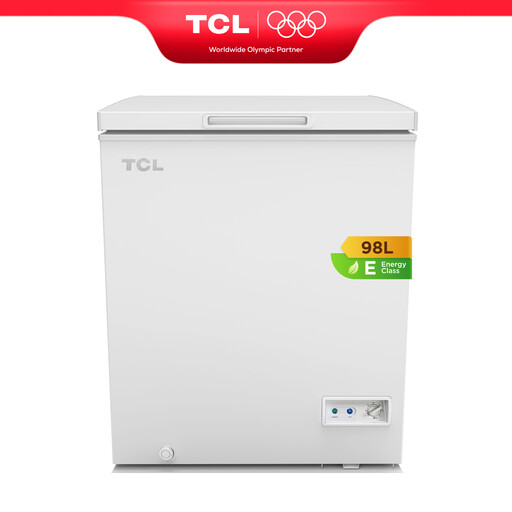 Image unavailable
TCL CF126EWE0FR 98 L chest freezer
This 98 L chest freezer is worth considering for a small amount of extra storage if you’re used to organising food in a deep compartment. The title lists a basket, an adjustable thermostat and an E energy rating. Measure the space and check the model’s ambient temperature range before buying.
View on Joybuy
Frequently asked questions
How do I know if my fridge freezer’s compartment is big enough?
It may be enough if it can hold your usual stock and you can keep everything organised. If batch cooking or bulk buys regularly fill it up, compare the usable freezer capacity of a separate appliance with your needs and the space available.
Can I put a freezer in an unheated garage?
Yes, but only if the garage’s ambient temperature stays within the operating conditions specified for the model you choose. Check the manual rather than assuming that all chest or upright freezers are suitable. For example, Liebherr states that FrostProtect allows the CFd 2505 Plus to operate at temperatures down to −15 °C, but this doesn’t apply to other models.
What should I compare on the energy label?
Compare the energy rating and annual consumption in kWh with the freezer capacity, ideally across similar formats. The European Commission states that domestic refrigeration appliances are covered by energy labelling. Noise level and capacity are also useful when comparing models for your space.
Do No Frost and LowFrost both mean you won’t need to defrost manually?
No. LowFrost does not mean you can avoid manual defrosting. Electrolux describes the LUB3AE88S as a LowFrost model that still needs to be defrosted manually. Check the technology and instructions for the specific model you’re considering.
Can I freeze food when its use-by date is approaching?
Plan to freeze it before that date rather than waiting until the last minute. The French Ministry of the Economy states that food must not be frozen once its use-by date has been reached or passed. Follow its storage instructions too.


