If you often open your freezer to find neatly organised food, consider an upright model with drawers. If bulk shopping means you mainly need more capacity and have floor space to spare, compare chest freezers. For a smaller stock of food in a limited space, look at undercounter models. Whatever the format, check the dimensions and the ambient temperature range allowed for the exact model, especially if it’s going in a garage or cellar.
Which format is right for you?
The right format depends as much on how you store and retrieve your shopping as it does on the capacity you need.
Households that buy in bulk
If you want to store more frozen food or batch-cooked meals, compare the usable capacity with the space available. A large chest freezer can hold plenty, but make sure its top-opening design and floor space requirements work for you.
People who regularly organise and check their food stocks
An upright freezer or a small model with compartments can make it easier to organise food by category and access what you need. Check the layout of the model you’re considering: the number and shape of the drawers matter just as much as the stated capacity.
Households planning to install a freezer in a room with little heating
The permitted ambient temperature depends on the specific model, not just its format. Liebherr states that its CFe 2080 Pure chest freezer is protected down to −15 °C, while Beko gives a minimum ambient temperature of 5 °C for the FSE1174N. Compare the stated range for the appliance you’re considering with the temperatures in the room.
What should you check before choosing?
Upright freezer
Consider it: if you want to open the appliance regularly and find your shopping in drawers or compartments.
Bear in mind: check the available height, and don’t assume an upright freezer will be suitable for a cold room.
Chest freezer
Consider it: if you prioritise bulk storage and are happy with a top-opening design.
Bear in mind: allow enough floor space and room to open the lid. Whether it’s suitable for a cold room depends on the specific model.
Undercounter or small upright freezer
Consider it: if a little extra storage is enough and the available space limits the size of the appliance.
Bear in mind: check that its capacity will cover your bulk shopping and that it can be installed in the space you have in mind.
Once you’ve chosen a format, compare specific models. Two appliances with the same design can differ in size, energy consumption and installation requirements.
| Criteria |
What to check |
Depending on your needs |
| Capacity and storage |
Compare the usable capacity in litres, then check the drawers, baskets or storage areas. Make sure the door- or top-opening design suits you. |
I buy in bulk, but I also want to be able to find the food I use regularly. |
| Space and opening clearance |
Measure the width, depth and height, as well as the clearance needed for the door or lid. Check the route to the installation spot too. |
Extra capacity won’t be any use if the appliance won’t fit in the room or I can’t open it easily. |
| Room temperature |
Check the climate class or ambient temperature range for the exact model. Compare it with the temperatures the room may reach in winter and summer. |
For a garage or cellar, I need a model suited to the conditions in the room, rather than relying on the word ‘chest’ alone. |
| Energy and noise |
The European energy label shows the A to G rating, annual consumption in kWh, capacity and noise level, among other details. Ideally, compare appliances with a similar capacity. |
If the freezer is close to a living area, I’ll check its noise level as well as its energy rating. |
| Frost and maintenance |
Check the cooling system and defrosting instructions for the model. A feature designed to reduce frost doesn’t necessarily mean that manual defrosting won’t be needed. |
I’d rather know what maintenance is required before choosing an appliance I’ll open regularly. |
| Power cuts and freezing capacity |
If these features matter to you, compare the stated power-cut safe storage time and freezing capacity in kg/24 h in the product specifications. |
When I add a lot of food to freeze, I want to compare the stated figures for each appliance rather than estimate them from its capacity. |
Which pitfalls should you avoid?
-
Assuming every chest freezer is suitable for a cold garage
The permitted ambient temperature depends on the model. Liebherr states that FrostProtect works down to −15 °C for the CFe 2080 Pure, while Beko gives a minimum of 5 °C for its FSE1174N undercounter freezer. These figures don’t apply to every appliance of the same format.
Check the temperatures the room may reach and compare them with the range stated for the model you’re planning to buy.
-
Choosing based only on the stated capacity
A chest freezer needs floor space and opens from the top; an upright freezer takes up more height. Capacity also doesn’t tell you how easy it will be to access your food.
Measure the space, delivery route and clearance for the door or lid, then check the internal layout.
-
Focusing only on the energy label rating
The European Commission says that the label for household fridges and freezers also shows energy consumption, storage capacity and noise. The rating alone therefore doesn’t cover all the details that can help you choose.
For appliances with a similar capacity, compare the rating, kWh per year, capacity and noise level together. Check the power-cut safe storage time separately if it matters to you.
-
Confusing reduced frost with no defrosting
Bosch states that the GSN36CWEP has No Frost. Liebherr describes SmartFrost and StopFrost on the CFe 2080 Pure as features that help reduce frost, but doesn’t class it as a No Frost model.
Read the care instructions for the exact model before choosing an appliance if avoiding manual defrosting is important to you.
Three models from well-known brands
These models illustrate different formats and usage requirements. Their features don’t apply to every appliance made by each brand.
Bosch
The GSN36CWEP is an example of a freestanding upright freezer for organising extra food stocks.
- Bosch states that this model has a usable capacity of 242 l, a width of 60 cm and No Frost.
- If you’re installing it in a room with little heating, check the permitted ambient temperature range for this model.
Liebherr
The CFe 2080 Pure shows why a chest freezer may be a good choice when capacity and room conditions matter.
- For this specific model, Liebherr states a capacity of 353 l and FrostProtect down to −15 °C.
- At 125 × 71 cm in width and depth, it needs plenty of floor space and clearance for the lid.
Beko
The FSE1174N is a freestanding undercounter freezer worth considering for extra capacity in a limited space.
- Beko states that it has a net capacity of 95 l, a width of 54 cm and transparent drawers.
- The stated minimum operating ambient temperature for this model is 5 °C. Check this if the room may get cold.
Freezers available on Joybuy
This selection includes upright and small undercounter models, as well as chest freezers, to give you extra freezing capacity. Compare their capacity with your usual shopping, then check the dimensions and installation requirements for each model.
 Image unavailable
Heinrich´s, 161 L No Frost upright freezer, stainless steel
Worth considering if you want extra upright storage with drawers to organise your shopping. The product name states a capacity of 161 L, No Frost, a reversible hinged door and a C energy rating. Check the dimensions and the permitted ambient temperature range for your chosen location.
View on Joybuy
 Image unavailable
TCL CF182EWE0FR, 140 L chest freezer
This chest freezer could complement your fridge-freezer if 140 L meets your needs and a top-opening design works for you. Its description mentions a storage basket, a counterbalanced lid and an E energy rating. Check the permitted ambient temperature range before considering a cellar or garage.
View on Joybuy
 Image unavailable
COMFEE' RCU60WH2(E), 60 L upright freezer
With a stated capacity of 60 L, this model is better suited to providing a little extra storage than to holding large bulk shops. Its name mentions three drawers, a reversible door and an E energy rating. If you’re thinking of placing it under a worktop, check the required space and ventilation, as well as the permitted ambient temperature.
View on Joybuy
 Image unavailable
CHiQ JR99DWE, 99 L chest freezer
This chest freezer has a stated capacity of 99 L, making it worth considering for a modest amount of extra storage. It has a removable basket and an adjustable thermostat; the product description says it needs manual defrosting when frost exceeds 5 mm. Check the permitted ambient temperature if you plan to install it in a cold room.
View on Joybuy
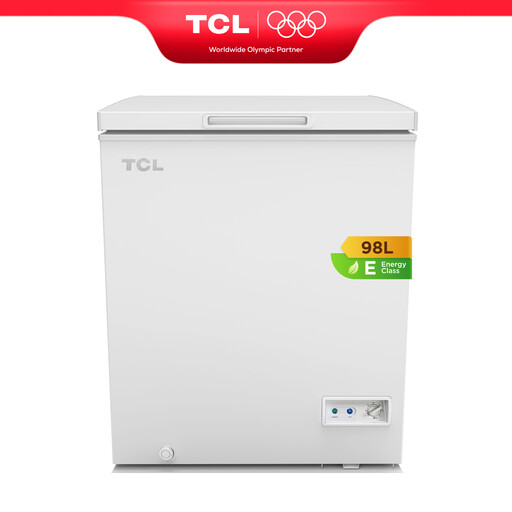 Image unavailable
TCL CF126EWE0FR, 98 L chest freezer
With a stated capacity of 98 L and a storage basket, this chest freezer is suited to providing extra storage rather than handling very large bulk shops. The product name mentions a counterbalanced lid and an E energy rating. Measure the space and opening clearance, then check the permitted ambient temperature range and defrosting instructions.
View on Joybuy
Frequently asked questions
Can I install any freezer in a garage or cellar?
No. Check the permitted ambient temperature for the exact model and compare it with the conditions in the room. Liebherr states that FrostProtect works down to −15 °C for the CFe 2080 Pure chest freezer, while Beko gives a minimum operating temperature of 5 °C for the FSE1174N undercounter model. These features don’t apply to every appliance of the same format.
What should I look for on the energy labels of two freezers?
Compare the energy rating, annual consumption in kWh, capacity and noise level, ideally between appliances with a similar capacity. The European Commission says that, since 1 March 2021, the energy label for household fridges and freezers has used a scale from A to G and displayed this information to help you compare models.
Do No Frost and frost reduction mean the same thing?
No. Bosch says that the No Frost feature on the GSN36CWEP means you don’t need to defrost it manually. A frost-reduction feature, such as those stated for the Liebherr CFe 2080 Pure, shouldn’t be taken to mean that defrosting is never needed. Check the care instructions for the model you’re considering.


