What sets the different types apart?
First, decide whether you need a separate appliance or are replacing your fridge too. Then compare the models based on freezer capacity, access to food and the space they need.
Upright freezer
Consider one : if you often reach for a variety of frozen foods and want to sort them into drawers.
Bear in mind : you’ll need space in front of the appliance to open the door and pull out the drawers. Also compare its usable capacity with that of the chest freezers you’re considering.
Chest freezer
Consider one : if storing large quantities or bulky packs is your priority and you have enough suitable floor space.
Bear in mind : food at the bottom is less easy to reach, and you’ll need enough clearance to lift the lid.
Fridge freezer
Consider one : if you’re replacing your fridge as well and want to keep just one appliance.
Check : the capacity of the freezer compartment itself, which may not be enough for large stocks of frozen food.
| Criterion | What to check | Who is it for? |
|---|
| Access and organisation |
Drawer or basket layout and removal; access to food at the bottom. |
When I take out different portions regularly, I want to find what I need without moving all the other food. Around 30% of consumers prioritise organised access above all else. |
| Capacity and footprint |
Freezer capacity in litres, external dimensions and clearance for the door or lid. |
I need usable space for large packs that will fit in the room. Storage capacity comes first for around 30% of consumers. |
| Room and power-cut performance |
Permitted ambient temperatures, required ventilation and the model’s stated storage time during a power cut. |
If the appliance is going in another room, I need to know whether it can operate at the usual temperature there. Its stated power-cut performance also matters to my choice. These conditions are a priority for around 20% of consumers. |
| Energy use and having one appliance |
kWh/year and the freezer compartment’s capacity in litres, separate from the total capacity of a fridge freezer. |
I want to consider ongoing electricity use or avoid adding another appliance when replacing my fridge. Around 20% of consumers put this choice first. |
ADEME reminds consumers that fridges and freezers run continuously. To compare appliances, the EU energy label shows information including annual energy consumption and capacity. You should still check the installation requirements for each model.
Models to suit your storage needs
These Joybuy models illustrate three options for a household short on freezer space: add a chest freezer, add an upright freezer or replace your fridge freezer. Compare the freezer capacity in litres before you decide.
 Image unavailable
AUCMA convertible chest freezer, 291 L
A separate space for storing larger quantities, with a removable basket to help organise some of the contents.
This model is described as convertible between fridge and freezer modes, with energy consumption of 226 kWh/year and dimensions of 1100 × 597 × 872 mm. Allow space to open the lid, and check the permitted ambient temperature range if you plan to keep it in an unheated room.
View on Joybuy
 Image unavailable
Candy CFQQ5T817EPS four-door fridge freezer, 467 L
Worth considering if you’re replacing your fridge too and want a single appliance with a freezer compartment.
Of the stated 467 L capacity, 156 L is for the freezer and 311 L for the fridge. The specifications list two freezer drawers, Total No Frost, 290 kWh/year and a stated power-cut storage time of 10 h. Check whether 156 L is enough for your frozen food.
View on Joybuy
 Image unavailable
Haier HTW5618ENMG three-door fridge freezer, 360 L
Another option if you’re replacing your fridge, with three drawers for organising frozen food.
The stated capacity is split between 235 L for the fridge and 125 L for the freezer. The specifications list Total No Frost, 271 kWh/year and a stated power-cut storage time of 11 h. Consider whether 125 L of freezer space is enough for your usual stock.
View on Joybuy
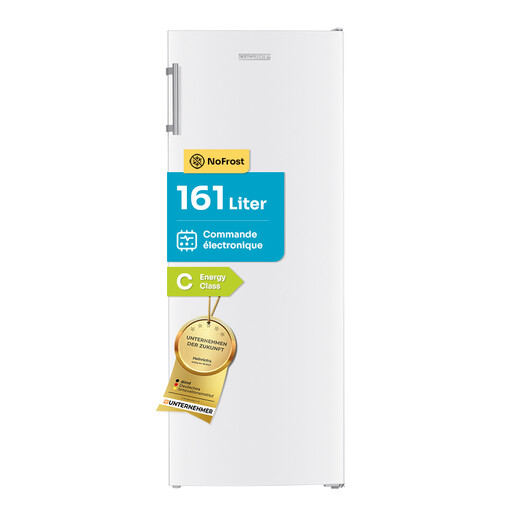 Image unavailable
Heinrich´s No Frost upright freezer, 161 L, white
A separate freezer to help keep your frozen food organised, if that matters more to you than storing large packs.
The description lists three drawers, two shelves and No Frost; the title states energy class C. Before choosing where to put it or comparing its energy use, check its dimensions, permitted ambient temperature range and kWh/year.
View on Joybuy
 Image unavailable
TCL CF182EWE0FR chest freezer, 140 L
A separate freezer if 140 L is enough for your needs and the chest freezer will fit in the room.
The stated dimensions are 637 × 556 × 846 mm, and the description mentions a counterbalanced lid. If a basket is important for organising your food, check whether one is included. Also check the kWh/year and the permitted ambient temperatures for your chosen location.
View on Joybuy
Frequently asked questions
Can I put a freezer in an unheated garage?
Yes, if the model’s stated ambient temperature range covers the temperatures in your garage. For example, Beko states that its HSM14540 chest freezer has a minimum operating temperature of -15 °C. Don’t assume this applies to another appliance.
What should I measure before ordering a freezer?
Measure the space and the delivery route, then allow for the door or lid to open fully and for the ventilation clearances specified in the manual. For an upright freezer, also check that there’s enough room to pull out the drawers.
How can I compare power-cut storage times?
Compare the stated hours for each model rather than assuming a storage time based on whether it’s a chest or upright freezer. For example, manufacturers state 23 h for the Beko HSM14540 and 24 h for the Whirlpool UW8 F2D WHBI N 2. UFC-Que Choisir, meanwhile, measures how long the temperature takes to rise from -17 °C to -9 °C in its test protocol.
Is the energy rating enough to compare two appliances?
No. The European Commission says that the energy label for refrigeration appliances also shows annual energy consumption, capacity and noise levels. Compare the kWh/year with the freezer capacity you need, especially if you’re choosing between a separate appliance and a fridge freezer.
Does a commercial warranty replace your statutory rights in France?
No. For goods sold by a business to a consumer in France, an optional commercial warranty is in addition to, and does not replace, the statutory guarantee of conformity. The DGCCRF states that claims under this statutory guarantee must be brought within two years of the goods being delivered.


