If you want to store large quantities, choose a chest freezer if you have enough floor space and don’t mind reaching in from above. An upright freezer is a better choice if you open it often and want to organise food in drawers. An under-counter freezer is best for extra storage or a particularly tight space. Whichever type you choose, check the net capacity, dimensions and permitted room temperature range for the space where you plan to install it.
Who is each type best for?
Households that freeze food in bulk
If you store bulk shopping, home-grown produce or prepared meals, start by working out how much you need to store and the net capacity you’ll need beyond your fridge-freezer. Also think about how you’ll separate different types of food.
Households that regularly use their frozen food
If you often take out portions or containers, access matters just as much as capacity. An upright freezer with drawers can make it easier to organise food by category, so check the layout inside the model you’re considering.
People with a cold or compact space
If you’re looking for a freezer for a garage, cellar, utility room or small kitchen, measure the space and check the room temperature range the model can operate in. Its format alone won’t tell you whether it’s suitable for an unheated room.
What should you compare?
Chest freezer
Consider one if: you want to store large quantities and have enough floor space for a freezer that opens from the top.
Bear in mind: you’ll need to organise food carefully to find items stored at the bottom.
Upright freezer
Consider one if: you regularly use your frozen food and drawers and front access would make it easier to organise.
Bear in mind: a large model may need plenty of height and depth.
Under-counter freezer
Consider one if: you need extra storage or only have space for a compact appliance.
Bear in mind: its capacity may be too limited to store large quantities on its own.
First, work out how much you need to store and how much space you really have. Then check the installation and maintenance requirements for each model.
| Factor |
What to check |
What you need |
| Capacity and format |
Compare net capacities and interior layouts. Measure the space, the route to the room and the clearance needed to open the freezer. |
I want enough room for my supplies, not an appliance that only adds a small amount of capacity to my fridge-freezer. |
| Access to food |
Check the drawers, baskets, shelves or compartments in the model. With a chest freezer, plan how you’ll find items stored underneath others. |
If I often take out portions, I’d prefer to keep them separate and find them without rummaging through the whole freezer. |
| Room temperature |
Compare the room’s minimum and maximum temperatures with the climate class and any stated suitability for low temperatures for that specific model. |
My garage or cellar can get cold, so I need to make sure the freezer I choose can operate there. |
| Energy use and ice build-up |
Compare the energy label and annual energy consumption of appliances with similar capacities. Check whether the cooling system eliminates or reduces the need for manual defrosting. |
I want to compare the energy use of an appliance that, as ADEME points out, runs continuously, as well as the maintenance it will need. |
Mistakes to avoid
-
Choosing the capacity without measuring the route or clearance
An appliance may fit the space you have in mind but still be difficult to get through a doorway, or need more clearance to open its lid. For example, Bosch lists the GSN58AWCV upright freezer as 1910 × 700 × 780 mm, while Liebherr lists the CFe 1870 chest freezer as 82 × 104 × 71 cm.
Measure doorways, corridors and the final installation space. For a chest freezer, also check that the lid can open fully.
-
Assuming any freezer will work in a garage
A climate class indicates the ambient temperature range an appliance is designed for. Beko explains that temperatures outside this range can affect how it operates.
Compare the room temperature with the specifications for the exact model. A stated suitability for temperatures as low as -15 °C for some models doesn’t apply to every chest or upright freezer.
-
Choosing an under-counter model as your main freezer for large quantities
According to the manufacturers, the Beko FSE1174N under-counter freezer has a net capacity of 95 L, compared with 366 L for the Bosch GSN58AWCV upright freezer and 451 L net for the Beko HSM46740 chest freezer. These capacities show why you need to consider both the space an appliance takes up and how much it can hold.
First, estimate how much storage space you need. If a compact appliance won’t be enough, compare chest and upright freezers that are suitable for your room.
-
Comparing only the letter on the energy label
The letter alone doesn’t tell you the freezer’s capacity or its stated annual energy consumption. It also doesn’t tell you how you’ll need to manage ice build-up.
Check the full energy label, net capacity and cooling system of models that meet the same storage needs.
A guide to the brands
These models illustrate different formats. The specifications relate to the models listed, not to each brand’s entire range.
Beko
Beko offers chest, upright and under-counter freezers. Its HSM46740 chest freezer has a stated net capacity of 451 L, while its FSE1174N under-counter model has a stated net capacity of 95 L.
- Beko says the HSM46740 can operate in an unheated room at temperatures as low as -15 °C.
- Check this suitability for each model: the FSE1174N has a climate class of SN-ST.
Bosch
Bosch lists the GSN58AWCV upright freezer with a capacity of 366 L, No Frost, Vario Zone and a Big Box compartment to help you organise different foods.
- Its removable drawers and shelves let you adjust the interior layout.
- Its stated dimensions of 1910 × 700 × 780 mm mean you’ll need to check the access route and installation space. Its suitability for a cold room can’t be inferred from its format.
Liebherr
Liebherr lists the CFe 1870 Pure chest freezer with a capacity of 281 L and FrostProtect, which allows it to operate in an unheated room at temperatures as low as -15 °C.
- Liebherr describes SmartFrost and StopFrost as features that help reduce ice build-up in this model.
- This chest freezer measures 104 × 71 cm across the floor and opens from the top, so allow space for the lid and plan how you’ll organise the food inside.
Freezers available on Joybuy
This selection includes one 161 L upright freezer and four chest freezers ranging from 95 to 140 L. Compare front-access storage with compact or mid-sized chest freezers. If you’re storing large quantities, make sure each model’s capacity matches how much you plan to keep frozen.
 Image unavailable
Heinrich´s 161 L upright freezer, stainless steel
This upright freezer lets you organise extra frozen food in drawers. The product listing specifies a capacity of 161 L, a reversible hinged door, No Frost and a C energy rating. Check its dimensions and the permitted room temperature range before choosing where to put it.
View on Joybuy
 Image unavailable
TCL CF182EWE0FR, 140 L chest freezer
This 140 L chest freezer is a good option for separate storage if you’re happy to access it from above. The product listing mentions a basket, a counterbalanced lid, temperature control and an E energy rating. Check the permitted room temperature range before installing it in an unheated room.
View on Joybuy
 Image unavailable
AUCMA 95 L convertible chest freezer
With a capacity of 95 L, this model is better suited to extra storage than as a large main freezer. The product listing specifies a convertible fridge-freezer function, a removable basket, a seven-level thermostat and an E energy rating. If you’re considering putting it in a garage, check the permitted room temperature range first.
View on Joybuy
 Image unavailable
CHiQ JR99DWE, 99 L chest freezer
This 99 L chest freezer can provide separate space for a small amount of frozen food, but it doesn’t offer a large capacity on its own. The product listing mentions a removable basket, a sliding lid and an E energy rating. Defrost it manually when ice build-up exceeds 5 mm, and check the permitted room temperature range for your space.
View on Joybuy
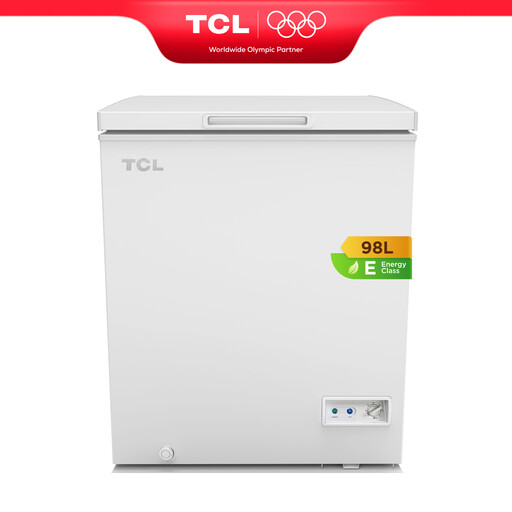 Image unavailable
TCL CF126EWE0FR, 98 L chest freezer
With a capacity of 98 L, this chest freezer is better suited to extra storage than as your main freezer for large quantities. The product listing specifies a basket, a counterbalanced lid, temperature control and an E energy rating. Measure the space and check the permitted room temperature range, especially if you plan to put it in an unheated room.
View on Joybuy
Frequently asked questions
Can you put any freezer in an unheated garage?
No. Compare the temperatures your garage can reach with the permitted room temperature range for the exact model. Beko states that its HSM46740 can operate at temperatures as low as -15 °C, while Liebherr specifies FrostProtect down to -15 °C for the CFe 1870. These specifications don’t apply to every appliance from these brands.
What temperature should you set to keep food frozen?
The French Ministry of Agriculture gives -18 °C as the recommended temperature for frozen food storage. Make sure food is packaged appropriately and the cold chain is maintained when choosing and using your freezer.
Does a chest freezer always need defrosting more often than an upright freezer?
No. Maintenance depends on the model’s cooling system, not just its format. Bosch lists No Frost for the GSN58AWCV upright freezer, while Beko and Liebherr respectively list MinFrost on the HSM46740 chest freezer and ice-reducing features on the CFe 1870. Check whether the model you choose still needs manual defrosting.


