Households freezing large quantities
If you store bulk buys, home-grown produce or bulky items, a chest freezer could suit your needs, provided you have enough floor space and can reach food at the bottom.


If you need to freeze large batches and have enough floor space, a chest freezer is a good choice. If you often check your supplies, the drawers in an upright freezer make them easier to organise and access. A larger fridge freezer is worth considering if you also need to replace your fridge: compare its freezer capacity alone with the amount you plan to store. Whichever style you choose, check the space needed to open it, the room temperature range it can handle, energy use, noise and power-cut storage time.
If you store bulk buys, home-grown produce or bulky items, a chest freezer could suit your needs, provided you have enough floor space and can reach food at the bottom.
For portions or meals you take out several times a week, an upright freezer lets you organise food in drawers. Just check that the drawers can open fully in the space you have in mind.
Where you plan to install it could determine your choice before you even consider the type. Check the room temperature throughout the year and compare it with the operating range and installation guidance for the specific model.
Worth considering: for large packs or a substantial stock of food, if you have enough floor space and room to open the lid.
Bear in mind: smaller items at the bottom may take more sorting and handling than they would in drawers.
Worth considering: if you open the freezer often and want to organise portions across several drawers.
Bear in mind: compartments may make it harder to store very bulky items; check how flexible the layout is before choosing.
Worth considering: if you only need a moderate increase in capacity and also need to replace your fridge.
Bear in mind: the total capacity includes the fridge section; only the freezer capacity will address your original lack of space.
Que Choisir highlights the generous storage space offered by chest freezers and the compartment-by-compartment access of upright models. Once you’ve chosen a type, compare the model’s features with your room and the way you use your frozen food.
| Criteria | What to check | Who it matters to |
|---|---|---|
| Capacity and size | Compare freezer capacity in litres, then measure the appliance, the clearance needed around it and the space required to open it. | If I’m storing bulk buys, I want more storage space without blocking the way through the room. Around 31% of consumers prioritise finding enough capacity to fit the space available. |
| Access to food | Check the drawers or baskets, whether they can be removed, and how easy it is to reach items at the bottom. | When I often take out small portions, I want to find them without moving everything else. For nearly 25% of consumers, easy day-to-day access comes ahead of other criteria. |
| Room temperature | Compare seasonal temperatures in the planned location with the model’s climate class and user manual. | In a garage, cellar or warm kitchen, I need an appliance designed for the temperatures in that room. This would be a priority for around 19% of consumers. |
| Storage time during a power cut, energy use and noise | Once you’ve found a suitable capacity, compare the kWh/year, dB and power-cut storage time listed for each model. | If I’m storing a lot of food or placing the appliance near a living area, I look first at how it performs day to day and during a power cut. Around 25% of consumers prioritise these practical considerations. |
An appliance may fit in the room, but there might not be enough space to lift the lid, open the door or remove the drawers.
Measure the delivery route too, then check the user manual for the clearance required around the model you’ve chosen.
The suitable ambient temperature depends on the appliance. Bosch says that a room that is too cold or too warm can affect how it works.
Compare the actual temperatures in the room with the range stated in the manual. Don’t assume a feature listed for one particular model applies to an entire brand.
The letter on the energy label doesn’t replace the annual energy consumption in kWh or a check of capacity, noise and power-cut storage time. These figures relate to different needs.
For appliances with a suitable capacity, compare the figures on their product information sheets instead of judging how they’ll suit you from one letter alone.
The open space can accommodate bulky packs, but items at the bottom may be harder to spot and take out.
If you check your supplies often, make sure you can reach the bottom and look for baskets, or consider an upright freezer with drawers.
Bosch offers freestanding and built-in upright freezers, which are worth considering if you value storage in compartments.
The Liebherr range includes chest freezers, which are worth looking at if you need to store large packs.
Beko offers upright freezers, including models advertised with a No Frost feature.
Whirlpool offers upright and chest freezers, so you can compare both types based on the space you have and the access you need.
These products include chest freezers in several capacities, an upright freezer and a fridge freezer to consider if you’re also replacing your fridge. Compare their freezer capacity and installation requirements before choosing a type.
 Image unavailable
Worth considering if you’re looking for a separate appliance for bulky supplies and have enough space to open the lid.
Advertised capacity: 291 L; energy rating E. The product title lists a removable basket, LED lighting and five-level digital controls.
Before installing it in a cellar or garage, check the permitted temperature range. Also check ventilation clearances and power-cut storage time to make sure they meet your needs.
 Image unavailable
This chest freezer is worth considering if you want a modest amount of extra capacity rather than a large space for family-sized batches.
Advertised capacity: 95 L; energy rating E. The title mentions a seven-level thermostat and a removable basket.
Compare the 95 L capacity with the amount you plan to store. Check the space needed to open the lid, the permitted room temperature and power-cut storage time if this is important to you.
 Image unavailable
Consider this if you also need to replace your fridge: check that the freezer compartment provides the extra capacity you’re looking for.
The advertised 467 L is the total capacity of the fridge freezer, not the freezer alone. The title lists a Total No Frost feature and energy rating E.
Check the capacity allocated to freezing, the dimensions, clearance requirements and the temperature range suitable for your room.
 Image unavailable
Compare this with other chest freezers if you want separate storage without immediately choosing a 291 L model.
Advertised capacity: 140 L; energy rating E. The title mentions a storage basket and counterbalanced lid.
Measure the floor space and the height needed to open the lid. If annual energy use, room temperature or power-cut storage time matters, check the model’s figures before you buy.
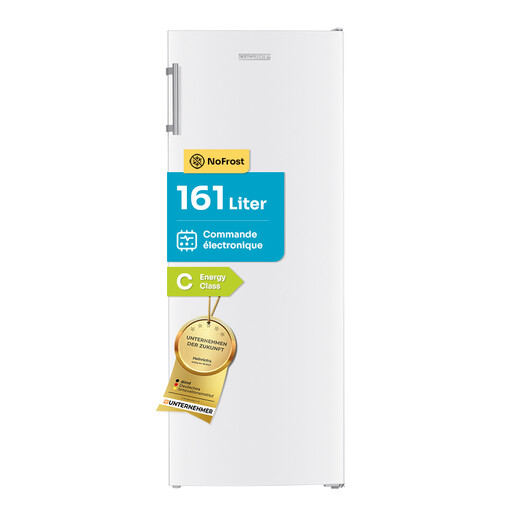 Image unavailable
Worth considering if you want to organise food in drawers rather than stack it in a chest freezer.
Advertised capacity: 161 L; energy rating C. The title mentions drawers, a No Frost feature and a reversible door.
Check the dimensions and the space needed to open the door and remove the drawers. Also check the climate class, kWh/year, noise level and power-cut storage time for your installation location.
No. A chest freezer is mainly worth considering for large quantities or bulky food, if you have enough floor space. If you often need small portions, drawers in an upright freezer may be more practical. Compare the usable capacity of models that will actually fit in your home.
No. Choose a model with an ambient temperature range that covers the temperatures in the room throughout the year. Check its climate class and user manual; a feature advertised for a specific appliance doesn’t apply to every product from that brand.
Look up the time stated for each model and compare it with other appliances suited to the amount you need to store. In its own tests, Que Choisir measures the time taken for the temperature to rise from −17 °C to −9 °C without power. Check the method used before comparing figures from different sources.