Households that prepare meals in advance
If you regularly freeze meals, drawers or separate compartments can help you sort them by contents and find what you need without moving everything else.


If you often put away and take out prepared portions, an upright freezer is a good choice: its compartments make it easier to keep everything organised. A chest freezer is better suited to storing larger quantities, provided you have space for it and a plan for organising its contents. If you’re already replacing your fridge and don’t need much freezer space, first compare the freezer capacity of fridge freezers. You may not need an extra appliance.
If you regularly freeze meals, drawers or separate compartments can help you sort them by contents and find what you need without moving everything else.
For bags of frozen food, larger packs or bulk buys, compare freezer capacity and the floor space required. With a chest freezer, also plan how to keep the items you use regularly within easy reach.
If you’re thinking of replacing your fridge, check whether the freezer compartment in a fridge freezer can hold your usual stock before planning for a second appliance.
For prepared meals and bulk shopping, first think about how you’ll use your freezer, then check its usable capacity, how easy it is to reach food and any restrictions on where it can go.
Consider it if: you often take out portions and want to organise them in separate compartments.
Bear in mind: capacity and how long food stays frozen during a power cut vary by model; the upright format alone doesn’t tell you either.
Consider it if: you mainly store bulky packs and have enough floor space.
Bear in mind: access from the top means you’ll need to organise the contents so that everyday portions don’t end up at the bottom.
Consider it if: you’re also replacing your fridge and the freezer compartment in the new appliance will meet your needs.
Bear in mind: the total capacity of a fridge freezer isn’t the same as its freezer capacity.
| Criteria | What to check | Consumers’ needs |
|---|---|---|
| Storage capacity | Compare the usable freezer capacity in litres with the size of the containers you need to store. Don’t use the total capacity of a fridge freezer. | If I buy in bulk, I want to be able to put everything away without running out of space for meals I’ve already prepared. Capacity would be the top priority for around 31% of consumers. |
| Access to portions | Check the drawers, baskets or easy-access compartments, and see whether they’ll fit the containers you usually use. | When I often take a meal out of the freezer, I want to find it without moving other food. Around 31% of consumers would put easy, organised access first. |
| Storage time during a power cut | Check the number of hours stated for the exact model and, where provided, the conditions under which it was measured. Also look for any alerts. | If I have a large amount of food in the freezer, I want to consider the risk of a power cut before choosing an appliance. This would be the top priority for around 23% of consumers. |
| Location and use | Check the dimensions, noise level in dB(A), energy consumption in kWh/year and the permitted ambient temperature range for your chosen location. | In a small room or an unheated space, I need to be able to install and use the appliance within the conditions specified for that model. Around 15% of consumers would put these practical considerations first. |
A chest freezer can hold bulky items, but stacked meals can be harder to spot and take out.
Before you buy, check your containers will fit inside the freezer and plan to sort food by category or date.
There isn’t a fixed storage time during a power cut for upright and chest freezers. The figure given depends on the model and the conditions under which it was measured.
Check the specifications for the model you’re considering. In its simulated power-cut test, Que Choisir measures how long food stays below −9 °C. Don’t compare this with a manufacturer’s figure that was recorded under different conditions.
The rating alone doesn’t tell you how much food you’ll be able to freeze or how much energy the appliance will use each year.
Also check the kWh/year, usable freezer capacity and noise level. Then compare appliances designed for similar storage needs.
Whether an appliance can operate in a cold space depends on the model. For example, Whirlpool states that Freezer Guard works down to −15 °C for the W3RHS31DW2, but this feature doesn’t apply to other freezers.
Check the temperature of the space and the operating range stated for the model you’re considering before deciding where to put it.
These models highlight features to compare on each appliance. They aren’t necessarily shared by every model from the same brand.
The B3RFNE274W upright freezer is worth considering if you want to organise portions in drawers.
The HCF500D4AWLYE chest freezer is designed for storing very large quantities.
The W3RHS31DW2 convertible chest freezer is worth considering if its capacity and location suit the way you’ll use it.
Haier offers chest and upright freezers in a range of capacities. Compare them based on the space available and how much you plan to store.
These models offer three ways to build up your freezer storage: a separate upright freezer to keep food organised, a chest freezer for extra capacity, or a fridge freezer if you’re also replacing your fridge. Compare the capacity available for freezing before choosing a format.
 Image unavailable
Worth considering if you want to organise portions in a separate freezer.
Stated capacity of 161 L, three drawers, No Frost system and energy rating C.
Check its dimensions and storage time during a power cut to make sure it suits your space and the amount you plan to store.
 Image unavailable
Worth considering if you want extra storage without choosing a large-capacity chest freezer.
Stated capacity of 95 L, fridge and freezer modes, removable basket, seven-level thermostat and energy rating E.
If you’ll be storing frozen food, check the setting for freezer mode and the operating conditions for your chosen location.
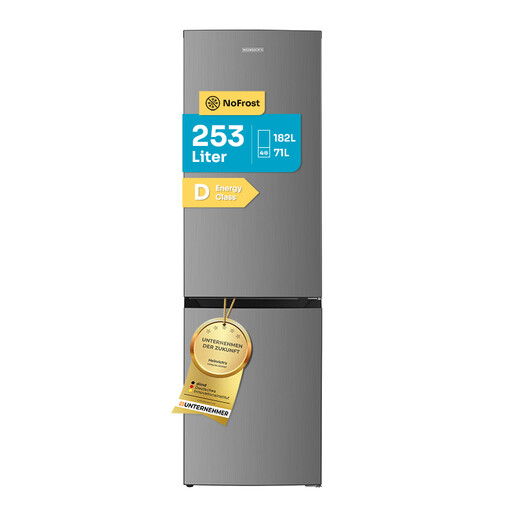 Image unavailable
Worth considering if you’re also replacing your fridge and want to keep your portions in the same appliance.
The stated 253 L capacity comprises 182 L of fridge space and 71 L of freezer space; the product title also specifies No Frost and 39 dB.
Compare your usual containers and shopping with the freezer compartment’s 71 L capacity, then check its storage time during a power cut.
 Image unavailable
Worth considering if you want a separate chest freezer for a modest amount of extra storage.
Stated capacity of 99 L, removable basket, sliding lid and energy rating E.
Check how much room you’ll need to open the lid and read the model’s defrosting instructions.
 Image unavailable
Worth considering as extra freezer space if bulk buying isn’t your main need.
Stated capacity of 60 L, reversible door and energy rating E.
Estimate how much space your portions will take up before choosing this capacity, and check how to adjust the temperature.
Compare the energy rating, annual consumption in kWh, freezer capacity and noise level. To work out which one better suits your needs, compare appliances with a similar capacity and format rather than relying on the letter alone.
It depends on the ambient temperature range allowed for the model you choose. Check its specifications and manual before installation. Whirlpool states that Freezer Guard works down to −15 °C for the W3RHS31DW2, but this doesn’t apply to other models.
Only compare them after taking into account the stated measurement conditions for each figure. Que Choisir simulates a power cut and measures how long food stays below −9 °C as part of its test. A figure given by a manufacturer may be based on different conditions.
No. Bosch, for example, describes No Frost as a way to avoid manual defrosting. However, you should still follow the model’s manual for cleaning, door seals and the clearances required for installation.