If you regularly reach for individual portions, start by comparing upright freezers and their drawers. For bulk shopping, a chest freezer is worth considering if you have the space and can organise its deep storage. A large fridge-freezer is better suited to households that need more space for both fresh and frozen food: check the litres allocated to freezing, not just the total capacity. Before adding another appliance, measure the space available in your current freezer and the volume of your usual batches.
Which option is right for you?
The right format depends on how often you take out portions, how much you need to store and how much space you have available.
People who prepare portions for the week
If you take out frozen meals almost every day, the drawers in an upright freezer make it easy to keep portions separate. With a chest freezer, use baskets or sections so you can find items stored at the bottom.
Households that buy in bulk
If you regularly store large containers or lots of frozen food, consider the capacity and open storage space of a chest freezer. Check its footprint and, if it’s going in an unheated room, the installation requirements for the specific model.
Households short on kitchen space
If you also need more room for fresh food, compare a large fridge-freezer with adding a separate freezer. Measure the freezer compartment’s capacity, the appliance’s dimensions and the space needed for delivery access.
What should you compare before buying?
Start by measuring your portions and the space you already have, then compare appliance capacities and practical considerations.
Upright freezer
Consider it if: you often take out portions and prefer to organise them in drawers.
Bear in mind: check that its capacity and height suit the quantities you need to store and the room you have in mind.
Chest freezer
Consider it if: bulk shopping or large containers call for open storage space.
Bear in mind: you’ll need floor space and a system for reaching food stored at the bottom.
Large fridge-freezer
Consider it if: you also need more space for fresh food and one appliance is a better fit for the room.
Bear in mind: its total capacity doesn’t tell you how much space is available for frozen food.
| What to consider | What to check | What I need |
|---|
| Freezer capacity |
Check the litres allocated to freezing, separately from the fresh-food capacity. Compare them with the volume of portions you make in a typical batch. |
Will my portions fit in the current compartment once they’re stored, or do I regularly need extra space? |
| Access to food |
Look at the drawers in an upright freezer or the baskets in a chest freezer. Check how you’ll reach food stored at the bottom. |
I often take out a particular portion and want to find it without moving everything else. |
| Installation |
Measure the appliance, the clearance needed to open it and the delivery route. For a cellar or garage, check the model’s climate class and operating ambient temperature range. |
Do I have floor space for a chest freezer, enough height for an upright freezer or room for a large fridge-freezer? |
| Energy and noise |
Compare the kWh/year and noise levels shown on the energy label. Consider the energy rating alongside capacity, and compare appliances with a similar format and capacity. |
If the appliance will run constantly near a living area, its energy use and noise will influence my choice. |
| Power cuts and freezing capacity |
Check the hours of storage time and the test conditions before comparing two figures. If you add a lot of food at once, also check the freezing capacity in kg/24 h. |
I sometimes add a large amount of food, so I want to compare this capacity without assuming that a particular format guarantees a certain storage time. |
What should you watch out for?
-
Confusing a fridge-freezer’s total capacity with its freezer capacity
Some of a fridge-freezer’s capacity is reserved for fresh food, so its total litres aren’t directly comparable with those of a separate freezer.
Check the capacity of the freezer compartments and compare it with the amount you usually prepare.
-
Choosing a chest freezer without planning how to reach the bottom
A large capacity doesn’t automatically make portions easy to find, and the lid needs enough clearance to open where you plan to put it.
Measure the footprint, clearance and delivery route. Consider organising food in baskets or sections.
-
Assuming storage time from the format alone
Manufacturers state a storage time for each model. UFC-Que Choisir measures, using its own test method, the time taken for the temperature to rise from −17 °C to −9 °C without power. Don’t assume this result is the same as a figure quoted in a manufacturer’s specifications.
Check the stated hours and how they were measured before making a comparison.
-
Looking only at the energy rating
The energy rating letter alone doesn’t tell you how many kWh the appliance uses in a year or how much usable space it offers.
Compare kWh/year and usable litres between appliances with a similar format and capacity.
An additional appliance runs continuously, so its annual energy use adds to that of the appliances you already use.
Which brands should you consider?
These brands offer options across different formats. The features mentioned apply to the specific models or ranges listed, not to every appliance they make.
Bosch
Worth considering for an upright freezer with organised compartments or a large fridge-freezer.
- Bosch lists a capacity of 366 L, removable drawers and shelves, and 12 h of storage time for the GSN58VWEV upright freezer.
- These figures apply to the GSN58VWEV. For an XXL fridge-freezer, check the freezer capacity and dimensions separately.
Whirlpool
Worth considering when comparing an upright freezer with a chest freezer for storing larger quantities.
- Whirlpool lists a capacity of 437 L and 32 h of storage time for its WHM4612 chest freezer.
- These figures don’t apply to other models from the brand. Also check how much space you’ll need around the chest freezer you choose.
Beko
Worth considering if you plan to install a chest freezer in an unheated room.
- Beko lists Freezer Guard −15 °C as a feature on some models in its range.
- This doesn’t apply to every Beko chest freezer. Check the ambient temperature range and climate class for the model you’re considering.
Liebherr
Worth considering for chest freezers with features designed to manage frost.
- Liebherr describes StopFrost as a system designed to reduce frost build-up on the models that feature it.
- This manufacturer’s description doesn’t replace comparing the capacity, kWh/year, dimensions and storage time of the model you choose.
Which appliances can you compare on Joybuy?
These options include a fridge-freezer for anyone who also wants more fresh-food storage, an upright freezer for organising portions in separate compartments, and three chest freezers with different stated capacities. Before choosing a format, compare the available space with the way you plan to use it.
 Image unavailable
Haier HTW5618ENMG, 3-door fridge-freezer, 360 L
Worth comparing if you want more storage for both fresh and frozen food. The model name lists a total capacity of 360 L, Total No Frost and an E rating. Check separately how much space is allocated to frozen food.
View on Joybuy
 Image unavailable
Heinrich´s, 161 L upright freezer, stainless steel
An upright freezer is a good fit if you regularly need to access individual portions. The product name lists a capacity of 161 L, drawers, No Frost, a C rating and a reversible door hinge. Measure the space needed for installation.
View on Joybuy
 Image unavailable
CHiQ JR99DWE, 99 L chest freezer
Worth considering if you want to add 99 L of freezer capacity rather than replace your existing fridge-freezer. The product name lists a removable basket, adjustable thermostat, sliding lid and an E rating. Think about how you’ll reach items underneath the basket.
View on Joybuy
 Image unavailable
TCL CF182EWE0FR, 140 L chest freezer
This 140 L chest freezer has a higher stated capacity than the two smaller TCL and CHiQ chest freezers featured here, but that alone won’t tell you which is right for your room. The product name lists a basket, counterbalanced lid and an E rating. Check how much clearance you’ll need to open it.
View on Joybuy
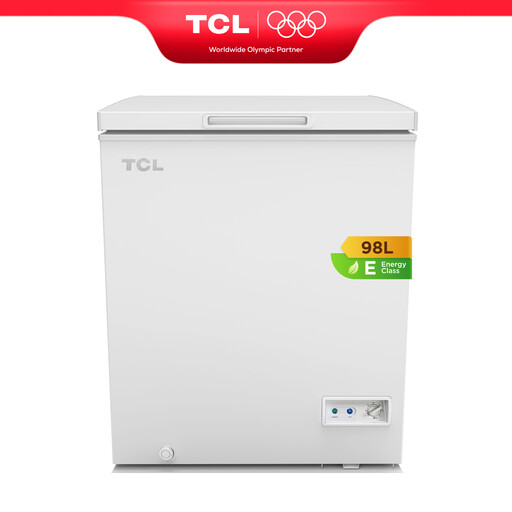 Image unavailable
TCL CF126EWE0FR, 98 L chest freezer
Worth comparing if you need some extra freezer space rather than capacity for regular bulk storage. The product name lists a capacity of 98 L, a basket, a counterbalanced lid and an E rating. Check that the capacity and access to the bottom suit the containers you use.
View on Joybuy
Frequently asked questions
What should you compare on the energy label when buying a new freezer in France?
Compare the energy rating, annual energy consumption in kWh, freezer capacity and noise level. The European Commission says that the label for refrigerating appliances includes these details, among others. For a fridge-freezer, distinguish the freezer capacity from the total capacity.
Can you compare the storage times stated by two manufacturers directly?
First check the test conditions and the model concerned. In its tests, UFC-Que Choisir measures how long it takes for the temperature to rise from −17 °C to −9 °C without power. A storage time stated by a manufacturer shouldn’t automatically be treated as equivalent to this result.
Can you put a chest freezer in an unheated garage?
It depends on the model and the expected ambient temperature. Check its climate class and operating temperature range. Beko lists Freezer Guard −15 °C on some models, but this feature isn’t available on every chest freezer.


