If you often reach for pre-portioned food, an upright freezer with drawers makes it easier to stay organised. For harvests or bulky items, a chest freezer offers open space, but takes up more floor space. An under-counter model is better suited to extra storage, while a fridge freezer may be enough if its freezer compartment can hold your supplies. Before choosing, check the usable capacity, access to your food, annual energy consumption and whether the model is suitable for the temperature of the room.
Who is each type best for ?
Households freezing pre-portioned meals
If you organise containers, bags and meals in advance, the drawers in an upright freezer can make everyday access easier. With a chest freezer, check the basket layout and how easy it will be to reach items at the bottom.
Households stocking up in bulk
For bulk buys, harvests or bulky items, a chest freezer’s open space can be useful if you have enough floor space. An upright freezer is also worth considering if being able to find each item quickly matters more to you than having a large open space.
Households considering a cellar or garage
Measure the room temperature throughout the seasons before choosing your appliance. Compare it with the operating temperature range stated for the exact model: a ‘garage’ mention in a product description is no substitute for checking this.
What should you check before choosing ?
First, work out how much space you have and how you’ll access your food stocks. Then compare the specifications of models that can genuinely be installed in your home.
Upright freezer
Consider it : if you often check your food stocks and want to organise portions in drawers.
Bear in mind : make sure the door and drawers can open fully in the space you have in mind.
Chest freezer
Consider it : if you store harvests, large quantities or bulky packs and have enough floor space.
Bear in mind : you’ll need to organise items in baskets or containers to reach those at the bottom.
Under-counter freezer
Consider it : if ceiling height is limited and you’re looking for extra storage.
Bear in mind : check that its capacity is enough for the amount of food you want to store regularly.
Fridge freezer
Consider it : if you also need to buy a fridge and its freezer compartment can hold your food stocks.
Bear in mind : the overall size of a fridge freezer doesn’t tell you how many litres of space are actually available for frozen food.
| Factor | What to check | Your needs |
|---|
| Access to food |
Check the drawer or basket layout, how the door or lid opens, and how easy it is to reach items at the bottom. |
I prepare portions in advance and want to find a meal without moving all my other food. |
| Capacity and location |
Compare the usable capacity in litres with the appliance’s dimensions. Also measure the space needed to open the door or lid and remove storage components. |
My food needs to fit inside the appliance, but it must also fit in its intended spot and remain easy to use there. |
| Energy consumption |
Check the current energy rating and annual consumption in kWh, taking the capacity and type of appliance into account. ADEME recommends using the energy label when choosing household appliances. |
As a freezer runs continuously, I want to compare its energy use on a clear basis, not just its rating. |
| Room temperature |
Check the minimum and maximum temperatures where the appliance will be installed. Check the climate class and any stated suitability for low temperatures for the exact model; Whirlpool notes that this information is included in its technical specifications. |
If the appliance is going in a cellar or garage, I want to know whether it can operate in that room in both summer and winter. |
| Power cuts and usage |
Compare the stated storage time in hours, the freezing capacity in kg/24 h if you freeze large quantities of fresh food, and the defrosting type. UFC-Que Choisir assesses storage time by simulating a power cut, among other tests. |
If I have a large stock of food, I’ll check the storage time; if I freeze large harvests, the amount that can be frozen in 24 hours matters too. |
What pitfalls should you avoid ?
-
Choosing based on litre capacity alone
A chest freezer can hold bulky items, but needs floor space and access from above. An upright freezer needs enough clearance to open the door and remove the drawers.
Measure the space and the route to it, then think about how you’ll get to your portions and large packs every day.
-
Assuming any model is suitable for a garage
The temperature in a garage or cellar may fall outside the appliance’s operating range. A low-temperature rating for one model doesn’t apply to every model from the same brand.
Compare the room temperature with the climate class or the operating range explicitly stated in the manual for the model you’re considering.
-
Comparing only the letters on energy labels
The energy rating doesn’t replace the annual consumption in kWh, which should be considered alongside usable capacity and appliance type. An old A+++ label and a current A to G label can’t be compared directly.
Make a note of the annual kWh consumption and usable capacity of the appliances you’re considering, then compare models that meet the same storage needs.
-
Assuming storage time based on the type or cooling system
Two freezers of the same type can have different stated storage times and maintenance requirements. The No Frost label alone doesn’t tell you how long food will stay frozen during a power cut.
Check the figures for each model: storage time in hours, freezing capacity in kg/24 h and defrosting type.
A few brands to know
These examples show why it’s important to compare specific models rather than assume a feature applies across an entire brand.
Bosch
Bosch offers under-counter freezers and fridge freezers, among other options, with capacities to suit different needs.
- According to its product specification, the GTV15NWEB under-counter model has a usable capacity of 83 L and a stated storage time of 16 h in the event of a power cut.
- The KGN36NWEA fridge freezer has 89 L of freezer capacity according to Bosch: compare this with your food stocks before considering it as an alternative to a separate appliance.
Whirlpool
The W3RHS37EW1 chest freezer is an option for storing large quantities, provided you have enough room for it.
- Whirlpool lists a 371 L capacity, a freezing capacity of 18 kg/24 h and a storage time of 36 h for this model.
- The FreezerGuard feature, rated for temperatures as low as −15 °C, applies to this model: check the suitability of any other model before installing it in a cold room.
Beko
Some models may be suitable for installation in an unheated room, provided you check their exact operating temperature range.
- In its archived test report, UFC-Que Choisir states that the BRFNE214M23WN is designed to operate at ambient temperatures as low as −15 °C, thanks to Freezer Guard.
- This information applies to the BRFNE214M23WN and doesn’t indicate whether other Beko models are suitable or whether this model is currently available.
Chest freezers on Joybuy
These chest freezer models offer a range of storage capacities to consider. They’re not a substitute for comparing them with an upright, under-counter or fridge freezer if access to food or the space available leads you to choose a different type.
 Image unavailable
AUCMA, 291 L convertible chest freezer
Worth considering for storing larger quantities if you have enough room for a chest freezer with a top-opening lid. The product title lists fridge or freezer modes, an E energy rating, a removable basket, LED lighting and a five-level digital control. If you’re planning to install it in a garage or want to compare how it performs during a power cut, check this model’s ambient temperature range and storage time.
View on Joybuy
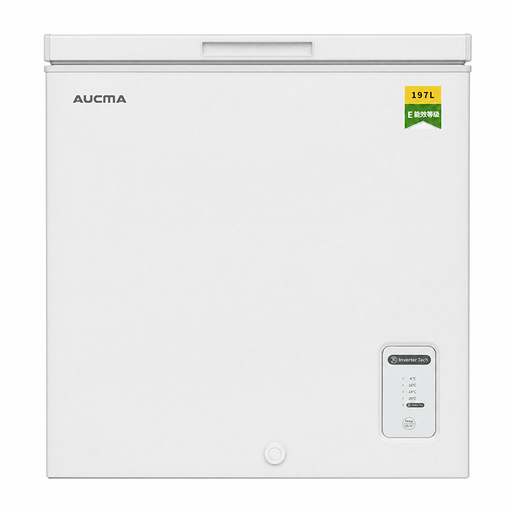 Image unavailable
AUCMA, 197 L convertible chest freezer
Compare its stated capacity of 197 L with the amount of food you need to store and the space the freezer will take up. The product title lists switchable fridge and freezer modes, an E energy rating, a removable basket and a five-level digital control. If you’re planning to install it in an unheated room, check the operating temperature range for this specific model.
View on Joybuy
 Image unavailable
AUCMA, 95 L convertible chest freezer
Its stated capacity of 95 L is better suited to extra storage than to a large family stock of food. The product title lists an E energy rating, a removable basket, a seven-level thermostat and switchable fridge and freezer modes. Measure the space needed to open the lid and check its ambient temperature range before installing it in a cold room.
View on Joybuy
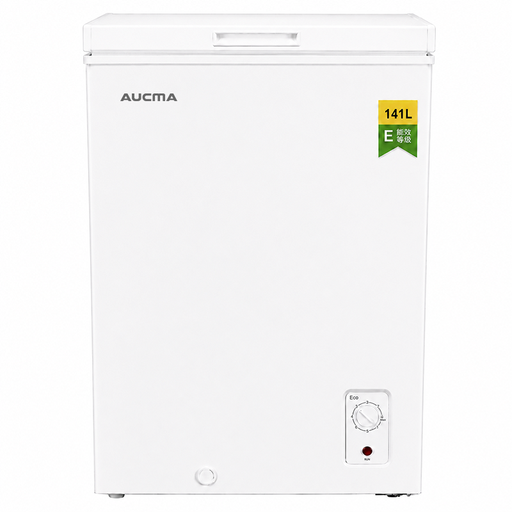 Image unavailable
AUCMA, 141 L convertible chest freezer
With a stated capacity of 141 L, this chest freezer should be considered in light of the size of your food stocks and the floor space available. Its product title lists an E energy rating, a removable basket, a seven-level thermostat and switchable fridge and freezer modes. If power cuts or freezing harvests are a factor in your decision, check this model’s storage time and freezing capacity.
View on Joybuy
 Image unavailable
CHiQ JR99DWE, 99 L chest freezer
Its stated capacity of 99 L could work as extra storage if it’s enough for your needs. The product title lists four-star freezing, an E energy rating, an adjustable thermostat and a removable metal basket. Check this model’s annual energy consumption, storage time and ambient temperature range before comparing it with other chest freezers.
View on Joybuy
Frequently asked questions
Which climate class should I choose for a garage or cellar ?
Choose a model with an operating temperature range that covers the room’s minimum and maximum temperatures. For example, Bosch lists a range of +10 to +43 °C for climate class SN-T; this won’t be enough for a room that falls below +10 °C. Check that the specific model you’re considering is suitable for cold temperatures: Whirlpool states that its W3RHS37EW1 chest freezer’s FreezerGuard feature works down to −15 °C.
Should you leave space around a freezer ?
Yes: follow the clearance and ventilation guidance in the manual for your chosen model, and remember to allow enough room to open it. Whirlpool recommends 5 cm above and 10 cm behind its freestanding fridges; this isn’t a universal rule for freezers.
How do you compare the energy consumption of two freezers ?
Compare their annual consumption in kWh and usable capacity, ideally between appliances that meet the same storage needs, then look at the energy rating and noise level. The DGCCRF states that the European regulation on energy labelling for household refrigeration appliances has applied since 1 March 2021 : don’t read an old A+++ rating as if it were part of the current A to G scale.
Should storage time during a power cut guide your choice ?
It’s worth comparing if you keep a large stock of food or are concerned about power cuts. Check the stated storage time for each model and any conditions that apply; in its test protocol, UFC-Que Choisir measures how long food stays below −9 °C during a simulated power cut.
Can a fridge freezer replace a separate freezer ?
Yes, if you also need a fridge and the freezer compartment is large enough for the amount of food you usually store. Check its capacity separately: Bosch lists 89 L of freezer space for the KGN36NWEA fridge freezer, while Whirlpool lists 371 L for its W3RHS37EW1 chest freezer. These two models illustrate the difference in capacity, but don’t by themselves determine which type is right for your household.


