Households that cook and freeze portions in advance
To quickly find homemade dishes, portions and food sorted by category, an upright freezer with drawers is generally more practical than a large open chest.


Start by choosing according to where you will place the appliance and how you want to access your food: an upright freezer is ideal for frequent, organised access, while a chest freezer prioritises capacity if you have a suitable room. An under-counter model is mainly useful as an extra freezer, whereas a large fridge freezer is the right choice if you are also replacing your fridge and want both functions in one appliance.
To quickly find homemade dishes, portions and food sorted by category, an upright freezer with drawers is generally more practical than a large open chest.
A chest freezer could be suitable if your priority is storing food, large packages or family-sized packs, and you have a suitable room outside the kitchen.
An under-counter model can modestly increase your freezer capacity without installing a second large appliance, provided you are happy with a more limited capacity.
Start with the space available and your storage habits, then compare the specifications of the exact model rather than looking only at the stated capacity.
| Priority | What to check | Your needs |
|---|---|---|
| Usable capacity | Compare the net freezer capacity of appliances in the same format. Also check how much room is available for large dishes, bags and packaging. | I want to store shopping and planned meals without unnecessarily taking over the room with excessive storage capacity. |
| Access and organisation | Check the number of drawers, baskets or compartments. With a chest freezer, look for a basket and plan to organise items using labels. | I need to be able to see, separate and remove portions without spending ages searching through a deep storage space. |
| Installation room | Check the climate class, overall dimensions, ventilation clearances and door-opening direction. Classes SN, N, ST and T correspond to different ambient temperature ranges, according to UFC-Que Choisir. | My appliance may be installed in a garage, cellar, utility room or warm kitchen: the actual room temperature must be suitable for the model. |
| Food preservation and maintenance | Check the storage time in the event of a power cut, temperature stability and defrosting functions. A No Frost system can reduce the need for defrosting, but noise and energy consumption still need to be compared. | I want to minimise maintenance and better protect my supplies after bringing home the shopping or following a power cut. |
| Energy consumption and noise | Compare the A to G rating, kWh/year, freezer volume and noise emissions on the energy label. The European Commission states that this information appears on the energy labels of refrigerators and freezers in the European Union. | As the appliance runs continuously, I want to compare running costs and noise levels on a like-for-like basis. |
A chest freezer can offer substantial storage, but portions placed at the bottom are less convenient to retrieve. An upright freezer makes it easier to organise food in drawers, although its maximum capacity may be more limited.
List your usual stock before comparing litres: daily portions, large dishes, vegetables, family-sized packs or XXL packaging. Then check the baskets, drawers, removable compartments and published internal dimensions.
The climate class defines the ambient temperature range in which the appliance is designed to operate. Outside this range, food preservation and energy consumption may no longer match the stated conditions.
Measure the room’s minimum and maximum temperatures, then check the climate class and any specific function for use in an unheated room in the model’s instructions.
Two appliances with the same rating may have different freezer capacities, noise levels and annual energy consumption.
Compare the A to G rating, kWh/year, net freezer capacity, noise and the EPREL information for the exact model.
Anses reminds us that at -18 °C, freezing stops the multiplication of bacteria without eliminating most micro-organisms. Freezing food late therefore does not make it safe again.
Freeze food as soon as you buy it or immediately after preparing it, date your portions and never refreeze food that has already been defrosted.
A French range covering upright freezers, chest freezers and compact formats, making it useful for comparing different storage options.
An option to consider if you want an organised upright freezer, with storage and door-alert features available on certain models.
A range available in France, including upright freezers, chest freezers and large-capacity fridge freezers.
A range of freestanding and integrated upright freezers suited to kitchens where built-in installation or vertical storage is a priority.
These Joybuy options include upright, under-counter and chest freezers, as well as a large-capacity fridge freezer for households that are also replacing their fridge.
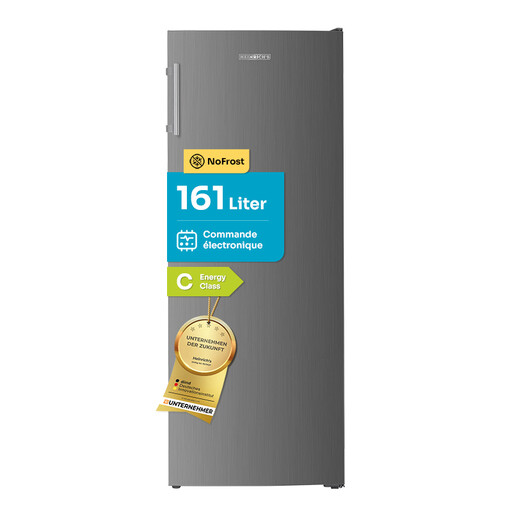 Image unavailable
A vertical option for organising portions and shopping by category in a well-ordered household freezer.
161 L, three drawers, two shelves, LED display, alarm, reversible door, temperature setting from -14 °C to -22 °C and energy rating C.
Check the dimensions, ventilation clearances, climate class and storage time before installation, especially in an unheated room.
 Image unavailable
An extra-storage format for small kitchens where a few portions and frozen foods need to be kept separately.
60 L, three storage zones, reversible door, adjustable thermostat, dimensions of 44,5 × 47,5 × 84,5 cm and energy rating E.
This capacity is suitable for a small reserve; check the climate class, annual energy consumption, storage time and required clearances for your chosen location.
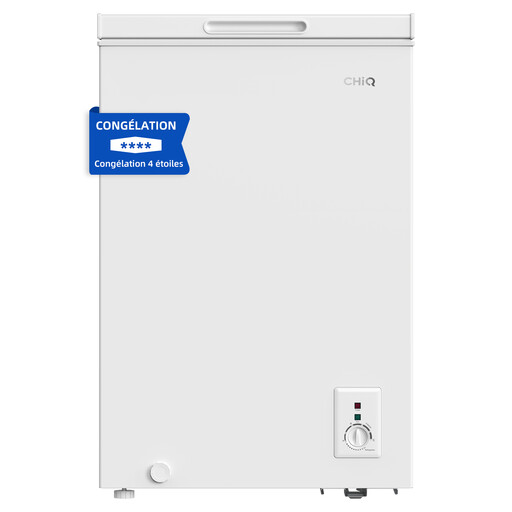 Image unavailable
Extra storage for frozen food, with a basket for items you use more frequently.
99 L, 4-star freezing, 4,5 kg/24 h, adjustable thermostat, removable metal basket, sliding lid and stated noise level of 39 dB.
Accessing the bottom of the chest requires you to rotate your stock. Manual defrosting is required when the frost exceeds 5 mm; also leave 10 cm of clearance around the appliance.
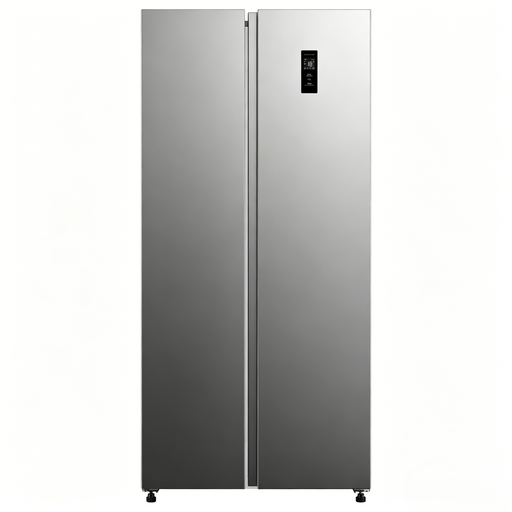 Image unavailable
Worth considering if your fridge also needs replacing and you want a large total capacity in one appliance.
444 L total side-by-side format, Total No Frost, 289 kWh/year, stated noise level of 40 dB and SN-T climate class from 10 to 43 °C.
The 444 L refers to the total capacity: check the net freezer capacity, dimensions, installation clearances and internal layout before buying.
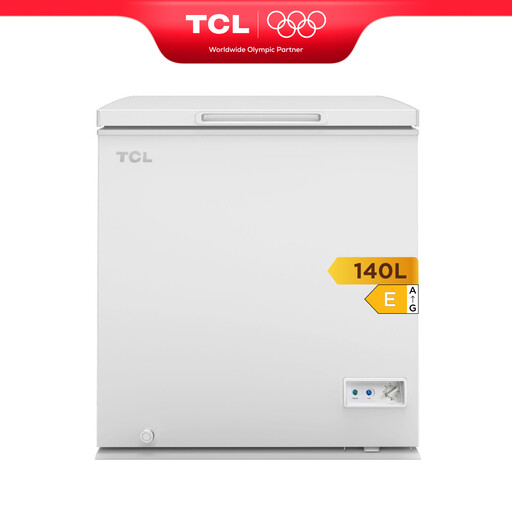 Image unavailable
Dedicated capacity for bulk shopping or batch cooking when you have enough floor space.
140 L, storage basket, lid that stays open, castors, adjustable feet and dimensions of 637 × 556 × 846 mm.
Food placed beneath the basket is less accessible than in a drawer model. Check the climate class, storage time, freezing capacity and annual energy consumption for your installation location.
A 4-star compartment is suitable for freezing and storing food at temperatures down to -18 °C. Anses explains that bacterial multiplication stops at this temperature, but most micro-organisms survive: freeze food as soon as you buy it or after preparing it.
Yes, but only if the ambient temperature range specified for the model genuinely covers the conditions in the room. According to UFC-Que Choisir, common classes range from SN, 10 to 32 °C, to T, 16 to 43 °C; not every appliance has a special garage function.
No. A chest freezer is suitable when very high capacity and bulky packaging are the priority, but it is less convenient for finding small portions every day. An upright freezer generally offers better visibility thanks to its drawers, although its maximum capacity is often more limited.
Compare the A to G rating, annual consumption in kWh, storage capacities and noise emissions. The European Commission states that the label’s QR code provides access to detailed information about the model in EPREL.
No. Anses recommends not refreezing food that has already been defrosted. Defrost it in the fridge, in the microwave using the defrost setting, or quickly through cooking or reheating, then eat the defrosted food promptly.