To increase your freezer capacity, choose a chest freezer if you’re storing large quantities and have enough floor space. An upright freezer makes it easier to access food stored by category, while a tabletop or under-counter model is better suited to a small amount of extra capacity. Whichever style you choose, check the dimensions, the room temperature range it can operate in, annual energy consumption, noise level and stated power-cut storage time.
Which style is right for you ?
Households that buy in bulk
If you’re stocking up or storing large packs, a chest freezer is worth considering if you have enough room for the freezer and to open its lid. You’ll need to plan how to organise the inside so you can find food at the bottom.
Households that often reach for frozen food
An upright freezer with drawers lets you separate different types of food and find what you need without rummaging through a chest. Check that the compartments can accommodate the packaging you usually buy.
Small spaces needing extra capacity
A tabletop or under-counter model can add to your existing capacity without the need for a large appliance, as long as it has enough room for the food you want to store and the door can open where you plan to put it.
What should you check before buying ?
Chest freezer
Worth considering : for large quantities or bulky food, if there’s enough free floor space in the room.
Trade-off : reaching food at the bottom and organising smaller items takes some planning.
Upright freezer
Worth considering : if you open the freezer often and want to sort food into drawers.
Trade-off : the compartments need to be large enough for your bulkiest packaging.
Tabletop or under-counter model
Worth considering : when you need extra capacity but space is limited.
Trade-off : its smaller capacity won’t meet the same needs as a large appliance for bulk shopping.
Once you’ve chosen a style, compare models suited to your room and the amount of food you realistically plan to store.
| What to consider | What to check | My needs |
|---|
| Capacity and access |
Compare the capacity in litres, external dimensions and delivery route. Check how the lid or door opens and the size of the baskets or drawers. |
I want to store bulk purchases without making everyday items difficult to find. |
| Where you’ll install it |
Compare the room’s minimum and maximum temperatures with the range allowed for the exact model. A feature advertised for use in a cold room doesn’t apply to every model from the brand. |
If I put the freezer in a garage or cellar, it needs to work at the temperatures the space reaches throughout the year. |
| Energy use and noise |
The European energy label shows details including consumption in kWh/year, capacity and noise emissions. Compare these figures between appliances of a similar style and capacity, rather than looking only at the rating. |
If it’s near a living area, I pay attention to noise; as it runs continuously, I also check its annual energy consumption. |
| Power cuts and maintenance |
Check the stated storage time in hours and how it’s measured. Look at the defrosting method and whether the exact model has an alarm: UFC-Que Choisir’s test protocol measures how long food stays below −9 °C during a simulated power cut. |
I want to know when to check the food after a power cut and what maintenance the appliance will need. |
What mistakes should you avoid ?
-
Choosing a large chest freezer based on capacity alone
A chest freezer can take up a lot of width and depth. Without easy access to the bottom or a plan for organising it, its capacity can be less convenient to use every day.
Measure the space, the delivery route and the clearance needed to open the lid. Also think about how you’ll use the baskets.
-
Assuming any freezer is suitable for a garage
The ambient temperature a freezer can operate in depends on the model. Low-temperature operation features advertised by some manufacturers only apply to the models they’re designed for.
Check the room temperatures throughout the year and compare them with the manual and product details for the model you’re considering.
-
Looking only at the energy rating letter
Two freezers with the same rating can have different capacities and annual energy consumption. The European energy label also shows kWh/year, capacity and noise level.
Compare these figures for models with similar styles and capacities to see how well each one meets your storage needs.
-
Comparing stated storage times without checking how they’re defined
A stated storage time during a power cut is only useful for comparing models if the temperature threshold and test conditions are known. For example, UFC-Que Choisir’s test protocol measures how long food stays below −9 °C during a simulated power cut.
Look for the time in hours in the model’s documentation and compare figures measured using the same method.
A few models from well-known brands
These specifications apply to the models mentioned and shouldn’t automatically be assumed to apply to the entire brand.
Beko
Beko chest freezers include models worth considering for stocking up, with specifications to check for each individual model.
- According to Beko France, the CF200EWN chest freezer has a capacity of 198 l, uses 199,94 kWh/year, produces 40 dB(A) and has a stated storage time of 36 h.
- Beko’s advertised operation down to −15 °C with Freezer Guard applies to appliances with this feature, not all its chest freezers.
Whirlpool
The WHFF 6403 W4E is an example of a large-capacity upright freezer with compartments for easy access to your supplies.
- Whirlpool France lists a capacity of 404 l, six drawers or baskets, energy consumption of 292 kWh/year and a noise level of 38 dB(A) for this model.
- The visual alarm that activates when the temperature rises above −8 °C is a feature of this model. Check the specifications of the model you’re considering.
Candy
Candy offers both a full-height upright freezer and a small tabletop model for different storage needs.
- Candy France lists a capacity of 169 l for the CNUQ2L513EWH and 90 l for the CNUQ2L58EX tabletop model, which has stated dimensions of 545 × 570 × 860 mm.
- Check the documentation for your chosen model to confirm any anti-frost features or suitability for use in a cold room.
Liebherr
The CFe 2500 Pure is an example of a large chest freezer to consider if you have enough space and the room is suitable for installation.
- Liebherr France lists a capacity of 497 l and external dimensions of 82 × 167 × 71 cm for this model.
- Liebherr’s stated FrostProtect compatibility down to −15 °C applies to this model; don’t assume it applies to other chest freezers.
Freezers available on Joybuy
This selection includes upright freezers and chest freezers to add to your existing capacity, from a little extra space to larger reserves. Start by choosing the style, then check the installation requirements for each model.
 Image unavailable
Heinrich´s upright freezer, 161 l, stainless steel
This upright model suits a household that wants to organise its supplies on shelves and in compartments rather than in a chest. The product name lists a capacity of 161 l, a No-Frost function, an alarm and a C energy rating. Before installing it in a cellar or garage, check the permitted ambient temperature range. Also check the dimensions, kWh/year and storage time during a power cut.
View on Joybuy
 Image unavailable
CHiQ JR99DWE, 99 l chest freezer
This 99 l chest freezer can provide extra storage if a top-opening design suits your space. The product name lists a removable basket, an adjustable thermostat and an E energy rating. This model requires manual defrosting, so it needs some maintenance. Also check the permitted ambient temperature, kWh/year and storage time during a power cut.
View on Joybuy
 Image unavailable
COMFEE' RCU60WH2(E), 60 l upright freezer
With a stated capacity of 60 l, this upright model is better suited to providing a little extra space than storing large quantities. The product name lists a reversible door and an E energy rating. Check the layout of the compartments before choosing: the product title and description don’t present them in the same way. Also check the permitted ambient temperature, kWh/year and storage time during a power cut.
View on Joybuy
 Image unavailable
TCL CF182EWE0FR, chest freezer listed as 140 l
This chest freezer is suited to adding extra storage if a top-opening lid works for the space. The product title lists a capacity of 140 l, a basket and an E energy rating; confirm the capacity of the version being sold. Also check the permitted ambient temperature, kWh/year, noise level and storage time during a power cut.
View on Joybuy
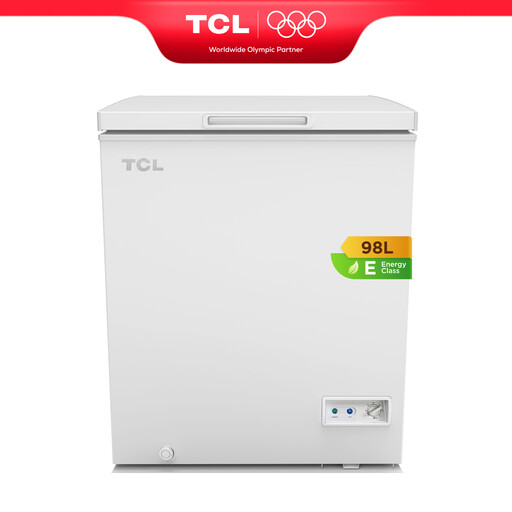 Image unavailable
TCL CF126EWE0FR, chest freezer listed as 98 l
This chest freezer can complement an existing freezer if a top-opening design suits the way you store food. The product title lists a capacity of 98 l and a basket; confirm the capacity of the version being sold. Measure the space and check the permitted ambient temperature, kWh/year, noise level and storage time during a power cut.
View on Joybuy
Frequently asked questions
Which style should I choose if I open the freezer every day ?
An upright freezer with drawers makes it easier to organise food by category and access it regularly. Check that the compartments are big enough for your packaging and that there’s enough room to open them fully.
Can I install any freezer in an unheated garage ?
No : compare the room’s minimum and maximum temperatures with the range allowed for the exact model. Beko’s Freezer Guard claim of operation down to −15 °C applies only to appliances with this feature, while Liebherr advertises FrostProtect operation down to −15 °C for the CFe 2500 Pure. These features don’t apply to every model from either brand.
How can I compare energy use and noise ?
Check the kWh/year, capacity in litres and noise emissions, ideally across freezers with similar styles and capacities. The European energy label shows these details; the rating letter alone doesn’t tell you everything about how the appliance will perform.
Is the stated storage time enough to assess a freezer during a power cut ?
A time in hours can help you compare models if you know how it was measured. UFC-Que Choisir’s test protocol measures how long food stays below −9 °C during a simulated power cut; check how any other stated time is defined.


