Which households is it for?

Households that prepare portions in advance

You prepare several meals or portions for freezing and need to be able to organise and retrieve them without moving the entire stock. An upright freezer with drawers is generally the most practical format to consider first.

Families that store large quantities

You keep large batches, home-grown produce or bulky food for several weeks and have a suitable room available. A chest freezer can provide more capacity, but you’ll need to check access to food stored at the bottom and the floor space it occupies.

Households without room for a second appliance

You want to increase your frozen-food storage without installing a separate freezer. Compare the net capacity of the freezer compartment in a fridge-freezer rather than its total capacity.

How to choose

Upright freezer

Consider it: for a variety of portions that you want to separate, identify and remove frequently.

Bear in mind: the door-opening space, drawer removal and the fact that maximum capacity is often lower than with a chest freezer.

Chest freezer

Consider it: for bags, batches or bulky food when floor space is available.

Bear in mind: you’ll need to organise food in baskets or storage boxes to find items placed at the bottom.

Large-capacity fridge-freezer

Consider it: if you want more freezer space without installing a second appliance.

Decisive factor: total capacity includes the fridge compartment; check the freezer compartment’s capacity separately.

Priority What to check Your needs
Capacity and storage Compare net freezer capacity, drawers, baskets or compartments, as well as the external dimensions and the space required to open the appliance. I want to store portions, bags and batches without wasting time looking for them. For a fridge-freezer, I focus on freezer capacity rather than total capacity.
Installation Check that the climate class covers the room’s minimum and maximum temperatures. Also consult the ventilation clearances specified in the model’s instruction manual. My garage, utility room, basement or laundry room may be colder or warmer than a kitchen. I choose an appliance designed for the actual conditions in that room.
Power-cut performance and continuous use Compare the stated storage time during a power cut and annual consumption in kWh/year between appliances with similar capacity and intended use. I want a safety margin during a power cut while keeping the consumption of an appliance that runs continuously easy to understand. ADEME recommends comparing annual consumption rather than relying on the energy class alone.

Mistakes to avoid

  • Choosing a chest freezer solely for its capacity

    A chest freezer offers open, flexible storage, but food kept at the bottom is less immediately accessible. Prepared portions are harder to find without a clear organisation system.

    Choose an upright freezer if you regularly take out small portions. With a chest freezer, plan to use baskets, storage boxes or clearly defined zones, and check access to the interior before buying.

  • Installing the appliance outside its specified temperature range

    An unsuitable ambient temperature can affect the operation intended by the manufacturer. The climate class corresponds to a specific range of ambient temperatures.

    Record the room’s minimum and maximum temperatures throughout the year, then compare them with the climate class and the instructions for the exact model.

  • Comparing the energy class alone

    A freezer operates continuously and its consumption depends in particular on its capacity, the ambient temperature and its features. The energy class alone is not enough to compare appliances with different capacities.

    Compare kWh/year between models with similar capacity and intended use, then also consider storage time during a power cut, dimensions and the internal layout.

  • Relying on the total capacity of a fridge-freezer

    The total capacity of a fridge-freezer combines the fridge and freezer compartments. The compartment intended for your reserves may therefore be insufficient despite a high overall figure.

    Check the product information sheet or EPREL and note the freezer capacity, number of drawers and footprint separately before replacing a standalone freezer.

Brand guide

Beko

Beko offers upright and chest freezers, with its Freezer Guard feature highlighted on certain models for installation in unheated rooms.

  • Beko states that certain Freezer Guard models can operate at temperatures as low as -15 °C.
  • This feature does not apply to every appliance in the range; check the information for the exact model.
  • For the RFNE448E35W, Beko states a capacity of 404 L, eight compartments and 11 hours of storage time during a power cut.

Whirlpool

Whirlpool sells freestanding and integrated upright freezers, including No Frost models arranged with drawers.

  • Whirlpool presents the WHFF6403W4E as a 404 L upright freezer with six drawers and a stated 11-hour storage time during a power cut.
  • The stated 292 kWh/year, 38 dB and 81.3 cm depth apply to this specific model, not the entire range.

Liebherr

Liebherr offers upright and chest freezers, as well as fridge-freezers with different storage options depending on the model.

  • Liebherr states that the FNe 4204 Pure NoFrost can operate at temperatures as low as -15 °C and includes a SpaceBox for bulky products.
  • The stated total capacity of 296 L for the CUe331-26 fridge-freezer does not, on its own, reveal the capacity of the freezer compartment.

Joybuy options

These Joybuy options include chest freezers and an upright freezer to increase separate storage for portions and family reserves.

AUCMA 291 L convertible chest freezer

AUCMA 291 L convertible chest freezer

For large family reserves and batches that need to be kept in a separate appliance.

Stated capacity of 291 L, five-level digital control, removable basket, LED light and defrost drain. Stated dimensions: 1100 × 597 × 872 mm; a minimum ventilation clearance of 10 cm is specified.

The basket does not replace a complete system for organising the freezer compartment. Check the climate class, storage time during a power cut and the freezer-mode setting before installation.

Joybuy

Heinrich’s 161 L No Frost upright freezer

Heinrich’s 161 L No Frost upright freezer

For a variety of portions that need to be organised and regularly retrieved from separate compartments.

Stated net capacity of 161 L, three drawers, two shelves, No Frost system, LED display, alarm and reversible door hinge. Stated temperature range: -14 °C to -22 °C.

This capacity is better suited to moderately sized, well-organised reserves. Check the dimensions, climate class, storage time during a power cut and that the features match this Stainless Steel variant.

Joybuy
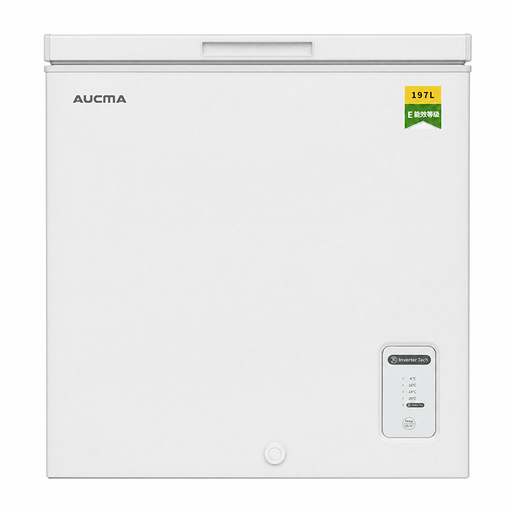
AUCMA 197 L convertible chest freezer

AUCMA 197 L convertible chest freezer

For increasing your family’s frozen-food reserves without choosing a very large chest freezer.

Stated capacity of 197 L, 4-star freezer function, five-level digital control, removable basket and defrost drain. Stated dimensions: 816 × 554 × 848 mm.

Organise portions so that items at the bottom remain accessible. Confirm the climate class, storage time during a power cut and freezer-mode setting in the instructions for the AF-200NF model.

Joybuy
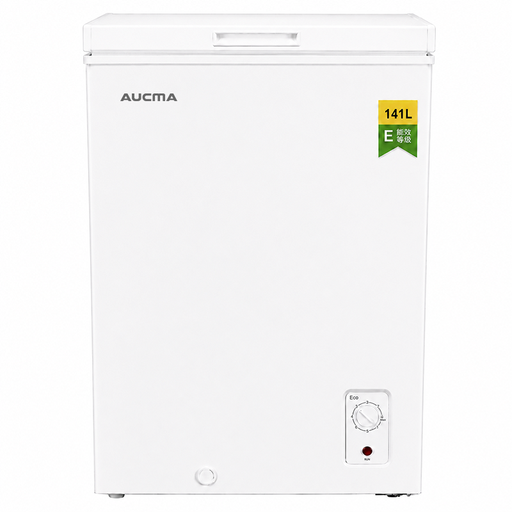
AUCMA 141 L convertible chest freezer

AUCMA 141 L convertible chest freezer

For extra capacity for portions and small batches.

Stated capacity of 141 L, 4-star freezer function, seven-level mechanical thermostat, removable basket, soft-opening lid and defrost drain. Stated dimensions: 632 × 554 × 848 mm.

This capacity is better suited to additional storage than to very large reserves. Check the climate class, storage time during a power cut and the freezer settings for the AF-150NF model.

Joybuy

TCL CF182EWE0FR 140 L chest freezer

TCL CF182EWE0FR 140 L chest freezer

For additional storage of portions or small batches in a dedicated freezer compartment.

Stated capacity of 140 L, storage basket, counterbalanced lid, adjustable thermostat, castors, adjustable feet and front water drain. Stated dimensions: 637 × 556 × 846 mm.

Organising food by category helps reduce the time spent searching inside the freezer. Check the climate class, storage time during a power cut, annual consumption and operating range for the CF182EWE0FR model.

Joybuy

Frequently asked questions

What capacity should I compare for family reserves?

Compare the net freezer capacity that is genuinely available. For a fridge-freezer, total capacity also includes the fridge compartment, so check the freezer compartment separately on the product information sheet or in EPREL. UFC-Que Choisir describes upright freezers as often being close to 200 L, reaching 400 L for larger models, while chest freezers can reach 600 L; these are format guidelines, not universal thresholds.

Can I install a freezer in a garage or cellar?

Yes, but only if the model’s climate class or operating range covers the temperatures actually reached in that room. Beko states, for example, that an SN-T class covers 10 to 43 °C and that certain Freezer Guard appliances are designed to operate down to -15 °C; this exception does not apply to every freezer.

How should I interpret storage time during a power cut?

Storage time is specific to each model and must be compared for the exact appliance. In its testing protocol, UFC-Que Choisir measures the time taken to rise from -17 °C to -9 °C without power; the upright or chest format alone therefore cannot indicate this duration.

Which regulated information should I check before ordering in France?

For relevant household refrigeration appliances sold in the European Union, check the energy label and the model information. EPREL, the European Commission’s public database, provides energy-efficiency and environmental-performance data based on the exact reference.