Who is this choice for?

Households that batch-cook

If you regularly freeze portions, tubs and bags, how easy they are to organise and access every day matters just as much as the available capacity. Que Choisir describes how freezers are used for frozen food and home cooking, while Europe 1 discusses preparing meals in advance.

Households that buy in bulk

Bulk buys and bulky containers mean you need to compare usable capacity with the space available. With a chest freezer, also think about how you’ll find food in its open interior. This is one point to consider when choosing between the formats described by Que Choisir.

Households planning to use a cellar, pantry or garage

If the room is unheated or subject to temperature fluctuations, check the permitted ambient temperature range for the exact model. Que Choisir explains the role of the climate class; the permitted temperatures listed by Liebherr and Beko France apply to their respective models.

What sets the different formats apart?

Upright freezer

Choose this if: you often take out individual portions and want to organise them in easy-to-access drawers.

Bear in mind: drawers divide up the space, so check that your dishes will fit and that the drawers will still be easy to handle once the freezer is installed.

Chest freezer

Choose this if: bulk buys or bulky containers call for an open interior and you have enough floor space.

Bear in mind: food at the bottom is less easy to reach. Organise it using baskets or categories.

Table-top or under-counter freezer

Choose this if: you need a separate appliance but don’t have room for a tall upright freezer or a chest freezer.

Bear in mind: compare its usable capacity with the amount of shopping and prepared food you need to store before relying on this format as your main solution.

Fridge-freezer

Choose this if: you’re also replacing your fridge and the new model’s freezer compartment is big enough for your usual shopping.

Bear in mind: check the capacity of the freezer compartment, not just the appliance’s total capacity, before deciding against a second appliance.

Criteria What to check Who should consider it?
Capacity Usable capacity in litres and dimensions, allowing for the clearances specified for installation. If bulk buys and prepared meals regularly overflow the current compartment, I want genuinely usable space for the containers I plan to store. Around 30% of consumers would make capacity their top priority.
Access and organisation The size and ease of use of the drawers, or whether there are baskets and how easy it is to reach the bottom of a chest freezer. If I take out portions every day, I want to find them without moving all the other food. Easy access would be the main priority for around 30% of consumers.
Installation room The minimum and maximum ambient temperatures permitted for the model, followed by the installation instructions. If I’m installing the appliance in an unheated garage, cellar or pantry, I need to know whether it can operate at the temperatures in that room. Around 20% of consumers would put this compatibility first.
Keeping food frozen Declared storage time in the event of a power cut and energy consumption in kWh/year; freezing capacity in kg/24 h if you’ll be adding a lot of food. If I keep food in the freezer all the time, I want to compare storage time and energy consumption across models that already meet my space requirements. These criteria would be a priority for around 20% of consumers.

What not to overlook

  • Installing a freezer in a cold room without checking the model

    An unheated cellar or garage won’t necessarily be suitable. The permitted ambient temperature depends on the appliance; the operating temperatures down to −15 °C published by Liebherr and Beko France apply to specific models.

    Note the room’s temperatures and compare them with the range shown in the manual for the freezer you’re considering.

  • Confusing a large capacity with easy storage

    In a chest freezer, food at the bottom can be difficult to reach. Drawers in an upright freezer make it easier to sort food, but can limit the size of some containers.

    For a chest freezer, plan to use baskets and rotate your stock. For an upright model, check there’s enough room to open and remove the drawers.

  • Choosing based on the energy rating alone

    An energy rating letter is no substitute for comparing annual energy consumption and usable capacity, especially when looking at appliances of different sizes.

    Check the kWh/year and litre figures for each model, then make sure its capacity suits your usual shopping.

  • Forgetting about delivery and your old appliance

    A large freezer needs to fit through your home’s access points and reach its intended location. You’ll also need to arrange for your old appliance to be taken away.

    Before ordering, confirm the seller’s delivery, installation and take-back arrangements.

Brands to consider, model by model

Bosch

The brand’s upright freezers may appeal to households that want to keep prepared meals and frozen food organised separately.

  • According to the Bosch Électroménager France product information, the GSN58VWEV has 366 L of usable freezer capacity and a stated storage time of 12 h in the event of a power cut.
  • This model measures 191 × 70 × 78 cm, so check that it will fit in your chosen location and that you can get it through the access points before opting for this capacity.

Liebherr

Its chest freezers are worth considering if you need a large open space for bulk buys.

  • Liebherr lists a capacity of 359 L and FrostProtect down to −15 °C for the CFd 2505 Plus.
  • This temperature rating applies to this model, not all of the brand’s chest freezers. Check that you have enough space, too.

Beko

Some of the brand’s chest freezers have a clearly stated minimum ambient temperature, making them worth considering for installation outside the kitchen.

  • Beko France says the HSM27050 can operate at an ambient temperature as low as −15 °C.
  • Its chest format calls for some thought about how to organise the open interior. You can’t assume an appliance will suit a cold room just because of the brand name.

Whirlpool

The brand offers fridge-freezers and chest freezers to compare, depending on whether you’re replacing your fridge or adding a freezer.

  • Whirlpool France lists 106 L of freezer capacity for the WHK25364W4E fridge-freezer; its WHM4612 chest freezer information states a storage time of 32 h in the event of a power cut.
  • These figures relate to two different appliances, so check the freezer capacity and storage time separately for the model you choose.

Electrolux

Built-in fridge-freezers are worth considering if you’re replacing an appliance integrated into your kitchen.

  • Electrolux lists 62 L of freezer capacity and three drawers for the ENT6NE18S built-in fridge-freezer.
  • Compare this capacity with your shopping and check the cabinet niche dimensions before choosing a built-in appliance.

Appliances to suit these needs

These appliances illustrate three ways to increase or reorganise your frozen food storage: replace your fridge-freezer, add a chest freezer or choose an upright model with compartments. Compare the freezer capacity you need for your shopping, then check the requirements of the room where you plan to install it.

Candy CFQQ5T817EPS four-door fridge-freezer

Candy CFQQ5T817EPS, 467 L 4-door fridge-freezer

Worth considering if you’re also replacing your fridge and want to keep your frozen food in a fridge-freezer. The model name lists a total capacity of 467 L, Total No Frost technology and an E energy rating. Compare the capacity of the freezer compartment alone with your needs, and check the dimensions and permitted ambient temperature range.

View on Joybuy

Haier HTW5618ENMG three-door fridge-freezer

Haier HTW5618ENMG, 360 L 3-door fridge-freezer

Another option if replacing your fridge is part of the plan. The model name lists a total capacity of 360 L, Total No Frost technology and an E energy rating. Check that the freezer section is big enough for the portions you plan to store, then check the dimensions and permitted ambient temperature.

View on Joybuy

AUCMA 291 L convertible chest freezer

AUCMA, 291 L convertible chest freezer

Its chest format is worth considering for bulk buys or bulky containers, as long as you plan how to organise them in the open interior. The product name lists a capacity of 291 L, switchable fridge and freezer modes, and a removable basket. Check the dimensions and ambient temperature range before installing it in an unheated room.

View on Joybuy
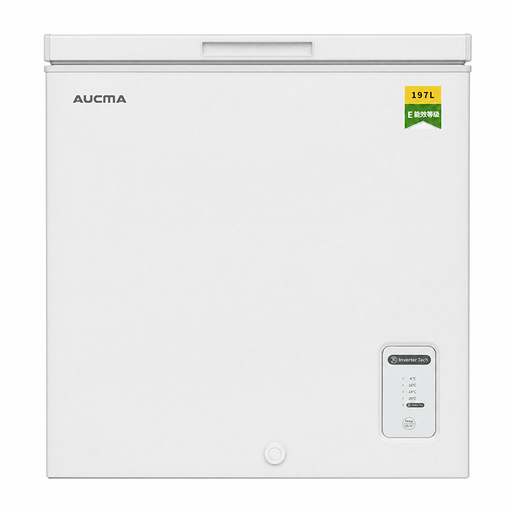
AUCMA 197 L convertible chest freezer

AUCMA, 197 L convertible chest freezer

Worth considering if you want to add a chest freezer for frozen food and prepared meals, without choosing the capacity of the other AUCMA model featured here. The product name lists a capacity of 197 L, fridge and freezer modes, and a removable basket. Plan how you’ll reach food at the bottom and check the installation requirements for your chosen room.

View on Joybuy

Heinrich´s 161 L upright freezer in stainless steel finish

Heinrich´s, 161 L stainless steel upright freezer

Worth considering if you’d rather organise food in a separate appliance with compartments than in an open chest freezer. The product name lists a capacity of 161 L, drawers and No Frost functionality. Check the dimensions, annual energy consumption and permitted ambient temperature range for your chosen location.

View on Joybuy

Frequently asked questions

Can you install a freezer in a garage or cellar?

Yes, as long as the permitted ambient temperature range for the model covers the temperatures in the room. Check the manual rather than relying on the format alone: the operating temperatures down to −15 °C for some Liebherr and Beko models don’t apply to every freezer.

What does the stated storage time in the event of a power cut mean?

It’s a model-specific duration, given in hours, and should be compared under similar test conditions. In its simulated power-cut test, Que Choisir measures how long food stays below −9 °C. Check the conditions attached to any stated figure before comparing two appliances.

Is the energy rating enough to compare two freezers?

No. You should also check each appliance’s annual energy consumption in kWh and usable capacity. According to the DGCCRF, household refrigerating appliances, including freezers and fridge-freezers, have been subject to the energy label applicable since 1 March 2021. The rating letter alone doesn’t tell you whether the capacity suits your needs.

What should you check about spare parts?

Ask which parts are available for the model you’re considering and how to order them. The DGCCRF outlines the availability periods set by ecodesign rules for household refrigerating appliances. These vary by part, including between door seals and other components covered by the rules.

How can you arrange for your old freezer to be taken away?

Check the collection arrangements with the seller before your new appliance is delivered. In France, the DGCCRF highlights the principle of free take-back of an equivalent used appliance when you buy a new one. Confirm where and when your old freezer needs to be ready for collection.