Which households suit each type?
How often you take out portions matters just as much as how much food you need to store.
Households that batch-cook several portions
If you label your meals with dates and regularly take out one or two portions, an upright freezer with drawers can make them easier to organise and access. Check that the drawers fit your containers and dishes.
Households that stock up in bulk
For bulk shopping or bulky containers, consider the open storage space in a chest freezer. You’ll also need to be able to reach food at the bottom and have a room whose temperature is suitable for the model you choose.
Households short on kitchen space
A slimline upright freezer is worth comparing if you mainly need more freezer space. If you’re also short on fridge space, measure the fridge and freezer capacities separately when considering a larger fridge-freezer.
What should you compare before choosing?
Upright freezer
Consider it: if you regularly take out portions organised in drawers.
The trade-off: drawers can limit the space available for some larger dishes; check their dimensions and how easily they slide out.
Chest freezer
Consider it: if you need plenty of storage or room for bulky containers, and have enough floor space.
The trade-off: food at the bottom needs to be organised in baskets or bins to keep it accessible.
Larger fridge-freezer
Consider it: if you need more space for both fresh and frozen food, particularly when replacing your main appliance.
The trade-off: check the freezer capacity separately; a large total capacity doesn’t guarantee enough room for your prepared meals.
| What to consider |
What to check |
Think about your needs |
| Access to portions |
Layout and dimensions of drawers, bins or baskets; whether compartments can be removed; access to food at the bottom. |
I often take out individual meals, so I want to find a dated portion without emptying the appliance. |
| Capacity and footprint |
Freezer capacity in litres; appliance and access-way dimensions; clearance needed to open the door or lid and allow for ventilation. |
For bulk shopping or large dishes, the shape of the containers matters as much as the stated capacity. In a small kitchen, the floor space and how the appliance opens may determine which type to choose. |
| Adding food and power cuts |
Freezing capacity in kg/24 h, stated storage time in the event of a power cut, and whether there’s a temperature or door alarm. |
When I freeze a lot of portions at once, I check the freezing capacity. If the appliance isn’t closely monitored, an alarm may also be useful. |
| Energy use and noise |
Annual consumption in kWh, volume and noise level on the energy label; compare appliances of a similar type and capacity. |
An appliance that runs continuously will affect my energy use. If it’s near a living area, I’ll also check its noise level. |
| Room where it will be installed |
Climate class, permitted ambient temperature range and clearances specified in the manual for the exact model. |
If the freezer is going in an unheated garage or cellar, I need to check that it can operate at the temperatures in that room. |
According to the European Commission, freezer energy labels show details including annual consumption, capacity and noise. Use these figures to compare the models you’re considering, rather than judging energy use by the rating letter alone.
Which brands and ranges should you consider?
These models show some configurations worth comparing; their specifications don’t apply to every product from each brand.
Bosch
The range includes upright freezers, including options for households looking to store food in a vertical appliance.
- Bosch lists the GSN54EWCV with a capacity of 328 l, a C rating, No Frost, VarioZone features and a BigBox drawer.
- Its stated storage time during a power cut is 14 h. Compare this figure and its dimensions with your installation and storage requirements.
Liebherr
The range includes chest freezers worth considering for storing larger quantities, particularly if you plan to install one in an unheated room.
- Liebherr lists a capacity of 248 l and FrostProtect down to -15 °C for the CFd 2085 Plus chest freezer.
- Check the permitted installation temperature range for the exact model and plan how to organise food at the bottom of the freezer.
Beko
The range includes upright freezers to compare if available width or room temperature is a key factor in your choice.
- Beko lists the RFNM200T40WN with a capacity of 177 l, a minimum ambient temperature of -15 °C and energy consumption of 210.50 kWh/year.
- These figures apply to this model: check its manual and the dimensions needed for installation.
Whirlpool
The range includes high-capacity upright freezers to consider if you want to divide your portions between several drawers.
- Whirlpool lists the WHFF 6403 W4E with a capacity of 404 l, six drawers and energy consumption of 292 kWh/year.
- This model has an E rating. Check its dimensions and compare its energy consumption with appliances offering the same capacity for your needs.
Which freezers should you consider on Joybuy?
These upright and chest freezers offer a range of separate storage capacities for prepared meals or bulk shopping. Compare their layouts and the specifications of the model you’re interested in with the space you have available.
 Image unavailable
Heinrich´s, 161 l stainless steel upright freezer
The upright design and drawers can help you separate portions you take out regularly. The product name lists No Frost, a C energy rating, an LED display and an alarm. Check the dimensions and ambient temperature range before deciding where to put it.
View on Joybuy
 Image unavailable
AUCMA, 291 l convertible chest freezer
This chest freezer is suited to storing prepared meals or bulk shopping, provided you can organise food at the bottom. The product name lists an E rating, a removable basket, LED lighting and a defrost water drain. If you’re installing it in a garage, check the permitted ambient temperature range rather than relying on the suggested use in the name.
View on Joybuy
 Image unavailable
CHiQ JR99DWE, 99 l chest freezer
With a capacity of 99 l, this is better suited to extra storage than to keeping a large stock of food. The product name lists an E rating, a removable basket and an adjustable thermostat. Check the annual energy consumption and the space needed to open the lid.
View on Joybuy
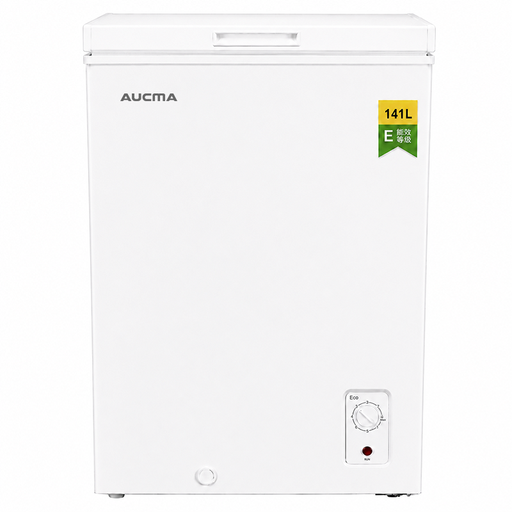 Image unavailable
AUCMA, 141 l convertible chest freezer
This chest freezer can hold portions in bins, but its removable basket won’t make food at the bottom as easy to reach as drawers would. The product name lists an E rating, a seven-setting thermostat and a defrost water drain. Check the ambient temperature range if the room is unheated.
View on Joybuy
 Image unavailable
COMFEE' RCU60WH2(E), 60 l upright freezer
This capacity is worth considering for a few extra portions, but may be too small for batch cooking in larger quantities. The product name lists an E rating and a reversible door. Check the internal layout before buying: product information describes the number and type of compartments differently.
View on Joybuy
Frequently asked questions
What temperature should you freeze home-cooked meals at?
Anses uses -18 °C as the benchmark for home freezing: this temperature stops bacteria from multiplying, but doesn’t destroy most microorganisms. It recommends freezing food as soon as you buy or prepare it, defrosting it in the fridge, in the microwave using the defrost setting, or quickly by cooking or reheating it, then eating defrosted food promptly and not refreezing it.
How can you tell whether a freezer can be installed in a garage?
Check the climate class and ambient temperature range in the manual for the exact model. Liebherr lists its CFd 2085 Plus chest freezer as suitable down to -15 °C, and Beko lists the same minimum temperature for its RFNM200T40WN upright freezer. These specifications don’t automatically apply to other models.
What should you look for on a freezer’s energy label?
According to the European Commission, the label in use since 1 March 2021 shows an A to G rating, annual consumption in kWh, storage capacities and noise. Compare the energy consumption of models with a type and capacity that meet your needs; the QR code links to additional information about the model in EPREL.
What should you do with your old freezer in France?
France’s Ministry for the Ecological Transition says to take this electrical appliance to a collection point or recycling centre, return it to a retailer or hand it over to a social and solidarity economy organisation. Use one of these options rather than putting it out with household waste.


