If you mainly need extra space for frozen food, choose a format that suits the way you use your supplies. An upright freezer makes it easier to organise food and access portions regularly, while a chest freezer is better suited to bulky purchases if you have enough floor space. An under-counter model works well as extra storage. If you’re also short of space for fresh food, compare the freezer capacity of a large fridge-freezer with that of a separate appliance. Whichever you choose, check the dimensions, the permitted room temperature, how long food will stay frozen during a power cut and the annual energy consumption.
Which format suits your needs?
Households that batch-cook
If you regularly store portions in tubs and bags, the drawers in an upright freezer can help you find what you need without rummaging through a large compartment. How useful they are depends on the size of your containers and how often you use them.
Households that buy in bulk
A chest freezer offers less compartmentalised storage for family-sized packs and bulky food. However, you’ll need to allow for its floor space and consider how easy it is to reach items at the bottom. If you’re planning to put it in a cellar or garage, check the permitted room temperature for that model.
People short on space
An under-counter freezer can add a little extra storage to a compact kitchen. If your food stocks grow, compare the footprint and usable capacity of an upright model before settling on the smallest format.
What should you look for?
If you need extra freezer capacity for regular use, start by listing the food you want to store and how often you’ll need to access it. This will help you choose a format before comparing the features of models with a suitable capacity.
| What to consider |
What to check |
Who this matters to |
| Storage capacity |
Think about the portions and bulky food you’ll be storing, then compare usable freezer capacity. For a fridge-freezer, make sure you look at the freezer capacity rather than the total capacity. |
When I batch-cook several meals or buy in bulk, I want enough room for my usual supplies. Around 29% of consumers put capacity at the heart of their choice. |
| Access to food |
Look at the drawers or baskets and check that your containers will fit and remain easy to reach. |
If I often need a particular portion, I want to find it without moving everything else. For around 29% of consumers, organisation comes before other factors. |
| Space and installation |
Measure the space, delivery route and the clearance needed to open the door or lid. If you’re placing the freezer in an outbuilding, check its permitted room temperature. |
In a small kitchen or an unheated room, I need to be able to install and use the appliance in the conditions it’s designed for. This is the top priority for around 21% of consumers. |
| Everyday use |
Compare the kWh/year and noise levels shown on the energy label, as well as each model’s stated storage time during a power cut. |
If I keep a large stock in an appliance that runs continuously, I pay close attention to energy use and how long it will stay cold during a power cut. Around 21% of consumers prioritise these practical considerations. |
What to avoid before you buy
-
Choosing based on capacity alone
A spacious chest freezer won’t necessarily make it easy to access the portions you use every day. On the other hand, a large fridge-freezer may be a good choice if you’re also short on space for fresh food.
Make a list of what you store and what you use regularly. Then compare the usable capacity and interior layout of the formats you’re considering.
-
Putting a freezer in an outbuilding without checking the permitted temperature
Whether a freezer is suitable for a garage or cellar depends on the permitted room temperature range for the specific model, not simply on whether it’s a chest freezer.
Before ordering, compare the temperatures the room may reach with those listed in the model’s specifications or instruction manual.
-
Comparing only the energy efficiency rating
The rating alone doesn’t tell you the annual energy consumption, capacity or noise level, all of which can help you choose between appliances suited to your needs.
Check the kWh/year and noise emissions on the energy label, then compare models with similar capacity and installation requirements.
-
Relying on the model name without checking its specifications
A recognisable model name isn’t enough to tell you its usable capacity, storage time during a power cut or installation requirements.
Check the full model number and compare its key specifications with the manufacturer’s documentation before making your decision.
Brands to compare
These brands offer formats that may suit the needs discussed here. The features mentioned apply to the specific models or ranges named, not necessarily to every appliance they make.
Bosch
The range includes upright freezers and large fridge-freezers. Compare them depending on whether you need more space for frozen food alone, or for fresh food too.
- According to Bosch Électroménager France, the GSN58AWEV upright freezer offers 366 L of capacity, VarioZone and BigBox storage, and NoFrost technology.
- This model measures 191 × 70 × 78 cm and has a stated storage time of 12 h during a power cut. Check that its size and storage time suit your needs.
Beko
Beko offers compact models and chest freezers, making it possible to compare a little extra storage with a larger-capacity option.
- Beko France lists the compact FSE1174N freezer with a capacity of 95 L and a width of 54 cm.
- Beko says some chest freezers in its range can operate at room temperatures as low as −15 °C. Check this feature for the model you’re considering rather than assuming it applies to every model.
Whirlpool
Whirlpool chest freezers are worth comparing if you’re looking for substantial storage for bulk purchases.
- Whirlpool France lists a total usable capacity of 308 L and a storage time of 36 h during a power cut for the W3RHS31DW2 chest freezer.
- Its stated dimensions of 112 × 85 × 71.5 cm mean you’ll need to check there’s enough room for the freezer and to open the lid.
Liebherr
Liebherr’s freestanding freezer range includes a variety of capacities, with frost-management features that vary by model.
- Liebherr describes FrostProtect as a feature designed for room temperatures as low as −15 °C on eligible appliances.
- If you’re installing a freezer in an unheated room, check that your chosen model has the stated feature, as well as the capacity and energy consumption you need.
Joybuy products for your needs
These models include an upright freezer for organising portions, a chest freezer for supplies you access less often, a compact option for a little extra storage, and a fridge-freezer if you also need more room for fresh food. Compare their freezer capacity and where you could install them before choosing.
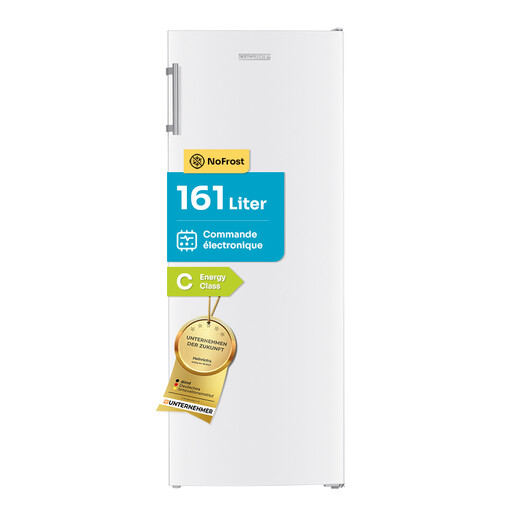 Image unavailable
Heinrich´s 161 L NoFrost upright freezer
Worth considering if you’d like to organise portions in a freezer separate from your fridge. The product title lists a capacity of 161 L, drawers, NoFrost technology and an energy efficiency rating of C. Check the dimensions, kWh/year and permitted room temperature for your chosen location.
View on Joybuy
 Image unavailable
COMFEE’ RCU60WH2(E) 60 L compact freezer
This model is suited to a small supply of portions if 60 L is enough for your usual needs. The product title lists three drawers, a reversible door and an energy efficiency rating of E. If you buy bulky items, check first whether this capacity will be sufficient.
View on Joybuy
 Image unavailable
TCL CF182EWE0FR 140 L chest freezer
This chest freezer can hold extra supplies if you have a dedicated space for it. The product title lists a capacity of 140 L, a storage basket, a counterbalanced lid and an energy efficiency rating of E. Also consider how easy it will be to reach food stored beneath the basket.
View on Joybuy
 Image unavailable
Samsung RF50C530EB1 495 L fridge-freezer
This fridge-freezer is worth considering if you’re short on space for both fresh and frozen food. The product title lists a total capacity of 495 L and an energy efficiency rating of E. Compare the freezer compartment’s capacity separately with your storage needs.
View on Joybuy
 Image unavailable
CHiQ JR99DWE 99 L chest freezer
This small chest freezer can provide extra storage if you prefer a single compartment to drawers. The product title lists a capacity of 99 L, a removable basket and an energy efficiency rating of E. Consider how easy it will be to reach food at the bottom, and note that this model requires manual defrosting.
View on Joybuy
Frequently asked questions
Do I need a separate freezer to batch-cook?
A separate freezer is worth considering if your current compartment can no longer hold the portions and other frozen food you regularly keep. Take stock of what you usually store. If you’re also short on space for fresh food, compare the freezer compartment of a large fridge-freezer before adding another appliance.
Can I put any freezer in a garage or cellar?
No. Before choosing a location, check the minimum and maximum room temperatures permitted for the exact model. Some manufacturers say their models are designed for rooms that reach as low as −15 °C, but this doesn’t apply to all their freezers.
What should I look for on a freezer’s energy label?
Look in particular at annual energy consumption in kWh, storage capacity and noise emissions, which the European Commission says are shown on the labels of applicable appliances. Compare these figures across models with a format and capacity to suit your needs. The efficiency rating alone won’t tell you how easy an appliance is to use.
Does a commercial guarantee replace the statutory guarantee of conformity?
No. If you buy a new freezer in France from a professional seller, the statutory guarantee of conformity applies regardless of any commercial guarantee, as economie.gouv.fr explains. Check the terms of any additional guarantee offered by the seller separately.


