
Livraison le jour même ou le lendemain

Qualité garantie

Débloquez vos offres de bienvenue: Livraison GRATUITE | Jusqu'à -80 % | 30 jours d'essai gratuits à JoyPlus
Téléchargez l'application
Does your child dream of a freestyle scooter to start landing tricks at the skatepark? As a parent, your priority is simple: a model that's safe, durable, and suited to their skill level—without you having to get lost in technical jargon. Faced with an overwhelming number of options, it's hard to tell a simple toy from real sports equipment.
This guide is here to shed some light. As the head of product selection at Joybuy, my mission is to give you the keys to making the right choice, one that fits both your child's ambitions and your budget.
Before we dive into our top picks, let's review the essential criteria for finding the ideal trick scooter.
A stunt scooter withstands repeated impacts. Its sturdiness is therefore the number one safety criterion.
For a kid's freestyle scooter, weight is a key factor. A lightweight model is easier to handle for learning the first tricks like the "bunny hop." But be careful: light weight should never come at the expense of durability.
The handlebar height is just as crucial. Ideally, it should come up to somewhere between the rider's waist and navel. A handlebar that's too high or too low will compromise balance and control.
Here are the models that caught our eye, each standing out for its unique features and target audience.

Why It Stands Out The VOKUL S2 was designed as the ultimate beginner freestyle scooter. It combines robust materials, like a 6061 aluminium frame and a Chromoly steel handlebar, with a design focused on safety for learning those first tricks. Its triple-bolt clamp guarantees rock-solid stability.
Pros
Who Is It For? This is the ideal choice for kids aged 7 to 14 who are new to the sport and want to learn the basics in complete safety.
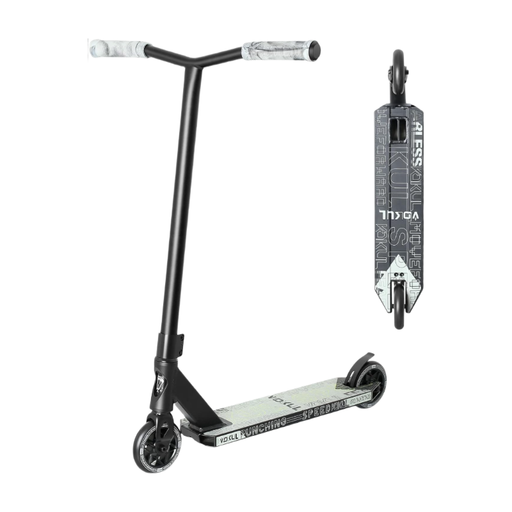
Why It Stands Out The VOKUL K1 is a step up, aimed at intermediate-level riders. It's equipped with larger 110mm wheels with a solid alloy core and ABEC-9 bearings for increased speed and smoothness. Its T-6061 aluminium deck and one-piece fork are built to withstand more complex tricks.
Pros
Who Is It For? Perfect for teens and young adults (8 to 18) who have already mastered the basics and are looking to take it to the next level with higher-performance gear.

Please note: this model is a fun, adjustable scooter, but it is not designed for intensive freestyle riding (tricks).
Why It Stands Out The Beleev V2 is all about the fun of riding and developing balance in younger children. Its LED light-up wheels and deck (battery-free for the wheels) make it particularly appealing. Its "lean-to-steer" system (the child leans to turn) is ultra-intuitive.
Pros
Who Is It For? An excellent choice for young children (3-12 years) who aren't quite ready for a stunt scooter but want to discover the joy of riding safely.
If these models don't quite match what you're looking for, or if you want to explore other designs, feel free to browse our full catalogue.
? Explore our full range of Scooters for Boys, Girls, and Kids to find the perfect one.
A classic scooter is made for getting around: it's often foldable, comfortable, and designed for commuting. A freestyle (or stunt) scooter, on the other hand, is a skatepark beast. It's not foldable and is built to take the impact of jumps and tricks, with reinforced components and smaller, harder wheels for maximum responsiveness.
There's no official age, but most kids get started around 7 or 8, once they have good balance and coordination. The most important thing is to choose a kid's freestyle scooter that's the right size and weight for them to ensure easy and safe handling.
Safety is not optional. Wearing a certified helmet is essential. It is also highly recommended to equip your child with knee pads, elbow pads, and wrist guards. Falls are part of the learning process, so it's best to be well-protected.