
Livraison le jour même ou le lendemain

Qualité garantie

Débloquez vos offres de bienvenue: Livraison GRATUITE | Jusqu'à -80 % | 30 jours d'essai gratuits à JoyPlus
Téléchargez l'application
Choosing a freestyle scooter for a child or teen can quickly become a headache. Between the technical jargon, marketing promises, and the fear of picking a flimsy or dangerous model, it's easy to feel lost. Our mission: to break it all down for you. Let's skip the fluff and get straight to the point to help you make an informed decision, risk-free.
This guide isn't the result of lab tests, but of a meticulous analysis of technical specs and, most importantly, hundreds of user reviews. The goal is simple: to give you the keys to decode the market and understand what truly makes a difference.
The market is flooded with models that look identical, but their quality can vary dramatically. Here are the classic mistakes that can turn a promising purchase into a major disappointment.
The disguised "toy scooter" trap: Many low-priced models have the look of a stunt scooter but are actually just toys. Their weak points? Decks that are too thin and bend, fragile welds on the fork, and handlebars that quickly become loose. These models aren't designed to withstand the repeated impacts of jumps and tricks, and can become dangerous after just a few weeks of use at the skatepark.
The "high-performance" bearing myth: The ABEC-9 rating is often touted as a guarantee of speed and quality. While good bearings are important, they aren't everything. An ABEC-9 bearing, no matter how good, mounted on a plastic (nylon) core wheel with low-grade urethane will never offer the smoothness and durability of a well-matched setup. It's the synergy between the wheel and the bearing that creates true performance.
The "grow-into-it" size mistake: Unlike a bike, a trick scooter must be perfectly sized to the rider's body. Handlebars that are too high (above the navel) or too low (below the hips) make control very difficult and learning tricks nearly impossible. Buying a model "for later" is a classic mistake that compromises both safety and the joy of riding.
To avoid these traps, just focus on three key components. These are what determine the durability, safety, and performance of both a pro scooter and a beginner model.
The deck is the cornerstone. It absorbs all the stress when landing jumps.
Wheels are crucial for speed, grip, and shock absorption.
The handlebars (or "bars") and their fastening system are essential for control and safety.
Here are our top picks that check all the boxes for different types of riders.
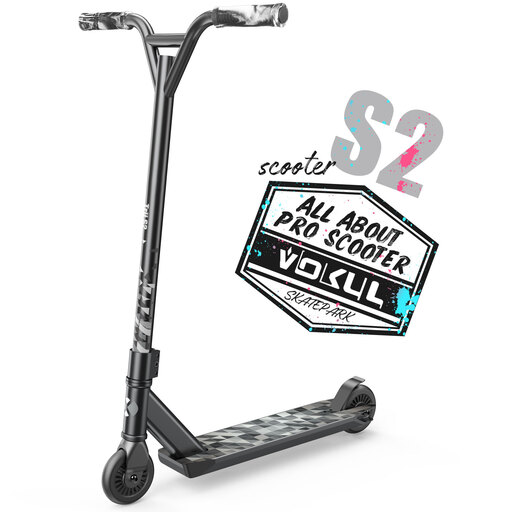
Why it's a great choice: Designed specifically for beginners, this model offers a stable build and appropriate dimensions for learning the basics safely. It's the ideal starting point for a child who wants to get serious about freestyle.
This is no toy. With its 4130 Chromoly steel handlebars and a reinforced 6061 aluminium deck, it's built to withstand those first jumps, unlike flimsy entry-level models.
The combination of a triple clamp and a sturdy construction ensures great stability, which builds confidence for young riders as they practice.
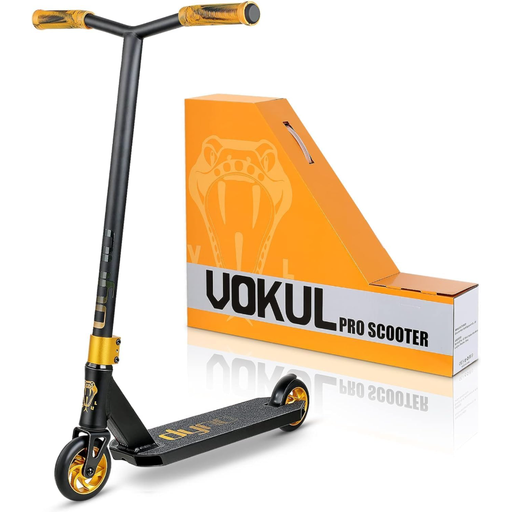
Why it's the right choice: Ideal for the rider who has mastered the basics and is looking to level up. The Vokul K1 Pro is equipped with higher-performance components to attempt complex tricks like barspins or tailwhips.
It debunks the bearing myth by pairing ABEC-9 bearings with 110mm alloy core wheels. This cohesive combination delivers a genuinely smooth and fast ride, not just a marketing gimmick.
Its 6061-T6 aluminium deck and heat-treated fork provide the necessary strength to handle higher jump landings, supporting the rider's progression.
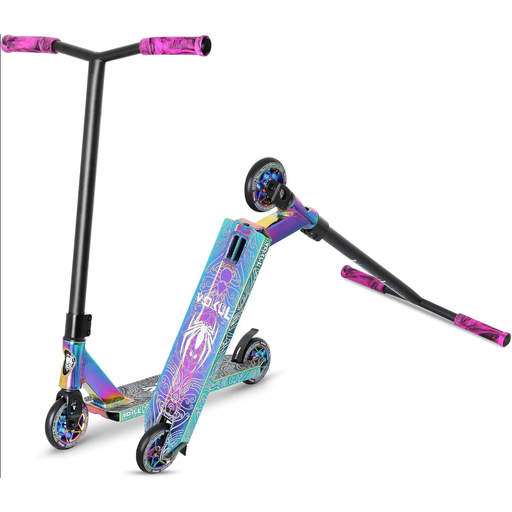
Why it's a great choice: For those who value style as much as performance. This version of the K1 Pro combines the same solid technical specs with a "Neo Chrome" finish that stands out at the skatepark.
It avoids the trap of improper sizing. Its proportions (handlebar height, deck length) are designed for freestyle riding, ensuring an optimal centre of gravity and good control for tricks.
Design is its key advantage, but it doesn't sacrifice performance. It includes all the components of a good intermediate scooter: 110mm wheels, ABEC-9 bearings, and an aluminium deck.
We've selected a full range of models that meet our quality criteria and current safety standards.
The golden rule is simple: the handlebars should come to between the child's waist and navel when they are standing on the deck.
The lifespan depends on the intensity of use and the quality of the components. A "toy" scooter can break in a matter of weeks. A quality beginner or intermediate model, like the ones featured here, can last for several years. Wear-and-tear parts (wheels, grips, bearings) can be replaced to extend its life.
Yes, it's possible, but it's definitely not its strong suit. Its small, hard wheels make for a much less comfortable ride on uneven surfaces (cobblestones, rough asphalt) than a classic commuter scooter. Not to mention, they are generally not foldable, which makes them impractical to carry or store on a daily basis.