
Livraison le jour même ou le lendemain

Qualité garantie

Débloquez vos offres de bienvenue: Livraison GRATUITE | Jusqu'à -80 % | 30 jours d'essai gratuits à JoyPlus
Téléchargez l'application
Planning a trip to the UK? Whether it's for a weekend in London, a semester studying in Edinburgh, or a business trip to Manchester, there's one practical but crucial detail to consider: your French electronic devices won't plug into the local wall sockets. The search for a France-to-UK plug adapter might seem simple, but the market is flooded with ineffective, and even dangerous, products.
As the Head of Product Recommendations at Joybuy, my role is to help you see clearly. No marketing jargon here—we'll get straight to the point. Here are the classic mistakes to avoid and the essential criteria for making the right choice.
To ensure safety and compatibility, three points deserve your full attention. This is your guarantee of a reliable adapter that won't fail you mid-trip.
The UK, Ireland, Malta, and Singapore use the Type G plug. It is recognisable by its three rectangular prongs.
This third prong is an essential safety feature. If your French device has a male plug with an earth pin (Type E/F), it is imperative to choose a Type G adapter that maintains the continuity of this protection.
Every adapter has a power limit that should not be exceeded. This value is expressed in watts (W) and amps (A).
Warning: Never use a standard travel adapter for high-consumption devices like a hairdryer, hair straightener, or kettle, unless the adapter is specifically designed and clearly marked for this purpose.
These logos are not just stickers.
The presence of at least one of these two marks (ideally both) on a UK plug adapter is a sign of quality, proving that the product has passed compliance tests.
Rather than an endless list, here are targeted options for different types of travellers.
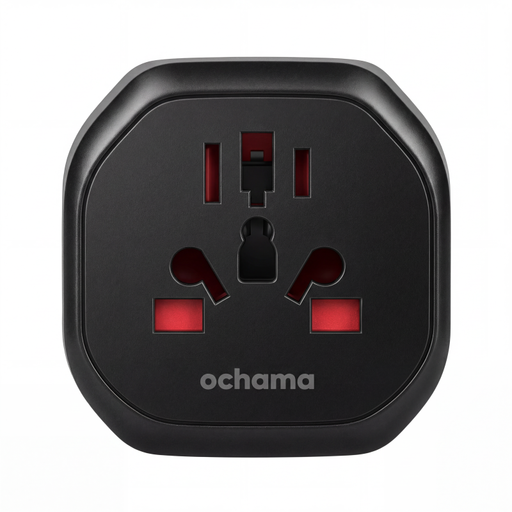
Why we chose it: For a city break or a short trip, this model covers the essentials. It's compact, accepts French plugs, and most importantly, it's certified. A simple and safe solution for charging your phone and camera.
Unlike unbranded products from unreliable vendors, it has CE and UKCA certifications, guaranteeing its compliance with safety standards. Its design also includes child safety shutters.
Simplicity and certified safety for occasional use. Its compact size will take up very little space in your luggage.
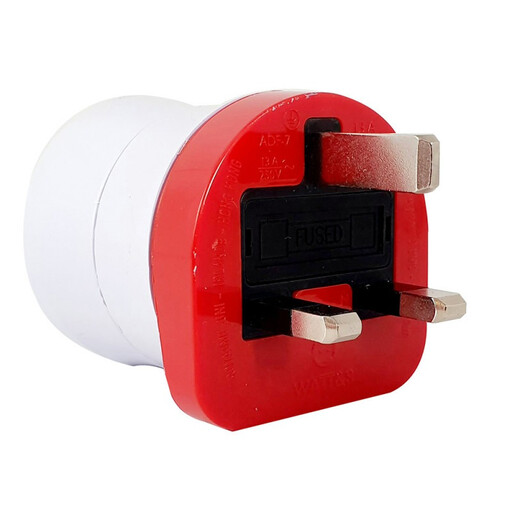
Why we chose it: For those who travel with a laptop and for whom reliability is non-negotiable. This model is specifically designed for intensive and secure use.
It ticks the two most important boxes: it features an earth connection for devices that require it (like a laptop) and supports a high power rating of 13 A / 3200 W, eliminating any risk of overheating with a powerful charger.
Maximum safety thanks to the earth connection and high power capacity, ideal for valuable electronic equipment and extended stays.
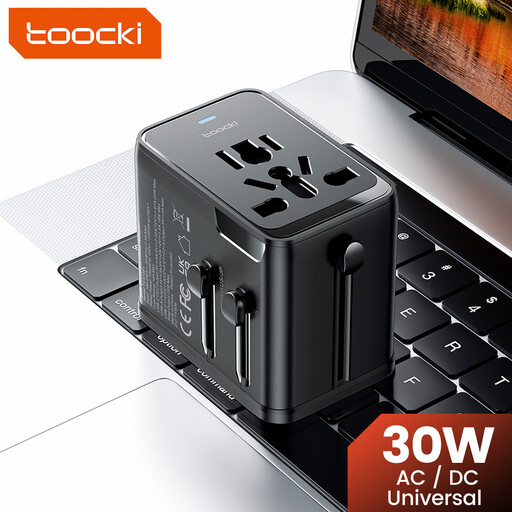
Why we chose it: For the traveller juggling a smartphone, tablet, headphones, and a power bank. This all-in-one model replaces a power strip and multiple chargers, with the added benefit of fast charging.
It integrates the charger function directly, making an external power brick unnecessary. With its 30W USB-C PD and USB-A ports, it offers a modern, fast, and safe charging solution.
Versatility and space-saving. It serves as both a universal adapter (EU, UK, US, AUS) and a multi-port charger with Power Delivery (PD) fast charging.
We have selected a full range of products that meet our safety criteria and current regulations.
No, an adapter simply changes the plug format to allow for a physical connection. Since the UK and France use a similar voltage (~230 V), a voltage converter is unnecessary for modern electronic devices (phones, laptops, etc.). They are almost all dual-voltage. To check, take a look at the label on your charger: if it says "INPUT: 100-240V", you're good to go.
This is strongly discouraged with a standard travel adapter. Heating appliances (hairdryers, straighteners, etc.) are very power-hungry (often over 1500 W). Most adapters are not designed for such a load and risk overheating or even melting. Always check the maximum power rating (in watts) of your adapter. For these devices, the safest option is to use a dual-voltage travel model or the one provided by your hotel.
A single-region adapter is designed for one specific conversion (e.g., France to UK). It is often more compact, more robust, and offers a more stable connection. A universal adapter, with its retractable prongs, is more versatile for travelling all over the world. On the other hand, its mechanical complexity can make it slightly more fragile and bulky. The choice will depend on the frequency and diversity of your destinations.