If you’d like to serve wholemeal fougasse on Sunday, check that wholemeal flour is listed in the ingredients, or choose it yourself when making your own. A multigrain or simply topped fougasse isn’t necessarily wholemeal. If fibre values are provided, compare them per 100 g, then check the ingredients and preparation time to make sure they suit your guests.
Who is this choice for?
Households keeping an eye on flour and fibre
You’d like to include a wholegrain product in your Sunday meal without guessing what it contains from the topping alone. Manger Bouger recommends choosing wholemeal or multigrain bread or other starchy foods at least once a day. For the fougasse you’re considering, check the ingredients list.
Hosts who consider the ingredients
You’re serving several guests, so you need to check for gluten-containing cereals, milk, cured meats and other toppings before choosing a fougasse to share.
Households planning how to serve it
You’re looking for a size that suits the number of people and the time available, whether you’re reheating a fougasse or planning ahead to make one from scratch.
What should you check?
For your Sunday meal, start with what matters most to you: the dough ingredients, what your guests can eat or how you’ll serve it.
| What to consider |
What to check |
Who it’s for |
| Flour and fibre |
Look for wholemeal flour in the ingredients; where fibre values are given, compare them per 100 g. |
If you want to serve a wholegrain product, you need to identify the flour used rather than rely on the recipe name. Around 42% of consumers put this check at the top of their list. |
| Ingredients and toppings |
Read the ingredients and allergen information. In particular, check for cheese or bacon lardons, depending on your guests’ dietary requirements. |
When several people share a fougasse, an ingredient in the dough or topping may mean one of them can’t eat it. For around 33% of consumers, whether the ingredients are suitable comes before other considerations. |
| Size and preparation |
Check the weight, the number of people it serves and the reheating instructions. If you’re making it from scratch, allow time for the dough to prove too. |
If your meal needs to be served at a particular time, the number of portions and the time required both matter. Serving arrangements are the top priority for around 25% of consumers. |
Common pitfalls to avoid
-
Confusing the topping with wholemeal flour
Olives, seeds or herbs don’t prove that the dough contains wholemeal flour. Auchan’s olive fougasse lists 1.6 g of fibre per 100 g and contains wheat flour, but it isn’t described as wholemeal.
To choose a wholemeal base, read the ingredients list. To compare the fibre content of similar products, use the values given per 100 g.
-
Choosing a topping without considering your guests
Carrefour Traiteur’s bacon lardon fougasse contains bacon lardons and Emmental, among other ingredients, so it won’t suit everyone’s dietary choices. The dough ingredients and allergens also need a careful check.
Check the ingredients before ordering, and have another bread option ready if the fougasse won’t suit everyone.
-
Leaving the serving instructions until the last minute
A fougasse that needs reheating and one made from scratch require different planning. Carrefour Traiteur recommends reheating its 300 g bacon lardon fougasse, which serves three, for 2 to 3 minutes at 170 °C. Lidl Recettes’ olive fougasse recipe, meanwhile, calls for around 120 minutes of proving time.
Check the portions and product-specific instructions, or plan to prepare the dough ahead of the meal.
Brands and retailers to explore
Auchan
Auchan’s fougasse product pages let you check the ingredients and, depending on the product, the nutritional information before you choose.
- The product page for its olive fougasse lists fibre and salt per 100 g.
- The fact that this product contains wheat flour isn’t enough to describe it as wholemeal fougasse.
Carrefour Traiteur
Its bacon lardon fougasse gives you specific details to help plan a bread to share and how to reheat it.
- The product page lists a 300 g loaf for three people and reheating instructions of 2 to 3 minutes at 170 °C.
- This recipe with bacon lardons and Emmental won’t meet the needs of anyone looking for wholemeal or meat-free fougasse.
Lidl Recettes
The olive fougasse recipe gives you an idea of the time and effort involved in making it from scratch.
- It calls for 15 minutes of kneading and around 120 minutes of proving time.
- The recipe mentions flour but doesn’t specify that it’s wholemeal, so you’ll need to choose the type of flour yourself.
An option for homemade fougasse
If you’d like to make your own fougasse with wholemeal wheat flour, this selection is for an ingredient for the dough, not a ready-to-serve fougasse.
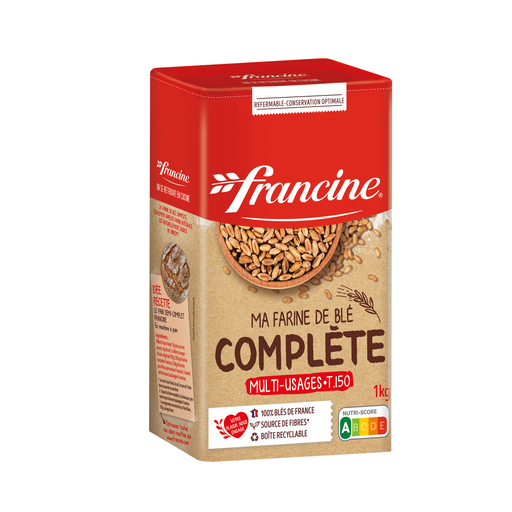 Image unavailable
FRANCINE T150 wholemeal wheat flour, 1 kg
For homemade fougasse using wholemeal wheat flour: a 1 kg pack of T150 flour. This is flour, not a ready-to-serve fougasse; check the quantities in your recipe before making the dough.
View on Joybuy
Frequently asked questions
Is olive or multigrain fougasse always wholemeal?
No. Neither olives nor the description “multigrain” confirms that wholemeal flour has been used. Check the ingredients and, if you’re comparing fibre, the values given per 100 g. Auchan’s olive fougasse contains wheat flour and has 1.6 g of fibre per 100 g, but it isn’t described as wholemeal.
What should you check if your guests have different dietary requirements?
Check the ingredients of each fougasse before serving, particularly for gluten-containing cereals, milk and toppings such as bacon lardons. For prepacked foods in France, the Directorate-General for Competition, Consumer Affairs and Fraud Control (DGCCRF) states that allergenic ingredients must be highlighted in the ingredients list.
How should you plan for reheating or making fougasse from scratch?
Follow the instructions for the fougasse you’ve chosen rather than using the same temperature for every product. Carrefour Traiteur recommends 2 to 3 minutes at 170 °C for its bacon lardon fougasse. If you’re making your own, Lidl Recettes’ olive fougasse recipe calls for around 120 minutes of proving time, so factor that into your meal plans.


