If you’re looking for a familiar-tasting fougasse while introducing a flour with more wholegrain, check the dough ingredients: the name ‘fougasse’ alone doesn’t tell you whether it contains wholemeal or semi-wholemeal flour. For a packed lunch, a homemade fougasse lets you choose the flours, while a bakery can tell you more about the ingredients in its dough. Both are a more reliable way to meet this need than choosing a ready-made fougasse by appearance alone. Also check the filling, allergens and storage instructions before taking it with you.
Who is this choice for?
Parents of children who are reluctant to eat wholemeal bread
If your child doesn’t like the texture of wholemeal bread, you could look for semi-wholemeal dough rather than choosing a fougasse by its appearance. Manger Bouger says semi-wholemeal products may be easier for some children to digest; adjust the portion to suit their appetite.
Families preparing a packed lunch
An easy-to-share fougasse can make a good base for lunch. Check the filling, how much you plan to take and what else you’ll be eating, then follow the storage instructions for the product you choose.
People keeping an eye on ingredients and allergens
The recipe matters more than the name of the bread. Carrefour’s bacon and Emmental fougasse contains wheat and milk, among other ingredients; its product information also mentions possible traces of sesame. Check the details for the exact product if any of these ingredients are a concern.
What should you look for?
When choosing a fougasse for a packed lunch with a fussy child, start with the dough ingredients. Then check the filling and how you’ll be able to transport and store the food.
| What matters |
What to check |
Who is it for? |
| Dough ingredients |
Look for wholemeal or semi-wholemeal flour in the ingredients. Compare the fibre per 100 g where this information is provided. |
When a child refuses bread with a very wholegrain texture, I want to know which flours are in the dough before preparing lunch. Around 31% of consumers would put this change in taste and texture at the top of their list. |
| Ingredients and allergens |
Check the allergens and any possible traces for the specific product; also look at its salt content per 100 g. |
If I need to avoid an ingredient, I can’t choose a cheese or bacon fougasse by its name alone. For around 31% of consumers, finding a recipe that suits their needs would be the main priority. |
| What’s in the lunch |
Check the weight or portion you’re planning, as well as what else you’ll take with the fougasse. |
For a meal to share outdoors, I need to plan the portions and the rest of lunch, not just choose a filling. Around 23% of consumers would prioritise this when planning their meal. |
| Buying and transport |
Check availability at your chosen store and follow the storage instructions for the fougasse and its filling. |
Before setting off, I want to be able to collect the product I’ve chosen and transport it as instructed. For around 15% of consumers, convenience would come before the other criteria. |
Mistakes to avoid
-
Assuming fougasse contains wholemeal flour
The cheese fougasse from Auchan, the bacon and Emmental fougasse from Carrefour, and the olive fougasse from PAUL are all described in their product information as containing wheat flour. This doesn’t confirm that their recipes include wholemeal flour.
If you’re looking for a mix of flours, check the ingredients list or ask the baker about the dough. A fibre claim doesn’t tell you which flours have been used.
-
Choosing the filling without checking the ingredients
Carrefour’s bacon and Emmental recipe contains pork, wheat and milk. A cheese fougasse also has a different ingredient profile from an olive fougasse. Neither the general name nor the appearance tells you whether it’s suitable if you need to check allergens or salt content.
Compare the ingredients and nutritional information for the product you’re buying, then plan the portion and the rest of lunch to suit your needs.
-
Planning your meal around a product that hasn’t been confirmed
Collection options and product ranges vary by store. Spotting a fougasse in a range doesn’t mean one will be available for you to take with you.
Check the product with your store or collection point, and have another lunch option in mind in case it isn’t available.
Retailers to consider
These retailers offer a few ideas for buying a fougasse or making your own version. Always check the ingredients and details for the specific product rather than assuming what it contains based on the retailer.
Auchan
Auchan lists several savoury fougasses, including a 400 g cheese version.
- The product information for its cheese fougasse lists the ingredients and nutritional information, and says to store it at room temperature.
- The recipe lists wheat flour, but doesn’t confirm that it contains a mix of white and wholemeal flours.
Carrefour
Carrefour describes a 250 g bacon and Emmental fougasse.
- Its product information lists wheat and milk, among other ingredients, and mentions possible traces of sesame.
- This ingredient list doesn’t confirm the presence of wholemeal or semi-wholemeal flour. Also check whether the product is available at your chosen collection point.
PAUL
PAUL describes an olive fougasse and also offers sandwiches for lunch.
- The published ingredients for its olive fougasse include T65 flour, olive oil and olives.
- The T65 flour listed for this fougasse doesn’t prove that it contains a mix of white and wholemeal flours.
E.Leclerc
E.Leclerc offers online shopping. For this lunch, check the product listed by the store you plan to use.
- Before choosing a fougasse for the flour mix you’re looking for, check its ingredients list and local availability.
Lidl
Lidl France publishes a recipe for fougasse with ewe’s milk tomme cheese and white onions, which could be an option to make at home.
- Making the dough yourself means you can choose the flours, using a recipe suited to those ingredients.
- The published recipe doesn’t tell you what’s in a ready-made fougasse sold in store.
ALDI
ALDI France lists bread and viennoiserie categories; check the range at your local store.
- For this lunch, check whether fougasse is available and what it contains before relying on it to be made with semi-wholemeal dough.
Flour for homemade fougasse
This Joybuy selection is for making dough at home: the product shown is wholemeal flour, not a ready-made fougasse to take away. How it works with another flour, and the result you get, will depend on the recipe you choose.
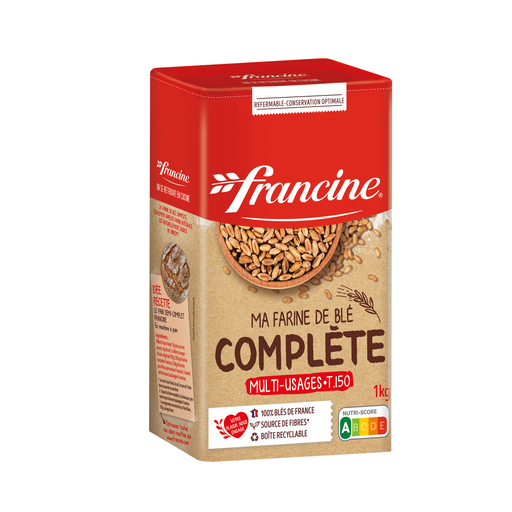 Image unavailable
FRANCINE T150 wholemeal wheat flour, 1 kg
Worth considering if you’re making fougasse from scratch and want to choose the flours in the dough. This T150 wholemeal wheat flour comes in a 1 kg pack; on its own, it isn’t a blend with white flour. Choose a suitable recipe before deciding on the proportions, and check the packaging if you want to compare fibre per 100 g.
View on Joybuy
Frequently asked questions
Does ‘multigrain’ fougasse always contain wholemeal flour?
No. The name alone doesn’t tell you which flours have been used. If this matters to you, look for wholemeal or semi-wholemeal flour in the ingredients list, or ask about the dough if the bread is sold without packaging.
Should you choose fully wholemeal dough for a fussy child?
Not necessarily. Manger Bouger says semi-wholemeal products may be easier for some children to digest, and that wholegrain or semi-wholegrain starchy foods can be offered according to appetite. Dough made with semi-wholemeal flour is therefore one option to consider, but you can’t assume your child will like its texture.
Which allergens should you check in a filled fougasse?
Check the allergens listed for the specific recipe, including cereals containing gluten and milk if it contains cheese. Carrefour also mentions possible traces of sesame in its bacon and Emmental fougasse. The DGCCRF says allergens must be highlighted on the labels of prepacked foods.
How should you take fougasse with you for lunch outdoors?
Follow the storage instructions for the fougasse you’ve bought and any other food you’re taking with you. Auchan says its 400 g cheese fougasse can be stored at room temperature. This doesn’t apply to other recipes or chilled fillings: follow the product’s own instructions and keep food chilled where required, as advised by Anses.


