Who is this option for?

Parents of children who are wary of wholemeal bread

You’d like to try a less refined flour without assuming your child will immediately take to a new kind of fougasse. Manger Bouger suggests that semi-wholemeal products may be an option for some children, but you’ll need to see whether your child likes the taste of the recipe.

Families taking food with them in summer

You’re looking for a fougasse that’s easy to share on a journey or at a picnic. How the product is stored matters just as much as how easy it is to carry, as does the storage of any food you add.

Shoppers who check the label

You want to know which flour is used in the recipe and compare the ingredients, allergens and nutritional information for the specific product, rather than relying on its appearance or name.

What should you look for?

First, decide whether to make a recipe where you control the flour or buy a ready-to-eat fougasse to take with you. Either way, try it with your child beforehand and check what will need to be kept chilled during the journey.

Consideration What to check Who is this for?
Flour and acceptance Look for semi-wholemeal or wholemeal flour in the ingredients. If you’re making it at home, try the fougasse before you leave. If my child is unsure about wholemeal bread, I want to be able to change the flour without finding out how they react during the journey. Around 42% of consumers rank making this gradual transition as their top concern.
Summer storage Follow the storage instructions for the fougasse you choose, and keep any added foods that need refrigerating chilled. For a long journey or a picnic in warm weather, I need to be able to transport the food according to its storage instructions. This is a priority for around 33% of consumers.
Convenience and filling For a ready-to-eat fougasse, check the ingredients, allergens and nutritional information, including fibre and salt per 100 g. When there’s no time to prepare food, I’m looking for a ready-to-go fougasse with a filling that suits the meal I have in mind. For around 25% of consumers, convenience and the specific product they choose come before other criteria.

Mistakes to avoid

  • Assuming “rustic” or “with grains” means it’s made with wholemeal flour

    These words alone don’t tell you which flour has been used. An Auchan cheese fougasse lists 1.6 g of fibre per 100 g; that figure doesn’t apply to other fougasses.

    For a prepacked product, look for the flour in the ingredients list. When comparing nutritional information, use the same 100 g basis.

  • Trying a 100% wholemeal recipe just before you leave

    The type of flour won’t tell you whether a fussy child will accept the taste or texture of the fougasse. Manger Bouger explains that some children may digest semi-wholemeal products more easily.

    Try the recipe in advance and adjust the flour depending on your child’s reaction. Don’t leave the first taste test until you’re travelling.

  • Assuming all fougasses should be stored in the same way

    The Auchan cheese fougasse comes with instructions to store it at room temperature. These instructions don’t apply to every fougasse or to refrigerated foods added to the meal. Anses stresses the importance of keeping perishable foods at a low temperature.

    Check the instructions for the product you choose, and use an insulated bag for any food or accompaniments that need to stay chilled.

  • Changing the flour and filling at the same time

    If the fougasse also has an unfamiliar filling, it’s harder to tell what your child doesn’t like. Cheese, cured meats and other ingredients also change what you need to check on the label.

    Start with a filling your child knows, then try a different flour separately. Check the allergens and salt content of the specific product.

Retailers and brands to consider

Carrefour

Carrefour offers Carrefour Bio T110 semi-wholemeal wheat flour, Francine T150 wholemeal flour and a range of ready-to-eat fougasses with different fillings.

  • These products give you the option of making something at home with a clearly identified flour or buying a ready-made fougasse.
  • The fact that semi-wholemeal and wholemeal flours are available in store doesn’t mean they’re used in ready-to-eat fougasses. Check each recipe.

Auchan

The 400 g cheese fougasse featured by Auchan is an example of a ready-to-eat product you can check by reading its label.

  • Its product information lists the ingredients, allergens and storage instructions, as well as 1.6 g of fibre and 1.7 g of salt per 100 g.
  • This fougasse contains wheat flour; its product information doesn’t identify it as semi-wholemeal or wholemeal. Its nutritional values don’t apply to other recipes.

Lidl / Belbake

Lidl has featured Belbake organic wholemeal spelt flour, intended for making homemade bread, among other things.

  • It’s another wholemeal flour to consider if you’re making your own recipe to suit this ingredient.
  • It isn’t a ready-to-eat fougasse. Check whether the product is available and try the recipe before taking it with you.

Flour for making your own fougasse

This Joybuy selection features wholemeal flour for a homemade fougasse. You’ll need to make and try the recipe, rather than buy a ready-to-go fougasse.
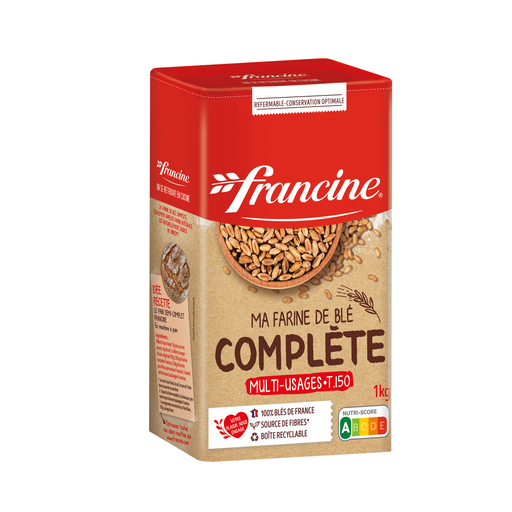
FRANCINE T150 wholemeal wheat flour, 1 kg pack

FRANCINE T150 wholemeal wheat flour, 1 kg

Worth considering for homemade fougasse if you’d like to try wholemeal flour and can test the recipe with your child before you leave.

T150 wholemeal wheat flour in a 1 kg pack. It’s neither a ready-to-eat fougasse nor a ready-made blend of white and wholemeal flours.

View on Joybuy

Frequently asked questions

Should you choose a 100% wholemeal fougasse straight away for a fussy child?

No, you don’t have to do that to try a different flour. Manger Bouger says some children may digest semi-wholemeal products more easily. For fougasse, a semi-wholemeal recipe or a homemade blend gives you a way to experiment gradually, without assuming your child will like the taste.

How can you tell whether a ready-to-eat fougasse contains wholemeal flour?

For a prepacked product, read the ingredients list and look for an explicit mention of semi-wholemeal or wholemeal flour. A name such as “rustic” isn’t enough: the Auchan cheese fougasse lists wheat flour but isn’t described as semi-wholemeal or wholemeal.

Can you keep a fougasse in a bag for a whole day in summer?

Follow the storage instructions for the specific fougasse and any food you’re serving with it; the same advice won’t apply to every filling. The Auchan cheese fougasse comes with instructions to store it at room temperature, while foods that need refrigerating must be kept chilled, in line with Anses advice.

What should you check on the label if the fougasse has a filling?

For a prepacked fougasse, check the ingredients, highlighted allergens, storage instructions and nutritional information for the product you choose. The DGCCRF outlines the labelling rules for prepacked foods; don’t assume one fougasse has the same filling as another.