
Livraison le jour même ou le lendemain

Qualité garantie

Débloquez vos offres de bienvenue: Livraison GRATUITE | Jusqu'à -80 % | 30 jours d'essai gratuits à JoyPlus
Téléchargez l'application
A well-organised kitchen often starts with the right containers. But buying food storage containers is not simply a matter of choosing the largest set available. Difficult-to-close lids, impractical sizes or materials that are unsuitable for heat can quickly turn a tempting deal into a pointless purchase.
Here are the key factors to consider before choosing airtight containers, glass storage containers or a set for organising your pantry.
A lid that closes with a click does not necessarily guarantee leakproof protection or an effective barrier against air. For leftovers, sauces and strongly scented foods, check for a sealing gasket and assess the quality of the closure system. Clips are convenient, provided they remain properly aligned after repeated opening and closing.
For dry foods such as rice, flour and pasta, a closure that limits moisture helps preserve texture. Always follow the manufacturer’s recommendations and store products in a clean, dry place.
A 12-piece set may seem economical, but some containers could end up forgotten at the back of a cupboard. Before ordering, consider how you actually use them: individual portions, dinner leftovers, meal preparation, spices or dry-food storage.
Stackable containers are especially worthwhile when their dimensions match your shelves. In a small flat or student kitchen, the overall height and the ability to nest containers often matter more than the number of pieces.
Glass generally resists stains and odours well, but it is heavier and can break if dropped. Plastic, on the other hand, is lightweight and convenient for carrying a lunch box, but it may warp when exposed to unsuitable levels of heat.
Never place a container in the oven, microwave or on a direct heat source without checking its labelling. The BPA-free designation must also be clearly stated for the specific product concerned; it cannot be inferred from its appearance.
Look for a statement confirming that the product is suitable for food contact, the glass-and-fork symbol or precise usage instructions. For glass food containers, also check the recommendations regarding thermal shock. A container taken out of the refrigerator cannot necessarily be exposed to intense heat immediately afterwards.
For plastic, check the usage limitations: refrigerator, freezer, dishwasher and microwave compatibility should never be assumed. The BODUM PRESSO set featured below is advertised as being made from BPA-free plastic, with airtight lids, and as suitable for hand washing or the dishwasher. Its instructions specify that it must not be used in the oven or on a direct heat source.
A genuinely practical storage system combines several capacities:
A set made up exclusively of large boxes can take up a great deal of space. Conversely, containers that are too small make it difficult to store family-sized dishes. Measure your shelves and the depth of your drawers before choosing your kitchen storage container set.
A lid that is still damp can compromise the seal. After washing, dry the container and its lid separately before closing them. Inspect the gaskets, clips and corners of the container regularly. Any part that is cracked, warped or no longer closes consistently should be replaced.
Glass jars can be particularly well suited to a pantry that is both practical and easy to survey. The Alpina product, for example, includes three stackable glass compartments and a lid. Its product information states that the glass components are dishwasher-safe, while recommending that they be handled with care.
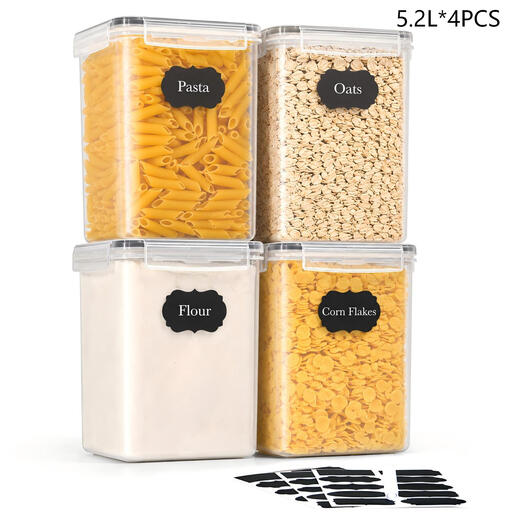
Why it suits this profile: this four-piece set comes with labels and markers, making it easy to organise fusilli, macaroni, rice, sugar or flour while you bring your kitchen into order.
The limited number of pieces prevents you from accumulating sizes you will never use. The labels also make dry foods easier to identify.
A focused storage solution for cupboards, with labelling accessories included according to the product information.

Why it suits this profile: with eight containers ranging from 150 ml to 1,040 ml, you can store everything from an individual portion to leftovers or a packed lunch for the office.
The range of capacities means you do not have to make everything fit into a single size. The glass also lets you see the contents without opening every box.
Borosilicate glass, removable lids and eight different capacities, as stated in the product information.

Why it suits this profile: five 1,040 ml containers and five 370 ml containers are well suited to batch cooking, advance meal preparation or lunches regularly eaten away from home.
The balanced distribution of capacities makes batch preparation easier and avoids ending up with a mismatched assortment of boxes that is difficult to store.
Clip-lock lids and borosilicate glass containers, with two clearly defined sizes in a practical distribution.

Why it suits this profile: its four capacities, from 0.25 to 2 litres, make it easy to organise a family pantry with lightweight plastic containers.
The distribution — 4 × 0.25 l, 3 × 0.6 l, 3 × 1 l and 2 × 2 l — offers greater flexibility than a set made up of a single capacity.
Plastic advertised as BPA-free, airtight lids and dishwasher compatibility, as stated in the product information.
We have brought together an up-to-date selection of products that meet these criteria, making it easier to organise your kitchen and pantry.
For a family, choose several capacities and lids that are easy to tell apart. People who take lunch with them will generally prefer medium-sized containers with clip-lock closures. Students often have limited space : stackable or nesting boxes help keep clutter to a minimum.
For spices, biscuits, cereals and pulses, transparent storage jars make it easy to identify the contents at a glance. For cooked meals, choose containers that are wide enough to fill and wash without difficulty.
Yes, provided the manufacturer specifies a leakproof closure and the gasket is correctly positioned. Always carry the container upright and check the clips before placing it in a bag.
Its lifespan varies depending on the material, washing frequency and conditions of use. Replace any warped lid, damaged gasket or cracked box. You should also avoid unauthorised temperatures, which can shorten the container’s lifespan.
Glass is well suited to those looking for a surface that is less prone to retaining odours and stains, but it is heavier and can break. Plastic is lightweight, convenient to transport and available in a wide range of sizes. The right choice therefore depends primarily on your storage space, how often you carry the containers and the product’s usage instructions.