
Livraison le jour même ou le lendemain

Qualité garantie

Débloquez vos offres de bienvenue: Livraison GRATUITE | Jusqu'à -80 % | 30 jours d'essai gratuits à JoyPlus
Téléchargez l'application
A food storage container makes it easier to store leftovers, prepare meals and organise your fridge. Yet some purchases quickly lead to disappointment: a lid that is awkward to close, a size that is unsuitable or a material that is incompatible with the microwave. Before choosing a container, a few simple checks can help you avoid unpleasant surprises and unnecessary expense.
A lid that clips on easily does not necessarily turn a box into an airtight container. If you want to transport soup, sauce or an already dressed salad, look for a silicone seal, a clip-lock system or an explicit statement that the container is leakproof. The lid should also remain easy to handle every day: a container that looks perfect on paper but is awkward to open will often end up at the back of a cupboard.
This indication may apply to the container, but not necessarily to its lid. Some lids need to be removed or left slightly ajar during reheating. With glass, you should also beware of sudden changes in temperature: moving it straight from the freezer into a preheated oven can cause thermal shock.
A large capacity does not guarantee convenient storage. A 2-litre container is ideal for a family-sized dish, but it may take up a substantial amount of space in a narrow fridge. Conversely, containers that are too small mean more lids and make organisation more complicated. Rectangular, stackable designs generally fit more easily into drawers, cupboards and fridges.
A glass storage container generally retains very few odours and is easy to clean. When clearly stated by the manufacturer, borosilicate glass is designed to withstand temperature changes better than some ordinary glass. However, you should still follow the precautions intended to prevent thermal shock.
Plastic is lighter for lunch boxes and everyday transport. Look for a specific statement such as BPA-free and check the usage instructions: dishwasher, freezer and microwave compatibility, or whether the container is unsuitable for heat. A plastic box designed for storing dry food is not necessarily suitable for reheating a meal.
To choose the right size, match the volume to its intended use:
A meal-prep container should also have a base that is wide enough to separate ingredients, as well as a lid that will not get in the way during transport. For flour, rice, pasta or sugar, a transparent jar with a suitably sized opening makes measuring and dispensing easier.
Do not rely on a general product description alone. Check separately whether the container is compatible with:
A glass food container may be oven-safe even though its lid is not. The PYREX Pure Glass Rectangular 0.8 L container, for example, is described as compatible with the fridge, freezer, microwave, oven and dishwasher. However, the instructions recommend allowing the glass to return to room temperature before exposing it to a significant change in temperature.
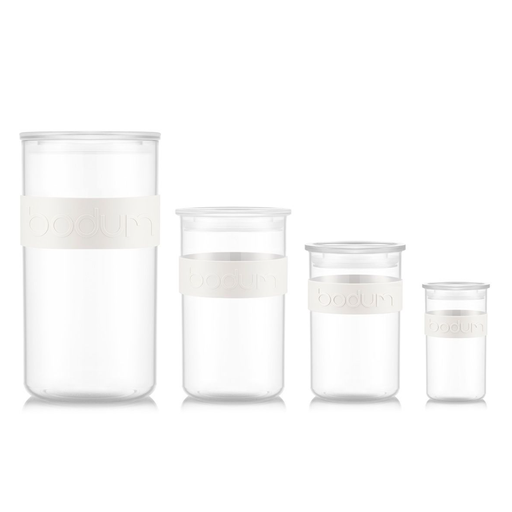
Why this choice suits this profile: The four capacities — 0.25 L, 0.6 L, 1 L and 2 L — provide a versatile set for getting started with storing leftovers, snacks and cupboard essentials.
The lids are described as airtight, while the range of sizes helps prevent a build-up of unsuitable containers. As microwave compatibility is not specified, it is best not to use them in the microwave without confirmation from the manufacturer.
BPA-free plastic, airtight lids and organised storage by capacity.

Why this choice suits this profile: This rectangular borosilicate glass container is ideal for anyone who wants to store, reheat or cook food in the same dish, provided the usage instructions are followed carefully.
The non-porous material is described as resistant to stains, odours and flavours. The product information also highlights the risk of thermal shock, which is often overlooked when moving a container from the freezer to the oven.
0.8 L capacity, stackable design and stated compatibility with the oven, microwave, freezer and dishwasher.

Why this choice suits this profile: With its 2-litre capacity, this model is made for family-sized dishes, storing larger quantities and preparing several portions in advance.
The removable silicone seal makes cleaning easier, while the lid must be removed before placing the container in the microwave. The product information rules out use on a hob and in a conventional oven.
Borosilicate glass, a lid with a removable seal, stated compatibility with the dishwasher, microwave and freezer, plus resistance to temperature variations of up to 200 °C according to the product information.
We have brought together a complete, real-time selection of products that meet these exacting criteria and European safety standards.
To keep your cupboard practical, group containers according to their use rather than by capacity alone:
A set of food storage containers can eliminate a great deal of clutter, but check the actual number of lids and the dimensions of each piece. For dry food, a four-piece set may be enough in a small home. A 12-container set, such as some BODUM PRESSO collections, will be more suitable for a family or a well-organised pantry.
A 0.8 to 1-litre container is often suitable for a small family portion or several individual portions. Glass makes it easy to see the contents and is highly resistant to odours, while plastic is lighter to carry. In both cases, check that the lid is leakproof and allow food to cool before sealing it for an extended period.
It depends entirely on the manufacturer’s instructions. Even when a container is described as suitable for the freezer and microwave, avoid sudden changes in temperature. Allow the container to warm up gradually and remove the lid if the instructions require it. Never use a container that is cracked, chipped or marked by a deep scratch.
There is no universal lifespan for all containers. Replace a box if the glass is damaged, the plastic becomes misshapen or the seal no longer closes properly. Regular care, thorough drying before stacking and respecting temperature limits will help the container remain reliable for longer.