
Livraison le jour même ou le lendemain

Qualité garantie

Débloquez vos offres de bienvenue: Livraison GRATUITE | Jusqu'à -80 % | 30 jours d'essai gratuits à JoyPlus
Téléchargez l'application
Dinner leftovers, meals prepared in advance, ingredients bought in bulk or lunch to take away: a food storage container should genuinely fit into your everyday routine, rather than simply looking practical on a product page. A leaking lid, poorly chosen size or material that is awkward to clean can quickly turn a set of containers into a wasted purchase.
Before placing your order, three potential pitfalls deserve your attention.
A glass storage container is ideal if you want a transparent, sturdy container that is less prone to retaining odours or stains. When stated by the manufacturer, borosilicate glass is designed to withstand changes in temperature better than some standard glass types. Even so, thermal shock should be avoided.
A BPA-free plastic food container is generally lighter and less likely to break. It is practical for transporting meals, organising the fridge or stacking several containers in a cupboard. The “BPA-free” claim should clearly apply to the product and does not remove the need to follow heat-related instructions.
For dry foods, dry food storage jars, made from transparent plastic or glass, make it easy to see how much rice, pasta, flour or cereal is left.
An airtight food container should close properly all the way around. A removable silicone seal generally makes cleaning easier, provided it is dried completely before the lid is put back on. Clip closures are effective at limiting leaks, but make sure the clips stay securely in place.
When storing food in the fridge, look for precise information about:
Stackable food containers make the most of your kitchen storage space, particularly in a narrow fridge or a small flat. Sizes from 250 to 600 ml are suitable for sauces, side dishes and small portions. Capacities from 800 ml to 1 litre are well suited to everyday leftovers and individual meal prep. The 2-litre models are better suited to family-sized dishes and storing dry foods.
A rectangular container often makes better use of the available space. Cylindrical jars can nevertheless fit neatly in a pantry, particularly for pasta, cereal and dried fruit.
The products below are presented based on their stated features and the uses intended by their manufacturers. Always check the model’s product details before using it in the oven, microwave or freezer.
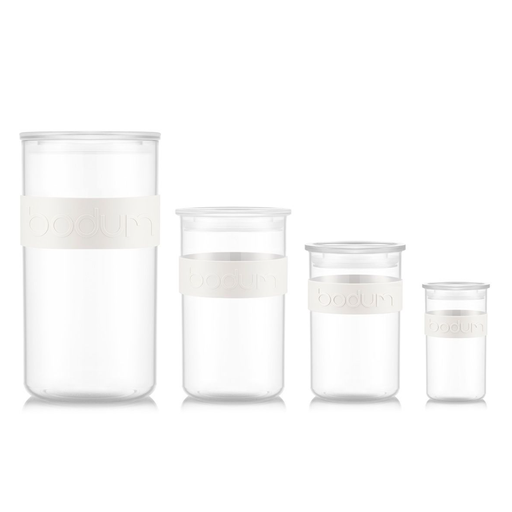
Why this choice suits this profile : the four capacities, from 0.25 to 2 litres, let you build your collection gradually with sizes suited to sauces, individual portions and family leftovers.
The range of sizes helps you avoid buying containers that are too large or unsuitable. The airtight lids are designed to help prevent spills, provided they are closed properly.
A 12-container set, BPA-free plastic as stated, a stackable design and practical sizes for everyday use.

Why this choice suits this profile : this jar combines textured borosilicate glass with an acacia lid, with a refined enough look to remain on a worktop or shelf.
The lid features a silicone seal suitable for dry foods. The wooden lid must be washed by hand—a useful reminder not to compromise on care for the sake of aesthetics.
A 750 ml capacity, transparent glass stated to be free from BPA, lead and cadmium, an acacia lid and a seal suitable for food contact.

Why this choice suits this profile : its 2-litre capacity is ideal for family-sized dishes, large quantities and organised batch cooking over several days.
The removable seal comes off easily for cleaning. The lid must be removed when using the microwave, and the container should never be placed directly on a heat source.
A large 2-litre borosilicate glass container, stated to be suitable for the fridge, freezer, microwave and dishwasher, together with a removable seal.
We have selected a complete range, updated in real time, of products that meet these demanding criteria and European safety standards.
A container’s service life depends above all on how it is cared for and the conditions it is exposed to. To keep your storage container with an airtight lid in good condition:
A deformed seal, broken clip or cracked container should be replaced. A dishwasher makes cleaning easier, but wooden lids, such as the one on the NUTS model, must be washed by hand.
For an individual portion, a capacity of 600 to 1,000 ml is a good compromise. For a family or a large batch, choose a container holding 1.5 to 2 litres. Small sizes are still essential for sauces, nuts, toppings and desserts.
Only if the manufacturer explicitly permits it. Leave some space for liquid or water-rich foods, which expand when frozen. You should also avoid moving a very cold container directly into an already hot oven.
The “BPA-free” claim alone does not guarantee microwave compatibility. Check the symbol or the model’s instructions. When microwave use is permitted, the lid will often need to be removed or simply left ajar.