
Livraison le jour même ou le lendemain

Qualité garantie

Débloquez vos offres de bienvenue: Livraison GRATUITE | Jusqu'à -80 % | 30 jours d'essai gratuits à JoyPlus
Téléchargez l'application
Food storage containers are used to keep leftovers, prepare multiple meals, organise the fridge or take your lunch to work. A purchase that seems simple can quickly turn into a disappointment: a lid that’s fiddly to close, dimensions that don’t fit your cupboards, or a container that can’t handle the intended use.
Before you fill your basket, here are the main pitfalls to avoid and the criteria to check when choosing airtight containers that suit your daily life.
A lid that simply snaps on doesn’t necessarily guarantee effective protection against leaks. To transport soup, sauce or a dish in the car, check for a reliable locking mechanism and, where the manufacturer includes one, a removable seal.
Food containers with lids should also be suited to the shape of the food. A very large but shallow box can take up more space and prove impractical for organising the fridge.
The mention “microwave-safe” doesn’t automatically mean the product can go in the oven or freezer. The container and its lid may have different usage limits.
A plastic lid, for example, might be designed for reheating a dish with the valve open, but cannot withstand the heat of an oven. So read the instructions for each part before heating or freezing the contents.
Food residue can get trapped under a silicone seal or around a valve. When these parts aren’t removable, cleaning becomes far less convenient. A container advertised as dishwasher-safe is also worth checking piece by piece: the container may withstand washing, while the lid needs to be hand-washed.
Each material suits different uses:
For an individual lunch, a capacity of around 500 to 800 ml may be enough, depending on the contents. Sizes from 1 to 2 litres are better suited to family leftovers, salads and meal prep preparations.
Compare the external dimensions with those of your shelves, drawers and transport bags. A 2-litre container, especially in a rectangular shape, can be very practical for large portions, but less suited to a small fridge.
A freezer-safe food container must leave enough room when its contents are likely to expand. In the microwave, generally remove the lid or open the valve, following the instructions. For the oven, don’t rely solely on the material: a plastic lid changes the usage conditions.
Finally, check the “dishwasher-safe containers” indications for the container, lid and seal. A gentle cycle and thorough drying will help preserve the seal over time.

Why this choice suits this profile: This set of 12 containers covers many needs, from small ingredients to family-sized portions, without having to buy each size separately.
The four capacities reduce the risk of using a box that’s too big or too small. The manufacturer states an airtight seal and dishwasher compatibility.
12 pieces in four sizes, BPA-free plastic, airtight lids and versatile storage for dry foods as well as leftovers.

Why this choice suits this profile: The transparent glass lets you identify the contents at a glance, while the 2-litre size is ideal for family meals and meal prep.
The silicone seal is removable for easy cleaning. The instructions advise removing the lid in the microwave and avoiding going straight from the freezer to a preheated oven.
Borosilicate glass, 2-litre capacity, removable seal and stated compatibility with the fridge, freezer, microwave and dishwasher.

Why this choice suits this profile: These four 1.6-litre boxes form a uniform set for preparing multiple meals, storing generous portions or organising a family kitchen.
Stainless steel doesn’t crack like some more fragile materials. The four identical boxes make stacking easy and reduce the risk of misplacing lids.
316L stainless steel, four 1,600 ml containers, snug-fitting lids and stated compatibility with the dishwasher and freezer.
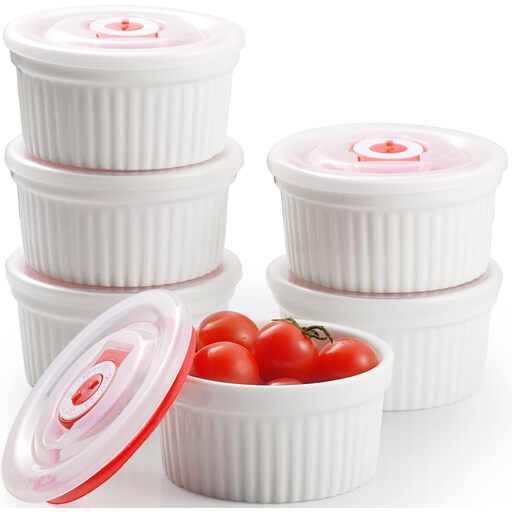
Why this choice suits this profile: These six individual portions are ideal for desserts, sauces, side dishes and preparations served straight to the table.
The uses are clearly separated: the ramekins are oven-safe, microwave-safe, dishwasher-safe and freezer-safe, while the lids should be hand-washed and are not intended for cooking.
Six 237 ml porcelain ramekins, lids with a date indicator, oven-safe and convenient storage for small portions.
We’ve put together a comprehensive, real-time updated list of products that fully meet these strict selection criteria and European safety regulations.
No. Check the manufacturer’s explicit statement and leave a little space for liquid or water-rich foods, which expand when frozen. Also avoid thermal shock, especially going straight from the freezer to a hot oven.
The lifespan depends on the quality of the material, knocks, heat and care. Glass can crack after an impact, while stainless steel can become dented. Regularly inspect the container, lid and seal, and replace any damaged part.
Wash the container promptly after use, remove any removable seals and dry each piece thoroughly before closing again. For strongly flavoured foods, glass or stainless steel can be more practical: these surfaces generally retain fewer odours than some plastics.