
Livraison le jour même ou le lendemain

Qualité garantie

Débloquez vos offres de bienvenue: Livraison GRATUITE | Jusqu'à -80 % | 30 jours d'essai gratuits à JoyPlus
Téléchargez l'application
Food storage containers are essential for keeping a well-organised pantry, preparing meals in advance and storing leftovers. But some purchases fall short after just a few weeks: lids that are fiddly to close, poorly thought-out sizes, or materials that don't live up to their advertised uses.
Before comparing models, it's best to avoid three common mistakes:
Glass food containers are ideal for leftovers, homemade preparations and fridge storage. Borosilicate glass, used on some containers, handles temperature changes better than standard glass. That doesn't mean it can withstand a sudden thermal shock, though: going straight from the freezer to a heat source is still not recommended.
Plastic is often more practical for transporting a meal or storing boxes up high. Look for a clear mention such as BPA-free plastic, then check the indications for dishwasher, oven, microwave and freezer compatibility. These can vary from one product to another.
For storage jars intended for pasta, cereals, flour or dried fruit, transparency lets you see what's inside at a glance. A wooden lid, however, requires special care: it's generally best to wash it by hand and avoid leaving it to soak.
Airtight food containers should have a seal that's correctly positioned and easy to clean. When it's removable, you can get rid of residue more easily, but remember to dry it thoroughly before closing the container again.
For meals and liquid preparations, check for clips, a peripheral seal and an explicit indication of leak prevention. For dry foods, a closure that limits air and moisture exchange helps preserve texture, provided you store the container in a clean, dry place.
Never fill a container completely before putting it in the freezer: liquid foods expand as they freeze. Also avoid pouring very hot liquid into it unless this use is expressly permitted.
A set of food storage containers in several capacities makes pantry organisation easier: small sizes for nuts and spices, medium containers for individual portions, and large boxes for rice, cereals or pasta.
Stackable glass jars make better use of available height, but their stability depends on the shape of the base and lid. In the fridge, rectangular containers generally make better use of space than round ones.
Cleaning also plays a direct role in ease of use. Check that the lid, seal and container are dishwasher-safe. If the lid has silicone, remove the seal regularly to prevent residue from building up.
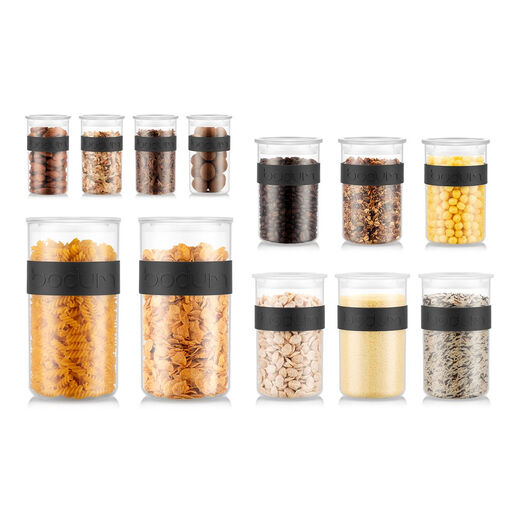
Why this choice suits this profile: With four different capacities, this set covers everything from small snacks to leftovers and dry ingredients, without needing multiple purchases.
The variety of sizes stops you from storing food in unnecessarily large boxes. The airtight lids are designed for storing dry foods, snacks and leftovers.
12 BPA-free plastic containers, with capacities from 0.25 L to 2 L, and stated dishwasher compatibility.

Why this choice suits this profile: Its rectangular shape is ideal for family portions, meal prep and storing leftovers in the fridge.
The manufacturer states compatibility with the fridge, freezer and microwave, provided you remove the lid to reheat the contents. The removable seal makes cleaning easier.
Borosilicate glass, 2 L capacity, lid with silicone seal and dimensions of 25.4 × 19.4 × 8.7 cm.

Why this choice suits this profile: The five 1,040 ml containers and five 370 ml sizes are ideal for individual portions, office lunches and regular meal prep.
The snap-lock closure is designed to limit leaks. The two capacities make it easy to prepare regular portions.
Borosilicate glass, sealed lids and a 10-piece set, with 5 containers of 1,040 ml and 5 of 370 ml.
We've selected a comprehensive list, updated in real time, of products that meet these demanding criteria and European safety standards.
Some products are stated as freezer-compatible, but always leave a little space to allow food to expand. Avoid sudden temperature changes and check for cracks or chips before each use.
Wash the lid and seal separately, then dry them thoroughly. Make sure the seal is correctly positioned all the way around and don't overfill the container. When transporting a liquid preparation, keep it upright in a suitable bag.
The lifespan depends on the material, how often they're washed and how they're handled. Replace any container that's cracked or warped, as well as any lid that no longer closes properly or any damaged seal. Gentle cleaning and sticking to the permitted temperatures will help your containers stay effective for longer.