
Livraison le jour même ou le lendemain

Qualité garantie

Débloquez vos offres de bienvenue: Livraison GRATUITE | Jusqu'à -80 % | 30 jours d'essai gratuits à JoyPlus
Téléchargez l'application
A food storage container might seem simple to choose… until the lid leaks in your bag, odours linger, or the different sizes don’t stack neatly in the fridge. To avoid impractical purchases, it’s worth looking beyond the piece count and the promises of airtightness.
The most common pitfalls are usually these:
Here are the criteria to examine before choosing an airtight container, a compartmentalised lunch box or a glass food storage container.
Borosilicate glass is ideal for those who want to see the contents and use their containers for storing leftovers, placing them in the fridge or transporting their lunch. However, always check the manufacturer’s instructions before using in the oven or microwave: the lid and accessories may have different restrictions.
Stainless steel generally resists knocks and odours well. However, it cannot be used in the microwave. A stainless steel bento box is therefore for transporting or storing food, not for reheating it directly.
Plastic containers have the advantage of being lightweight and practical for the office or on the go. Check their composition, heat compatibility and ease of cleaning. The BPA-free label does not exempt you from following the manufacturer’s usage instructions.
A truly effective airtight container depends on several factors: a correctly positioned seal, a firm enough closure and a perfectly clean rim. Models with clips or latches allow you to visually check the closure, but they require regular cleaning.
For saucy foods, soups and dishes transported in a bag, first test the container with cold water. Also avoid filling it to the brim, leaving a little space under the lid. For a vacuum-insulated food jar, preheat or pre-cool the container with water for a few minutes: this step can help maintain the temperature stated by the manufacturer.
A small container of 150 to 370 ml is suitable for sauces, toppings or snacks. Sizes from 520 to 1,040 ml are better suited to generous single portions and family leftovers. For meal prep, several stackable boxes simplify preparing meals for several days.
A compartmentalised lunch box separates dry foods, vegetables and sides. It also prevents different textures from mixing before the meal. In a cupboard, a set of kitchen storage containers with labels makes it easy to identify rice, pasta, flour or sugar.
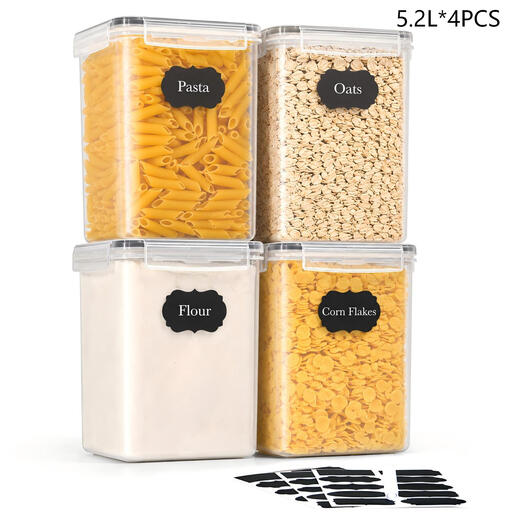
Why this choice suits this profile: This small set lets you start organising dry goods without investing in a large batch straight away. It works well for rice, pasta, flour, sugar and spices.
The compact size reduces the risk of ending up with unused or overly bulky containers. The included labels and markers make it easy to identify the contents.
4-piece set designed for storing dry foods, with labels and markers.

Why this choice suits this profile: Its 316L stainless steel construction and five compartments are ideal for those who regularly prepare meals for work, outings or portion control.
Foods stay separate instead of ending up mixed together in a single box. The four latches let you check the closure before transport.
316L stainless steel, five compartments, PP lid and four closure latches. Not suitable for microwave or oven.

Why this choice suits this profile: This large container is designed for soups, saucy dishes and meals to take on journeys, workdays or outdoor activities.
The wide mouth makes filling, serving and washing easy. The leak-proof closure is designed for transport, but the manufacturer recommends not turning the jar upside down.
1.5 litre capacity, 316 stainless steel, vacuum insulation and wide opening. Hand wash recommended.

Why this choice suits this profile: With eight capacities ranging from 150 ml to 1,040 ml, this set allows you to distribute meal prep, individual portions and leftovers in the fridge.
The variety of volumes avoids using a large container for a small amount. The removable lids make storage and cleaning easier.
Eight borosilicate glass containers, sizes from 150 ml to 1,040 ml, detachable lids and design suitable for transporting lunch.
We’ve put together a comprehensive, real-time updated list of products that meet these demanding selection criteria and European safety regulations.
For a meal made up of several foods, go for a lunch box for the office or picnic with a secure closure and compartments. For soup or a liquid dish, a wide-mouth vacuum-insulated food jar will be more practical. Always check the seal before putting the container in a bag.
Wash the container after each use, dry it thoroughly and remove the seal when it is detachable. Avoid abrasive sponges on stainless steel and follow the dishwasher recommendations. A cracked lid or a deformed seal should be replaced to reduce the risk of leaks.
It all depends on the material and the manufacturer’s instructions. Glass may sometimes be suitable, but the lid often needs to be removed or left slightly open. Stainless steel, especially in a stainless steel bento box, must never be placed in the microwave. Always check the instructions before reheating food.